
How to Organize a Small Closet With No Shelves: A Hanging-Zone Plan
If you are trying to figure out how to organize a small closet with no shelves, start by treating the rod, floor, and door as a limited storage system rather than empty space to fill. A closet with no shelves can look almost empty and still be frustrating to use. You may have one hanging rod, a bare floor, and a door that takes up part of the opening. The mistake is treating that blank space as something to fill with random organizers. A better approach is to divide the closet according to what the rod, floor, and door can realistically support.
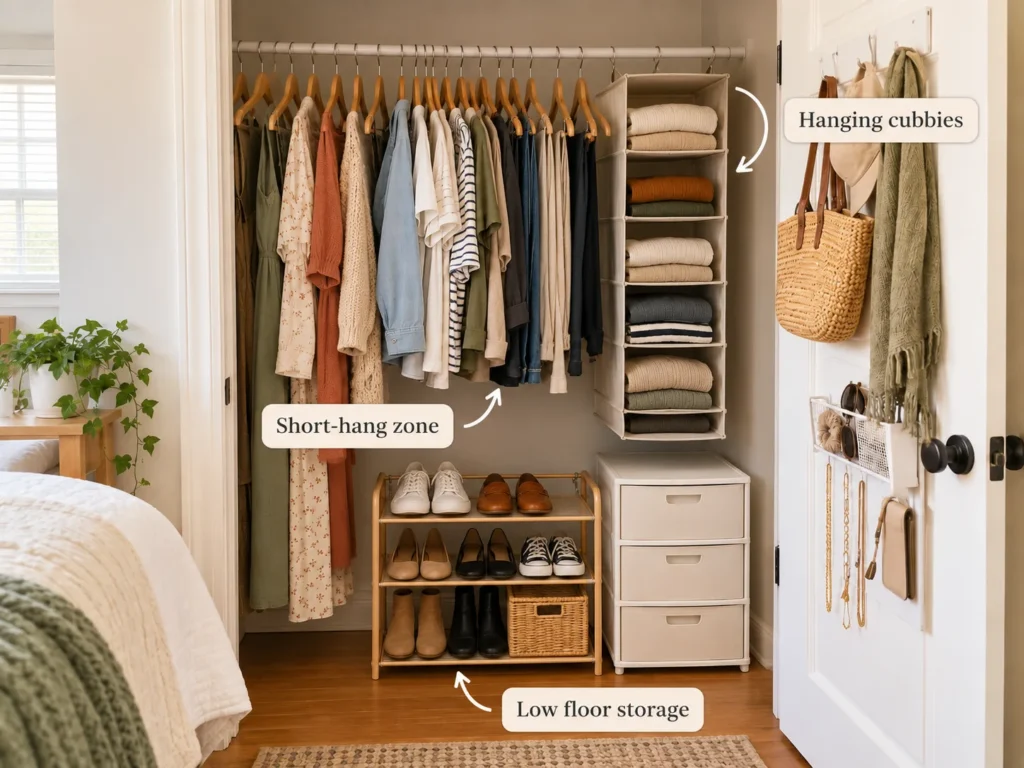
This guide uses a Hanging-Zone Plan for renters: protect long-hang space first, create a short-hang section, decide whether a hanging shelf deserves part of the rod, use the floor only where it stays reachable, and treat the door as optional storage rather than guaranteed storage.
Quick answer: measure the rod and hanging drop, group long and short clothes separately, calculate how much rod width you can afford to give up, then choose one removable organizer for folded items and one measured floor solution. A rod-only closet works best when every organizer earns the space it consumes.

Start With the Hanging-Zone Plan
Instead of asking what shelves you are missing, look at the storage surfaces you already have. In most shelf-free closets, the rod is the main structural feature. That means every hanging organizer, lower rail, handbag hook, or stack of bulky hangers competes for the same limited width.
The Hanging-Zone Plan gives each type of space one job so the closet remains usable after you add storage.
If your closet has a built-in shelf and you need a broader renter-friendly system, start with our complete small closet organization guide for renters. This article stays focused on closets where the rod and floor have to do most of the work.
Zone 1: full-height hanging
Reserve part of the original rod for dresses, coats, long cardigans, jumpsuits, and anything that needs uninterrupted vertical drop. This is the zone that is easiest to accidentally destroy when trying to “double” hanging capacity.
Zone 2: short-hang or double-hang
Group shirts, blouses, folded-over trousers, and short jackets together. Their shorter drop can create room for a lower removable rail or a compact drawer unit below.
Zone 3: suspended folded storage
A fabric hanging shelf can replace some missing shelf space, but it also consumes rod width. Use it only for folded clothing or light accessories that benefit from vertical compartments.
Zones 4 and 5: floor and overflow
The floor can hold shoes, low drawers, or one bin when the door still opens and the back remains reachable. Seasonal overflow should move to the least convenient safe zone, which may be the floor edge, under-bed storage, or another dry storage location outside the closet.
Measure the Closet Before You Divide the Rod
Write down the closet’s usable width, depth, rod height, floor depth, and door opening. Measure the space as it actually functions, not just the empty cavity. Trim, hinges, bypass-door overlap, baseboards, and projecting handles can reduce usable storage.
In a closet without shelves, the most important dimensions are the ones that tell you how much rod width and vertical drop you can trade for new storage.
It also helps to sketch the opening on paper and mark the parts that cannot be used. A 48-inch closet may not provide 48 inches of equally accessible storage if a sliding door covers one side or a return wall hides the end of the rod. Note the section you can see and reach without moving half the wardrobe. That accessible width is often more important than the nominal closet width when deciding where daily clothing should live.
Measure usable rod width
Measure from the point where the first hanger can sit comfortably to the last usable hanger position. Do not count wall corners where shoulders jam against the side or a door blocks access.
Measure hanging drop
Hang one of your longest garments and one of your shortest. Measure from the rod to each hem. This shows where a lower rail or floor unit can fit without crushing clothing.
Calculate Your Rod Budget Before Buying Anything
Your closet rod is a fixed-width budget. Every organizer attached to it spends some of that budget. This is the key difference between a rod-only closet and a closet with built-in shelves.
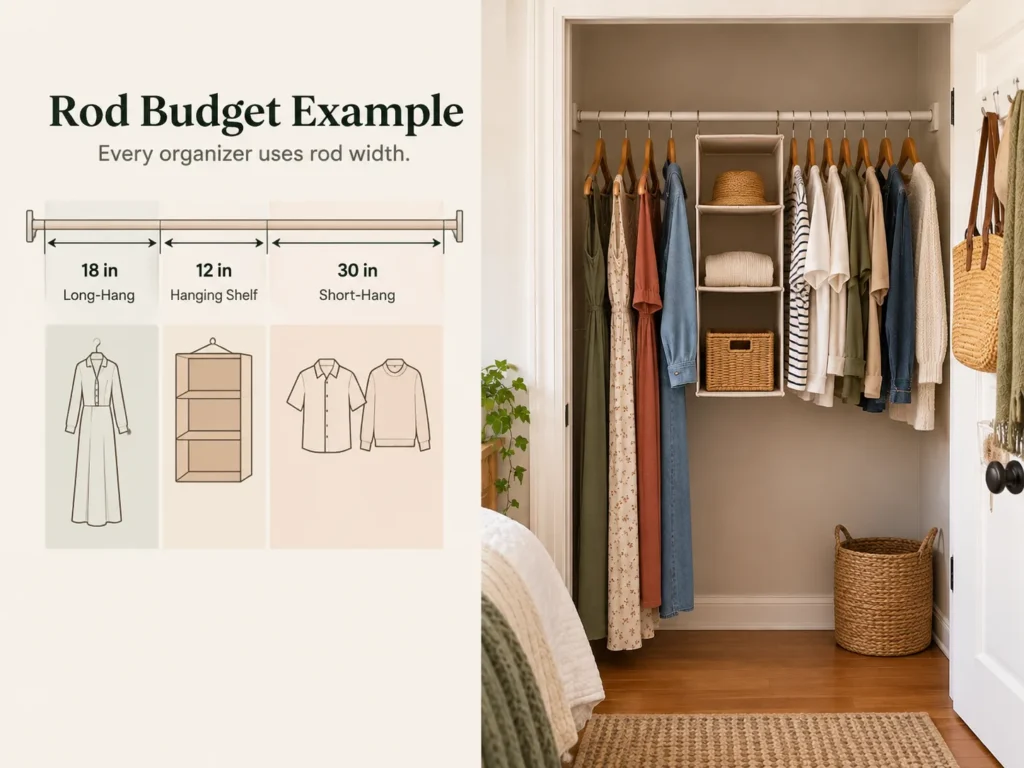
Start with total usable rod width. Subtract the width needed for long garments. Then subtract any hanging shelf organizer. What remains is the width available for short garments or a double-hang section.
Think of the calculation as a planning check rather than a rigid formula. Clothes need a little sideways movement so hangers can slide apart, and a hanging organizer needs enough clearance that its fabric sides do not press into sleeves. Leave a small buffer instead of allocating every last inch on paper. If the plan only works when every hanger is compressed tightly together, the layout is already at its practical limit before laundry returns.
A simple rod-budget example
Suppose the usable rod is 60 inches wide. If long clothing needs 18 inches and a hanging shelf uses 12 inches, only 30 inches remain for normal hanging. If you add a second organizer later, the closet may technically hold more categories but give everyday clothes too little room to move.
Why hanging shelves can cost more space than expected
A hanging cubby does not just occupy its advertised width. Clothing beside it needs shoulder clearance, and soft organizers can bow outward when loaded. Measure the real loaded width rather than assuming a narrow product will behave like a rigid vertical line.
Protect long-hang space first
Decide how much full-height hanging your wardrobe needs before adding any lower rod or hanging shelf. Long garments have fewer alternative storage options than T-shirts or folded sweaters, so protect that zone first.
Sort Clothes by Storage Mode, Not Just Category
Traditional closet advice often starts with categories such as shirts, pants, dresses, and jackets. In a closet with no shelves, a more useful first sort is by storage mode: what must hang full length, what can hang short, and what can be folded or contained.
Long-hang clothes
Put dresses, coats, long cardigans, suits, and wrinkle-prone pieces in the full-height group. Their combined width determines the minimum long-hang zone.
Short-hang clothes
Shirts, blouses, short jackets, and trousers folded over hangers can share the short-hang zone. This is the area most likely to support double hanging or storage underneath.
Folded clothes and accessories
Sweaters, casual knits, gym clothes, scarves, and soft accessories may work better folded. These are the items that can justify a hanging shelf, drawer unit, or external dresser instead of taking more rod width.
Build the Full-Height Hanging Zone First
Place the full-height zone at one end of the closet rather than scattering long garments across the entire rod. A single vertical lane is easier to protect when you later add a lower rail, shoe rack, or drawer unit elsewhere.
Keep long garments on one side
Choose the side that is easiest to reach with the door open. In a sliding-door closet, that may mean keeping long garments away from the section that is permanently half-covered by the opposite panel.
Do not let floor storage interfere with hems
Leave enough floor clearance that hems do not sit on shoes, baskets, or drawer tops. If a dress touches an organizer, either shorten the floor unit, move the long-hang lane, or keep that floor area empty.
Decide Whether Double Hanging Actually Fits
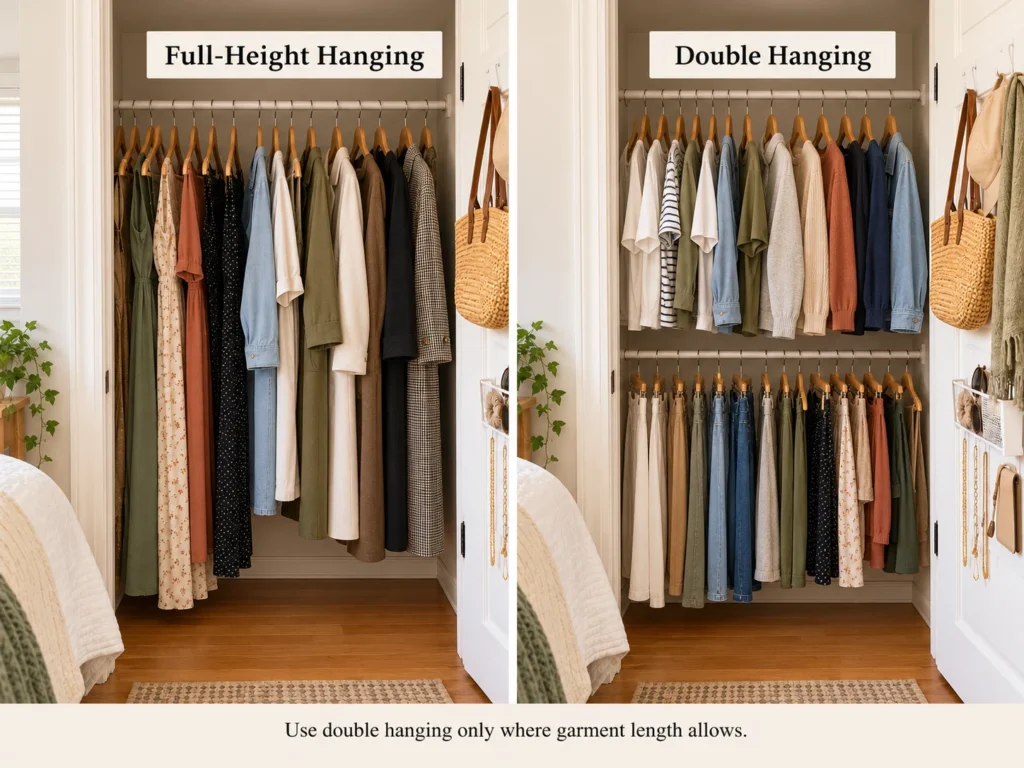
A removable lower rod can add useful capacity when a large part of your wardrobe is short-hang clothing. It is less useful when coats, dresses, or long shirts dominate the closet.
Before committing to two levels, test the idea with the clothes you already own. Hold a temporary line or measuring tape at the proposed lower-rail height and check where the upper garments would end. Then imagine removing a shirt from the back row while the lower row is full. Capacity matters, but so does the angle your hand and hanger need to move. A slightly smaller double-hang section that is easy to use is better than a full-width second rail that feels cramped every morning.
Use a lower rail only under short garments
Clip-on and tension-style lower rails belong only beneath garments with enough remaining drop. Measure from the bottom of those clothes to the floor before selecting the lower rail position.
Check vertical spacing after loading
Test the system while both upper and lower rails are loaded. Hangers need room to tilt in and out, sleeves should not pile on the lower bar, and the bottom row should not drag on the floor.
Use a Hanging Shelf Without Losing Too Much Rod Width
A fabric hanging shelf can create instant folded storage without drilling, which is why it is popular in rental closets. The tradeoff is simple: every inch of hanging-shelf width is an inch no longer available for normal hangers.
Choose the width after the rod budget
Use the narrowest organizer that genuinely fits the folded category. If you only need space for six sweaters, a wide six-cubby tower may be unnecessary. Measure the folded stack first.
Load hanging cubbies lightly
Soft hanging shelves work best for lightweight clothing and accessories. Heavy stacks can distort the organizer and add load to the closet rod. Follow the product’s stated capacity and avoid putting dense objects such as books or heavy storage boxes in fabric cubbies.
Know when drawers are the better choice
If you have generous space under short garments but very little spare rod width, a freestanding drawer unit may be more efficient than a hanging shelf. The correct choice depends on which dimension is scarce: rod width or floor area.
Build Floor Storage Under the Short-Hang Zone
The floor beneath short garments is often the largest unused volume in a shelf-free closet. Treat it as a measured zone rather than a dumping area.
If you use a freestanding clothing-storage unit, do not let the no-drill goal override the product’s safety instructions. The U.S. Consumer Product Safety Commission has a mandatory stability standard for many clothing storage units and notes that covered units include anti-tip devices. Follow the manufacturer’s setup and anchoring instructions, and choose a different low-profile solution if you cannot install a required restraint in your rental. See the CPSC clothing-storage-unit guidance.
Choose one main floor job
Choose the primary floor job first: shoes, drawers, a hamper, or one low bin. Trying to fit all four usually blocks access to the back and creates another pile.
Measure shoes before choosing a rack
Count the pairs that need closet storage and measure your largest pair. Boots, wide sneakers, and heels use very different dimensions. A compact rack is useful only when your actual shoes fit it without spilling into the walkway.
Test drawer travel with the door in place
If you use freestanding drawers, load the hanging clothes first and then measure available height. Pull every drawer fully open with the closet door in its normal position. A drawer tower that fits under shirts but cannot extend is wasted floor space.
Use the Door Only If It Still Opens Normally
Closet doors can hold accessories, but the door is a moving part of the room, not a free wall. Check the top gap, hinge area, handle, and what the organizer will touch when closed.
Door storage also changes weight distribution. A pocket organizer may look light when empty but become surprisingly heavy after it is filled with accessories. Load it gradually and reopen the door several times. If the hinges begin to sag, the bracket scrapes the frame, or the door will not stay in its normal position, reduce the load or choose another storage zone. The door should remain a door first and storage second.
Hinged doors offer the most flexibility
A standard hinged door may accept an over-door pocket organizer or compatible hook system after a closure test. Open the door fully and confirm the organizer does not hit a nearby wall, dresser, or closet contents.
Sliding and bifold doors need more caution
Sliding doors overlap, so thick storage on the back can prevent panels from moving. Bifold doors fold into the opening and may not tolerate bulky organizers. Use door storage only when the hardware and clearance actually support it.
Where Folded Clothes Should Go When There Are No Shelves
Not every folded item has to live inside the closet. The right solution depends on which resource is more available: rod width, floor space, or storage elsewhere in the room.
Option 1: hanging cubbies
Hanging cubbies work when the rod has spare width and the folded category is lightweight. Keep frequently used pieces at eye or waist level so the organizer does not become a stack of forgotten clothes.
Option 2: low freestanding drawers
Low drawers are useful when short garments leave enough clear height. Transparent or labeled drawers can help with visibility, but the unit should not block long clothing, shoes, or door travel.
Option 3: another furniture zone
A dresser, under-bed container, or another appropriate storage location may be the best choice when the closet is already using its rod and floor efficiently. A small closet does not need to hold every item you own simply because it is called a closet.

Keep Shoes and Seasonal Clothing From Taking Over
Shoes and seasonal clothing are two categories that can consume the remaining floor and rod space quickly. Give both a limit before they spread into every available gap.
Everyday shoes should be easiest to reach
Keep the most frequently worn pairs in one visible row or on the easiest tier of a rack. Move occasion shoes, seasonal boots, or rarely worn pairs to the back or another appropriate storage location.
Use vertical shoe storage only when depth allows
Vertical shoe towers save floor width but can use more depth and height. Measure the closet with the door closed and check that the tower does not project into hanging clothes or block the opening.
Compare the Main No-Shelf Storage Options
The best organizer is the one that solves the closet’s tightest dimension without creating a new bottleneck.
| Problem | Consider | Main tradeoff |
|---|---|---|
| Too many short garments | Removable lower rail | Uses vertical drop |
| No place for folded clothes | Hanging cubbies | Uses rod width |
| Open floor under shirts | Freestanding drawers | Uses floor depth |
| Shoes cover the floor | Low shoe rack | Uses floor width |
| Accessories disappear | Over-door pockets | Uses door clearance |
| Seasonal items crowd daily clothes | Secondary labeled storage | Moves items outside prime zone |
A useful way to choose between options is to ask which dimension you can afford to spend. If rod width is scarce but the floor is open, choose floor storage. If the floor is blocked by a door but the rod has spare width, a narrow hanging shelf may be better. If both are tight, the correct answer may be to move folded or seasonal items outside the closet rather than forcing in another organizer.
Hanging shelf vs lower rail
If hanging width is the bottleneck but short garments dominate, a lower rail usually preserves more rod capacity than a wide hanging shelf. If folded clothing is the bigger problem, the hanging shelf may be worth the width it consumes.
Hanging shelf vs floor drawers
If the rod is already crowded but the floor under shirts is open, drawers often make better use of the closet than suspended cubbies. Test drawer depth, door movement, and garment clearance before buying.
Avoid the Most Common No-Shelf Closet Mistakes
A shelf-free closet often becomes less usable after organization because every blank area gets assigned to a product. Leave enough breathing room that clothing, shoes, and drawers can move normally.
No-drill does not automatically mean damage-free. Adhesive products depend on surface condition, preparation, load, and removal technique. Command’s official FAQ notes that weak, old, uncured, or damaged paint can pull away and that correct removal matters. Check both the product instructions and your lease before treating an adhesive organizer as renter-safe.
Do not spend all your rod width
Do not add hanging shelves, handbag hooks, and accessory hangers until there is barely enough rod left for clothes. Calculate the rod budget first and preserve space for the categories that truly need hanging.
Do not fill the floor wall to wall
A floor packed edge to edge may increase capacity but makes cleaning and retrieval harder. Leave enough room to pull a bin forward, move a shoe rack, or reach the back without unloading the entire closet.
Three Rod-Only Closet Layouts
Use these examples as starting points. The goal is to match the storage layout to your wardrobe, not to reproduce a specific photo.
A Simple Pre-Buy Checklist for Closets With No Shelves
- Measure usable rod width.
- Measure total closet depth with the door closed.
- Measure short-garment and long-garment drop.
- Decide the minimum width needed for full-height hanging.
- Calculate how much rod width remains after any hanging organizer.
- Check the floor footprint beneath short garments.
- Open every closet door fully and record blocked areas.
- Count the shoes that genuinely need closet storage.
- Check the lease before drilling, removing hardware, or using adhesive.
- Read the organizer’s fit range and rated load.
- Test the setup while fully loaded.
- Keep receipts and packaging until the layout has survived a normal week.
Small Space Scout rule: every organizer spends either rod width, floor depth, door clearance, or vertical drop. Buy only when the storage gained is worth the space spent.
Frequently Asked Questions
How do I organize a closet with no shelves?
Start by separating long-hang, short-hang, and folded clothing. Protect the full-height hanging zone, calculate your rod budget, then add either a hanging shelf or a floor unit based on which dimension has more available space.
What can I use instead of closet shelves?
Removable hanging cubbies, freestanding drawers, low shoe racks, under-bed storage, and compatible over-door organizers can replace different shelf functions. You usually do not need all of them.
Can I add a second hanging rod without drilling?
Possibly. Clip-on or tension-based lower rails are available, but fit range and load limits vary. Use them only under short garments, measure the vertical drop, and follow the product instructions.
Are hanging closet shelves worth it?
They can be useful when you need folded storage and have spare rod width. They are less useful when the rod is already crowded or the closet contains many long garments.
Where should folded clothes go?
Use a narrow hanging cubby, low drawers beneath short garments, a dresser, or under-bed storage. Choose the location that solves the folded-clothing problem without taking critical hanging space.
How do I store shoes in a small shelf-free closet?
Count the pairs you actually need in the closet and measure the largest pair. A low rack works when floor width is available; a narrow vertical tower can help when width is tight but depth and height are available.
Should I use the back of the closet door?
Only when the door type and clearance support it. Hinged doors are usually easier to use than sliding or bifold doors. Test closure and movement before loading an over-door organizer.
Use the Rod as a Budget, Not an Empty Line
The best way to answer how to organize a small closet with no shelves is to stop thinking of the missing shelf as the main problem. The real limitation is that the closet has only a few usable resources: rod width, hanging drop, floor depth, and door clearance.
Protect the clothing that has no easy alternative first. Then decide whether your next problem is folded clothing, shoes, or extra hanging capacity. Add one removable solution at a time and test it during a normal week.
If your closet has a shelf but still feels cramped, start with our small closet organization ideas for renters pillar guide. You can also follow the growing Closet Organization collection for the rest of this series.