
How to Store Baking Sheets and Cutting Boards in a Small Kitchen Cabinet
To store baking sheets and cutting boards in a small cabinet, start with the opening rather than the shelf inside. A pan may fit once it is in the cabinet but still catch on a face frame, hinge or shelf when you try to remove it. Measure the largest piece, check the path it must follow through the door and then choose a rack or divider that supports it without wasting the rest of the cabinet.
Vertical storage is often the easiest arrangement because one tray can leave without lifting a whole pile. It is not automatically the right answer for every cabinet, though. A short cabinet, a narrow opening or one unusually large board can make a small flat stack more practical. This guide will help you test the space first and buy only if a real problem remains.

Edit the Collection Before Measuring
Bring every flat kitchen item into one place: sheet pans, cookie sheets, cooling racks, muffin tins, cutting boards, serving trays and pizza pans. Check the oven and dishwasher too. A cabinet measured around half the collection will be overcrowded as soon as the other pieces return.
Set aside items that are badly warped, cracked or no longer used. Keep different sizes when they have different jobs, but question duplicates that always stay at the bottom of the pile. Then make three loose groups:
- Frequent: used every week and worth the easiest reach.
- Occasional: useful, but able to sit farther back or higher up.
- Awkward: unusually tall, wide, thick or heavy pieces that may need their own slot.
If food-container lids are mixed into this cabinet, solve them as a separate shape instead of forcing them into the bakeware row. Our guide to food container lids in a shallow drawer shows how to test those pieces by loaded height.
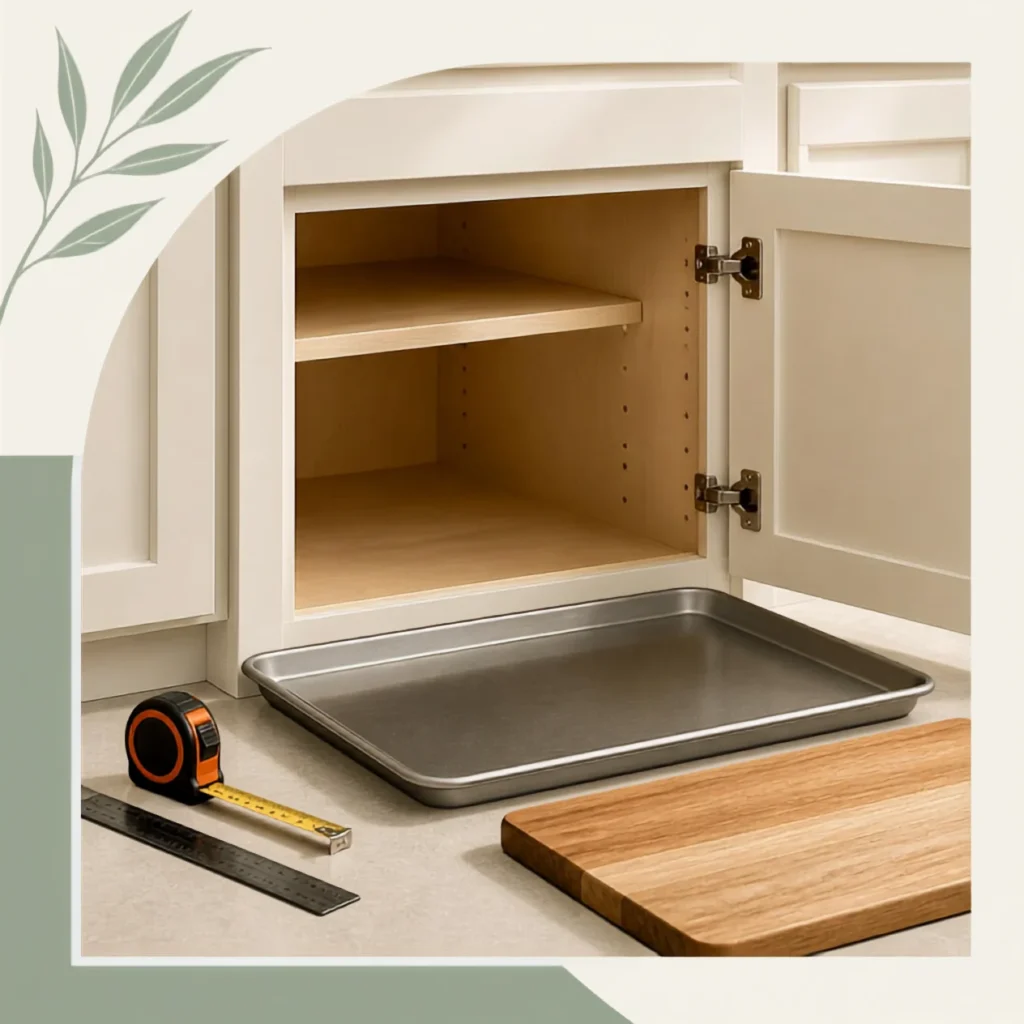
Measure the Cabinet Opening and the Largest Piece
Measure the clear doorway first. With the door fully open, record the width and height that an item can actually pass through. A face frame can make this smaller than the cabinet interior, and a hinge may take another bite out of one side. Then measure the usable interior width, depth and height, noting shelf pins, pipes or supports that project into the space.
Next, measure the largest item in the orientation you plan to use. Include rolled rims, handles, feet and raised edges. Product names are not reliable size guides. For example, Nordic Ware lists a quarter sheet at 13 by 9.6 inches and a half sheet at 17.9 by 12.9 inches in its Naturals bakeware dimensions. Those are examples from one manufacturer, not universal measurements.
Write down these six numbers
- Clear opening width and height
- Usable interior width, depth and height
- Largest item’s length and width when upright
- Thickest item’s depth, including handles or rims
- Proposed organizer’s complete base footprint
- Space needed for your hand to grip and lift the item
The largest piece does not have to control the whole cabinet. If one oversized tray fails the opening test, give it a separate suitable location and size the everyday cabinet around the pieces that pass comfortably.
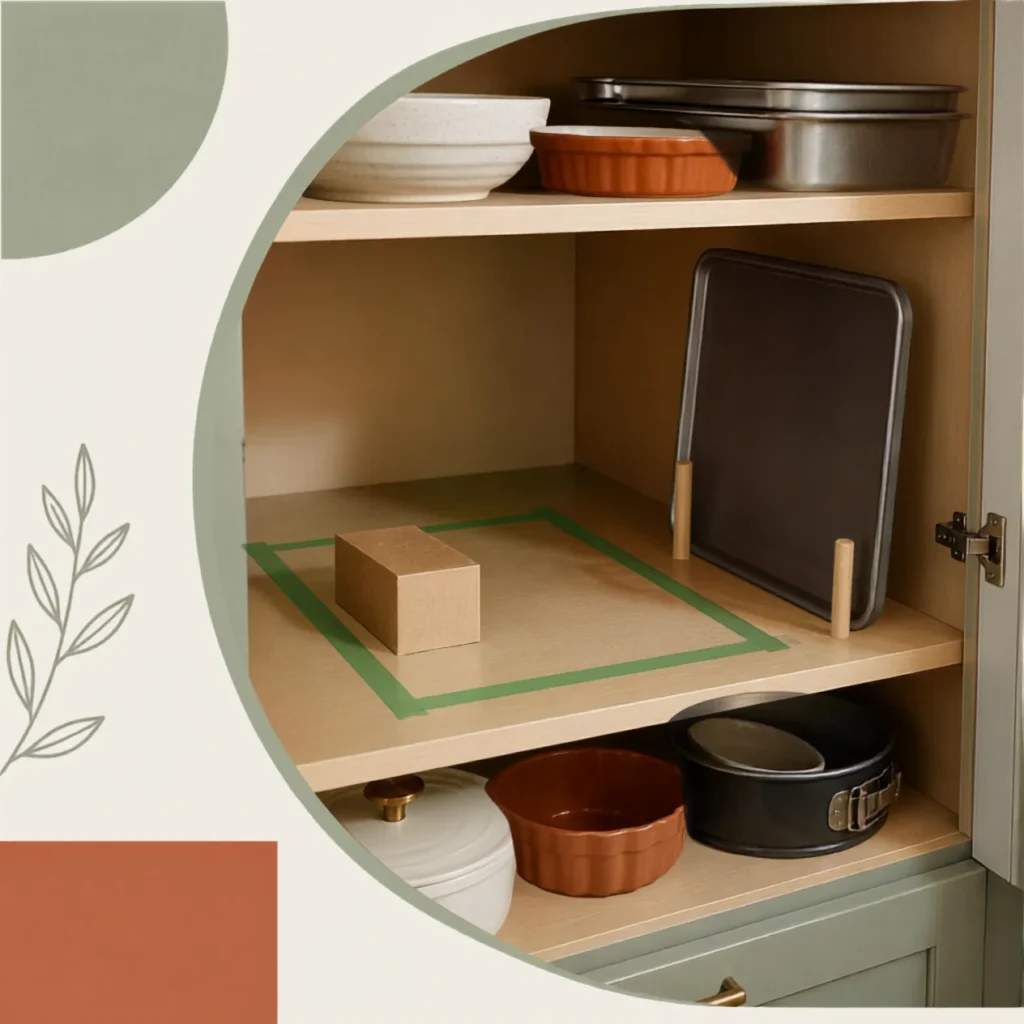
Test the Pull-Out Path Before Buying
An organizer can fit perfectly and still create an awkward cabinet. Before ordering one, mark its base footprint with removable painter’s tape on the empty shelf, or place a small box of similar size there. Stand the largest item in its proposed position and remove it several times.
Watch the complete movement. Can the item rise high enough to clear the divider? Does it need to tilt toward a shelf, countertop or open door? Can you hold it by an edge without scraping the cabinet frame? Open the neighboring appliance or drawer as well if it could block your stance.
Repeat the test with the cabinet partly loaded. A layout that works only when every neighboring slot is empty will be frustrating in normal use. The goal is simple: remove one everyday pan while the rest stay in place.
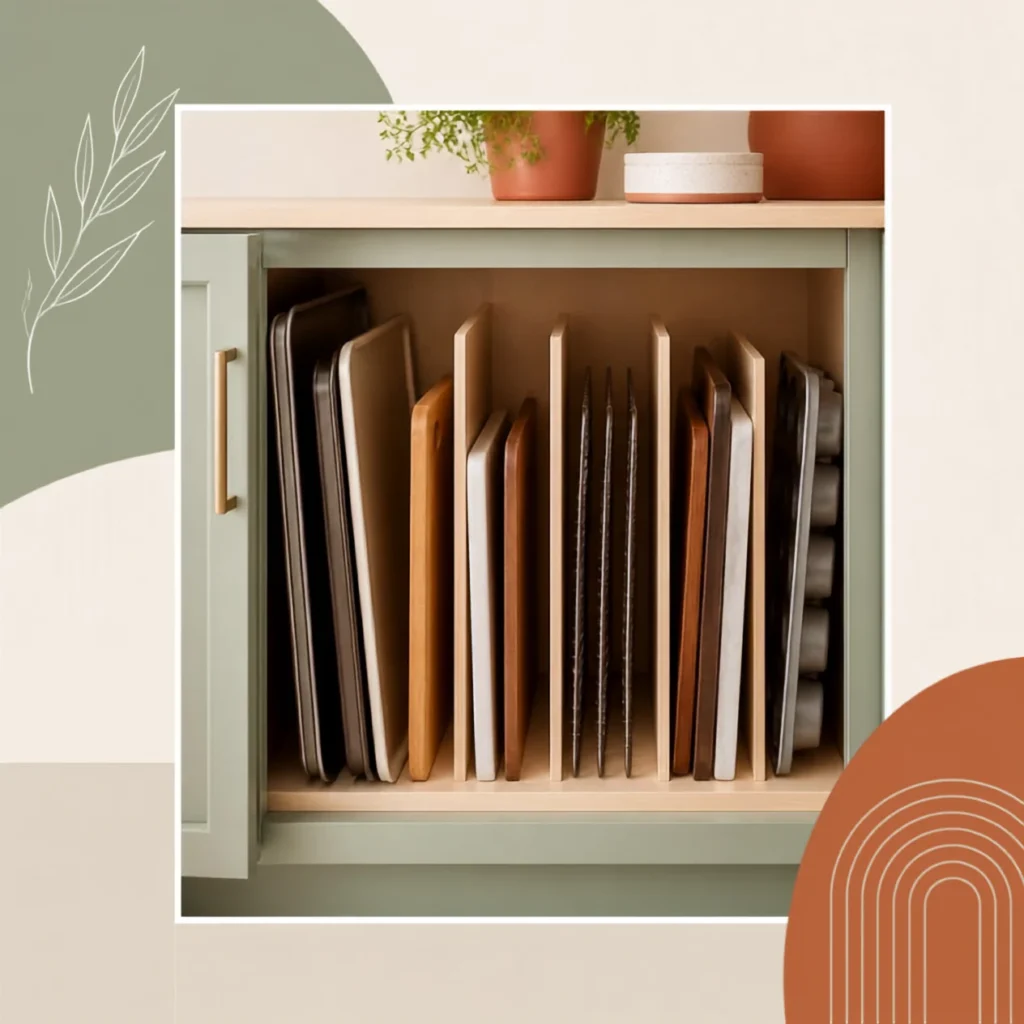
Choose How to Store Baking Sheets and Cutting Boards
Choose by access and fit rather than by the most polished photograph. These four arrangements cover most small-kitchen situations.
| Method | Works well when | Check before choosing |
|---|---|---|
| Freestanding adjustable rack | You rent, want separate slots and have enough shelf footprint | Base size, divider spacing, non-slip feet and loaded height |
| Mounted cabinet dividers | The cabinet is compatible and installation is allowed | Screw locations, shelf material, opening size and permission |
| Small flat stack | You own only a few similar pieces and can lift them easily | Total weight and whether the most-used item stays on top |
| Verified range storage drawer or high cabinet | The pieces are used less often and the location is suitable | Appliance manual, reach, heat and the item’s removal path |
A freestanding rack is a practical renter-friendly starting point because it does not alter the cabinet. Still, measure the rack itself. One current example, the YouCopia StoreMore Bakeware Rack, is listed at 11.6 inches wide, 7.4 inches deep and 6.4 inches high with seven adjustable dividers. Those figures describe the organizer, not the height of a sheet pan loaded into it.
Mounted dividers can use space efficiently but are not automatically rental-safe. Confirm how they attach and whether the cabinet system accepts them. Avoid relying on adhesive hooks for heavy pans, and do not assume a tension rod can support bakeware unless its manufacturer specifically allows that use and load.
Load the Cabinet So One Piece Can Leave at a Time
Put the most-used sheet pan or cutting board at the easiest edge, where your hand does not have to reach around the cabinet door. Give thick muffin tins, boards with handles and heavy stones wider spaces. Equal-looking slots are less useful than slots sized for the objects that occupy them.
Keep dividers close enough to limit leaning but not so tight that a rolled rim catches. If thin cooling racks slide together, group compatible pieces in one slightly wider slot rather than giving each a loose compartment. Keep very heavy pieces low and stable, following the cabinet and organizer manufacturers’ instructions.
Use the cabinet for flat preparation and baking pieces, not as a general hiding place. Mixing bowls, appliance parts and loose lids placed in front of the rack will recreate the same access problem in a different form. For a broader zoning plan, see our small kitchen storage guide for renters.
Store Cutting Boards Only After They Are Clean and Dry
A vertical slot makes cutting boards easy to separate, but it should receive only clean, dry boards. The USDA recommends washing cutting boards with hot, soapy water after each use, rinsing them and allowing them to air-dry or patting them dry with clean paper towels. Its cutting-board guidance also advises replacing boards that are excessively worn or have hard-to-clean grooves.
Follow the board maker’s care instructions, especially for wood, laminated or composite materials. Do not trap a damp board tightly between two sheet pans just because the slot is available. Let it finish drying in an appropriate place before returning it to the cabinet.
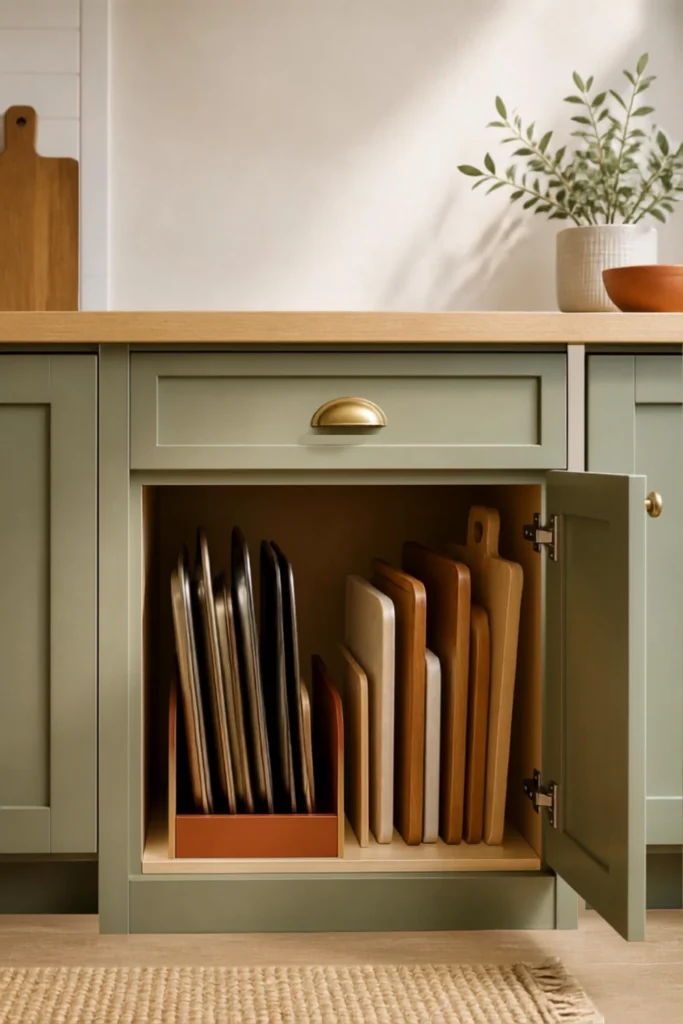
Check These Details Before Buying an Organizer
Compare a product page with your written measurements rather than with a cabinet photograph. Check:
- the complete outside width and depth of the base;
- the divider height and whether divider spacing adjusts;
- the loaded height of your own tallest pan or board;
- whether the base resists sliding on your shelf surface;
- whether installation, drilling or a particular cabinet system is required;
- the stated use and load guidance; and
- the return policy in case the real pull-out test fails.
A rack with more slots is not necessarily more useful. Narrow spacing can encourage overfilling, while a wide base may take space from cookware that already fits well. Buy for the remaining access problem after the collection has been edited and tested.
Frequently Asked Questions
Is it better to store baking sheets vertically or flat?
Vertical storage usually makes individual pieces easier to remove, provided the opening, height and dividers fit. A small flat stack can be simpler when you own only two or three similar pans and the one used most often stays on top.
Can cutting boards and baking sheets share one organizer?
Yes, if every item is clean and dry, the dividers support the different thicknesses and the heavy pieces remain stable. Give a thick wooden board more room than a thin metal sheet rather than forcing both into identical slots.
How do I know whether a bakeware rack will fit?
Compare its outside base dimensions with the usable shelf, then add your tallest stored item and repeat the pull-out test. Check the clear door opening separately because it may be smaller than the interior.
Can I keep baking sheets in the drawer under my oven?
Only after identifying the drawer’s function in the exact appliance manual. Some ranges have storage drawers intended for cookware; others have warming or baking drawers. Whirlpool, for example, markets particular models with a storage drawer for baking sheets, but its self-clean instructions say to remove items from the drawer before the cycle. Follow the directions for your model.
What if my largest pan fits inside but not through the opening?
Do not build the entire cabinet around an unusable angle. Store that one pan in another suitable place, or choose a horizontal position if it can be reached safely without burying everyday pieces. Size the vertical row around the items that enter and leave comfortably.
Measure the Exit, Then Choose the Divider
A reliable way to store baking sheets and cutting boards starts with the clear opening and the largest everyday piece. Rehearse the lift and turn with a temporary footprint, then choose the smallest stable system that lets one item leave without moving the rest. That short test does more for a small cabinet than adding another organizer on guesswork.