
Bathroom Organization
How to Organize a Small Bathroom With No Storage: A Simple 7-Step System
Wondering how to organize a small bathroom with no storage? A practical system can help you decide what belongs in a tiny bathroom, where each category should live, and what should move somewhere else. The goal is to maximize every inch of space while keeping the bathroom functional and uncluttered.

How to organize a small bathroom with no storage becomes much easier when you stop asking the room to hold every bathroom-related item you own. A pedestal sink, one tiny medicine cabinet, or a narrow vanity may simply not have enough capacity for daily products, backup toiletries, bulk towels, hair tools and cleaning supplies at the same time.
The answer is not to cover every wall and floor gap with organizers. Start by deciding what deserves space in the bathroom, protect the surfaces that make the room usable, give each category one permanent home, and move backup inventory somewhere else.
This seven-step system works especially well for renters and small homes because it focuses on function before products. If you eventually need more physical storage, our small bathroom storage ideas for renters guide covers renter-friendly and no-drill options in detail.
Start here: what should actually live in a tiny bathroom?
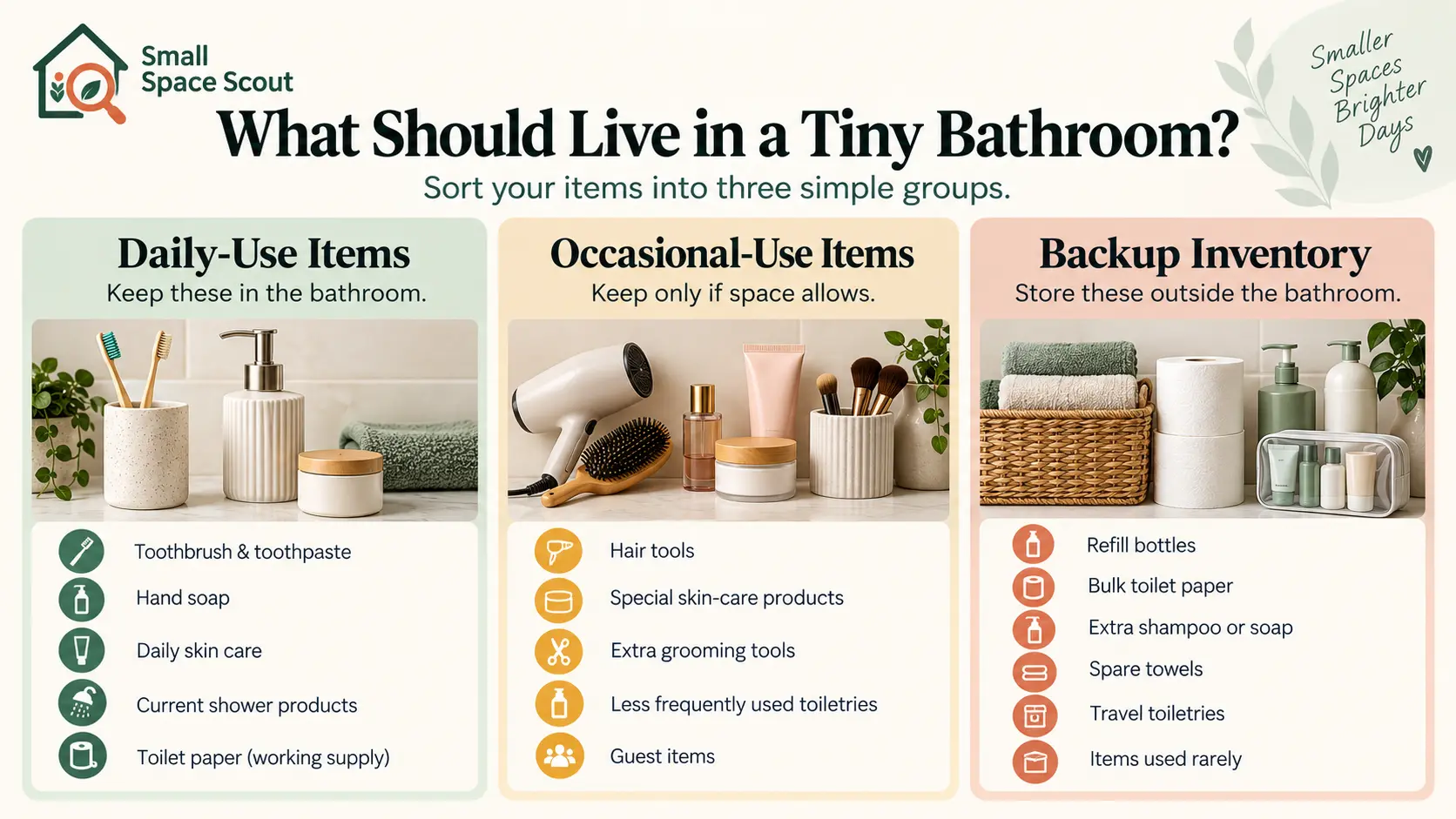
Before you add shelves or buy baskets, divide everything connected to the bathroom into three levels: daily use, occasional use and backup inventory. The smallest room should reserve its easiest-to-reach space for the things you use every day.
This one decision can remove more clutter than adding another cabinet. A product does not need to live in the bathroom just because it is used for grooming.
Daily-use items
Keep the essentials you reach for every day close to where you use them: toothbrush and toothpaste, hand soap, a small daily skin-care routine, current shower products and a working supply of toilet paper. These items earn the most convenient positions because you use them constantly.
Occasional-use items
Hair tools, special skin-care products, extra grooming tools and less-used toiletries can stay only if the room has comfortable capacity. If storing them forces daily essentials onto the floor or across the sink, they should move.
Backup inventory
Refill bottles, bulk toilet paper, duplicate soap, travel toiletries and extra towels usually do not need premium bathroom space. Store them elsewhere and bring in a replacement only when the active item is nearly finished.
For a separate plan for clean towel storage and damp-towel drying, see our small bathroom towel storage ideas guide.
Quick decision guide for bathrooms with almost no storage
Use this as a starting point before buying anything. The best first move depends on what your bathroom is missing.
| If your bathroom has… | Start by doing this |
|---|---|
| Pedestal sink | Move backup toiletries out of the room |
| No drawers | Create one contained daily-use zone |
| No linen closet | Store bulk towels elsewhere |
| Almost no counter | Keep the sink area as workspace, not storage |
| No shower shelf | Add one compact shower solution |
| No usable floor space | Use doors and vertical zones first |
| Two people sharing | Give each person one defined daily-use area |
Step 1: Empty the movable clutter
You need to see the actual room before you can organize it. Temporarily remove toiletries, towels, hair tools, cleaning supplies, extra toilet paper and any loose items that have collected on the sink, floor or toilet tank.
You are not trying to create a perfect empty-room photo. You are looking for the real usable surfaces: counter space, the back of the door, shower walls, narrow gaps, the area above the toilet and whatever cabinet space already exists.
This prevents a common mistake: buying organizers to fit around clutter instead of solving the clutter first.
Do not organize clutter you do not need
Remove empty containers, expired toiletries, products nobody uses, broken grooming tools, duplicate samples and unnecessary packaging. If you would not choose to buy the item again today, it probably does not deserve scarce bathroom space.
Step 2: Set a realistic bathroom capacity
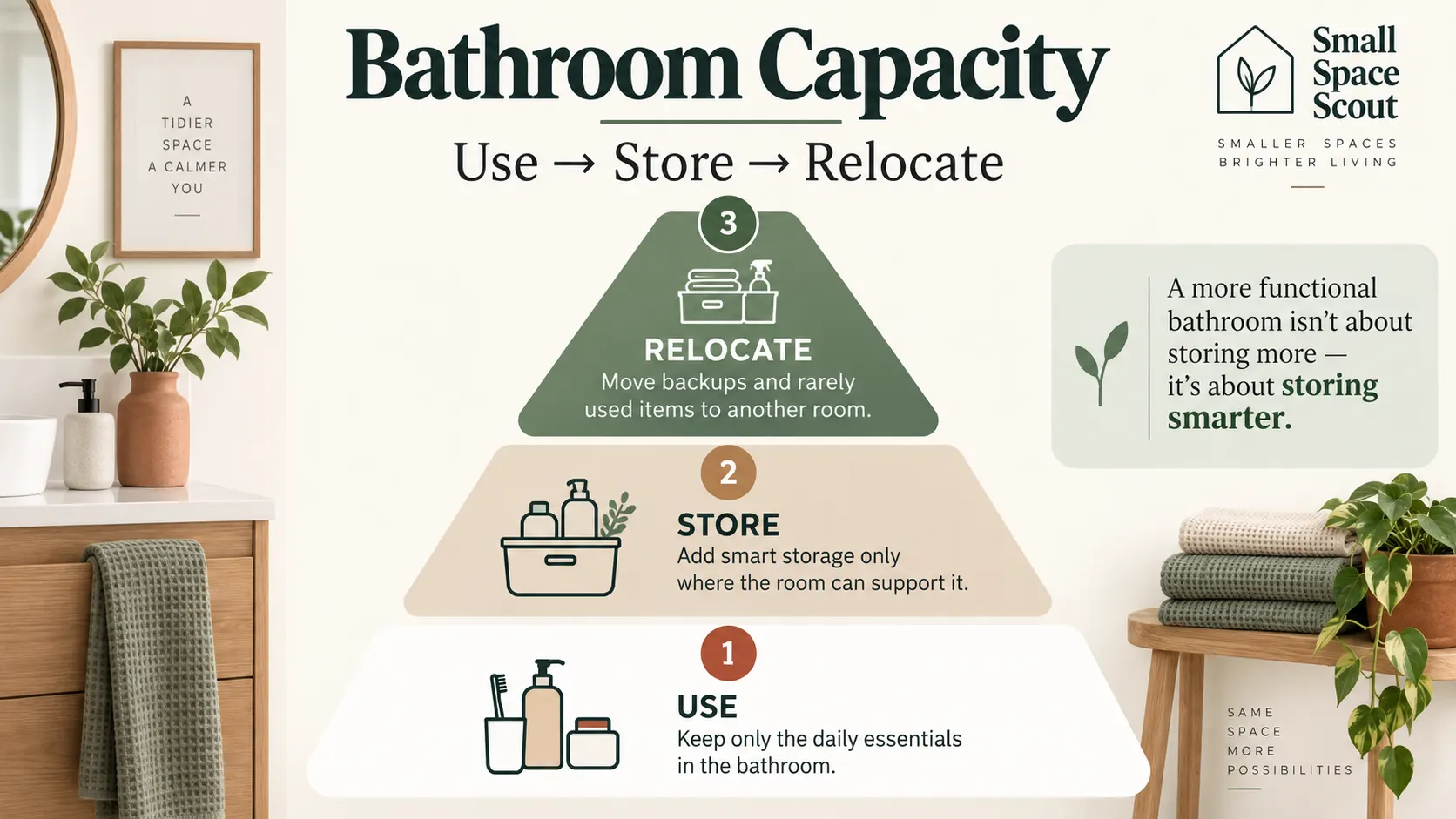
Every small bathroom has a practical storage limit. Think of that limit as the room’s storage budget.
A bathroom with a pedestal sink and one medicine cabinet may realistically support daily toiletries, shower products and a few towels. Trying to force bulk toilet paper, replacement bottles, hair appliances, spare linens and cleaning stock into the same room can make the space harder to use than it was before.
Change the question from “How can I fit everything in here?” to “How much can this room hold without making everyday tasks annoying?” Once you respect the room’s capacity, organization becomes simpler because overflow has a clear destination.
A useful test is to look at what you touch during a normal weekday. Items used every morning or evening deserve convenient access. Products used once a week can accept a less convenient location. Unopened replacements should not compete with active products for the same shelf. Consumer Reports makes a similar distinction between regularly used active items and duplicate inventory that can be stored elsewhere.
Step 3: Protect the surfaces that make the bathroom usable
In a bathroom with almost no storage, open surfaces can quickly become accidental shelves. Protecting them is part of the organization system.
Keep the sink usable
The sink and immediate counter area should function as workspace first. Keep only a compact group of daily essentials nearby. If bottles cover the entire edge, washing your hands, cleaning the sink and getting ready all become harder.
Keep the floor clear
An empty corner is not automatically storage space. The floor still needs room for walking, cleaning, opening the door and stepping out of the shower safely. Add a cart or freestanding unit only when it fits without creating a new obstacle.
Keep the shower floor clear
Shampoo and body wash lined across the tub edge or shower floor make cleaning harder and create visual clutter. Give active shower products one defined zone rather than spreading them around the wet area.
Do not make the toilet tank your overflow shelf
The toilet tank can hold a lightweight basket in some layouts, but it should not become the default home for unrelated products. If items keep landing there because they have nowhere else to go, the system needs a better category home.
Step 4: Give every category one permanent home
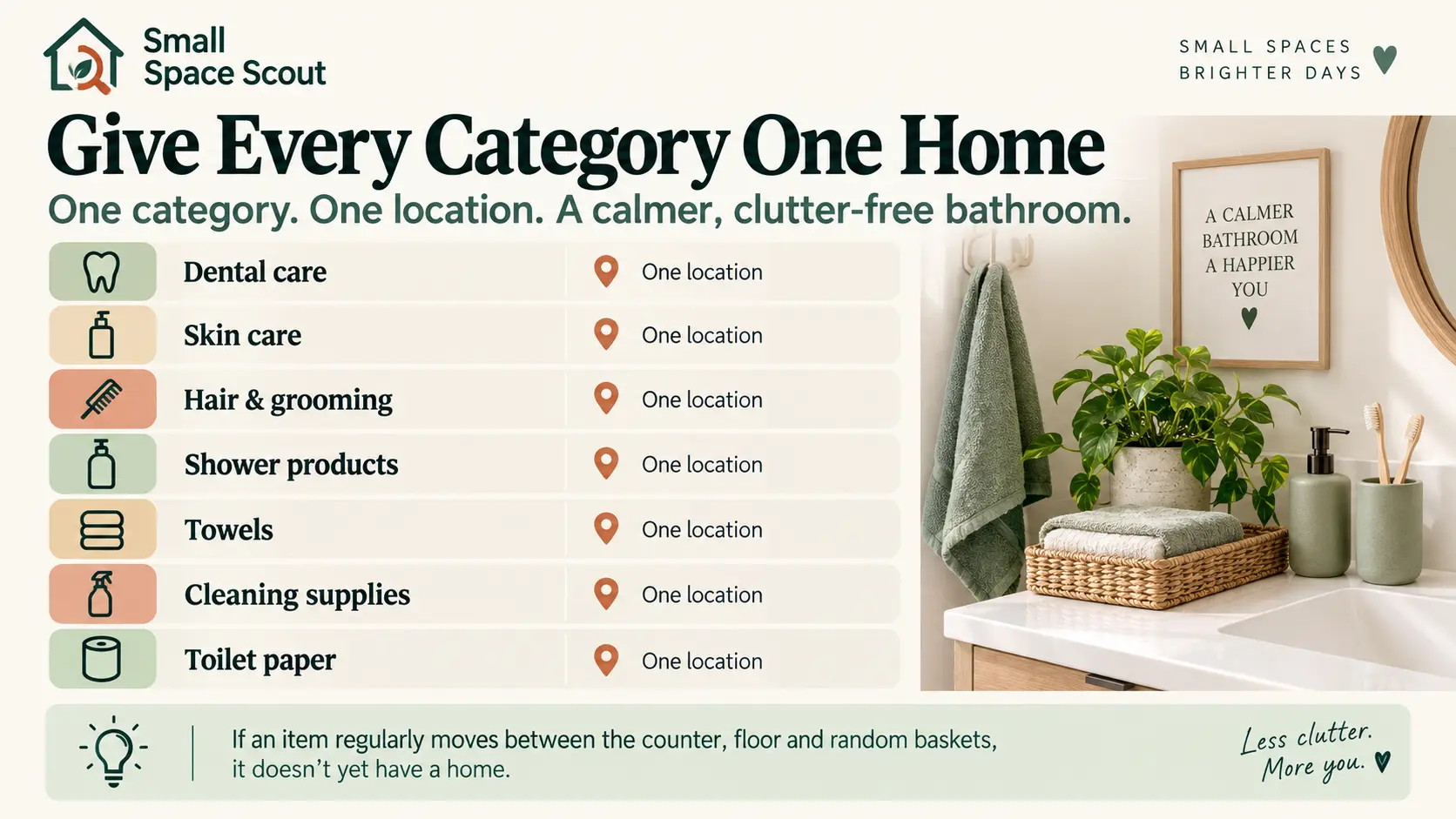
A bathroom can have plenty of baskets and still feel disorganized if products move between those baskets every day. The solution is to give each category one obvious home.
Dental care might live in one cup or drawer zone. Skin care gets one tray. Shower products stay in one shower location. Towels have one rack or basket. Cleaning supplies occupy one defined area. Toilet paper has one small working-supply location.
When an item regularly moves between the counter, floor, windowsill and random containers, it does not have a home yet. The goal is not more containers. The goal is fewer decisions about where things belong.
Step 5: Add storage only where the room can support it
Only after reducing inventory and assigning categories should you add physical storage. Start with areas that do not interfere with the room’s basic function.
Choose the smallest solution that comfortably holds the category it is meant to serve. A five-tier cart for three bottles is not efficient just because it fits. Likewise, a large over-toilet unit can technically add capacity while making the room feel crowded. In a zero-storage bathroom, every organizer should solve a defined problem and still leave the room easy to clean.
Back of the door
An over-door rack or a few renter-appropriate hooks can handle towels, robes or lightweight items without taking floor space. Check door thickness and clearance before adding anything.
Above the toilet
This vertical zone can work for towels, toilet paper or backup toiletries when a stable freestanding unit fits comfortably. Keep the amount controlled so the small room does not feel visually top-heavy.
Shower wall or corner
Choose one compact system for the shower products currently in use. You do not need to store every replacement bottle in the wet zone.
Narrow unused gaps
A slim cart can be useful between fixtures, but only when exact measurements confirm that it will not block movement or cabinet doors.
Existing cabinets
Use the vertical space inside existing cabinets before buying another piece of furniture. Small bins, dividers or pull-out storage can make an awkward cabinet more usable.
For specific no-drill products, under-sink ideas and over-toilet solutions, see our complete small bathroom storage ideas for renters guide. For the wet zone specifically, our shower storage without drilling guide compares adhesive, suction, tension and hanging methods.
Step 6: Create a bathroom storage zone outside the bathroom
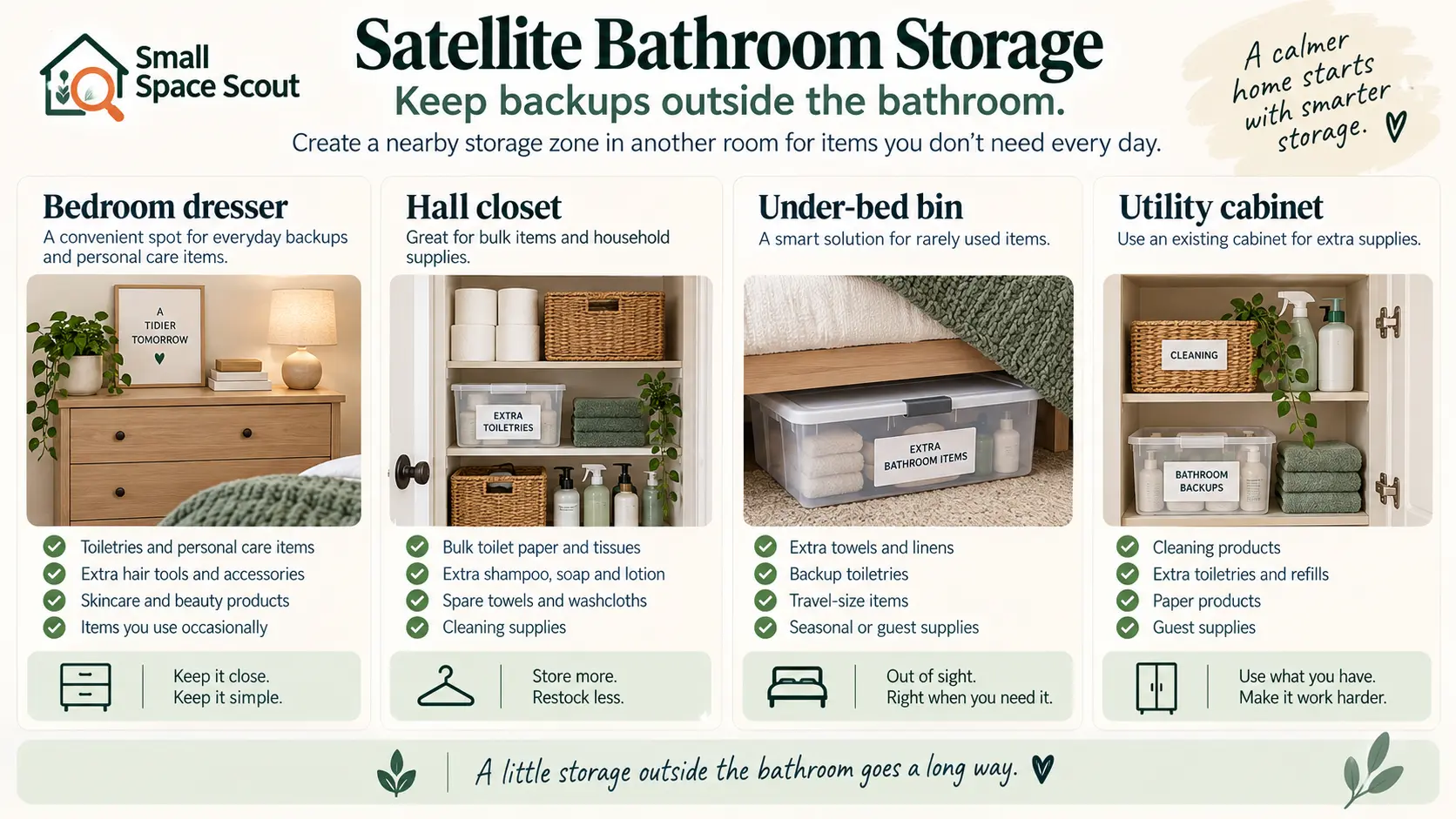
If the bathroom has almost no built-in storage, stop requiring every bathroom-related item to live there. Create a nearby satellite bathroom storage zone.
A bedroom dresser can hold hair tools or makeup that you actually use in the bedroom. A hall closet can hold extra towels. An under-bed bin can store unopened refills. A utility cabinet can hold backup cleaning products.
The bathroom then keeps only working inventory. One shampoo bottle stays in the shower; the replacement waits in satellite storage. One package of frequently needed toilet paper stays accessible; the bulk pack lives elsewhere.
This approach creates capacity without making the bathroom physically larger.
Step 7: Create a 60-second bathroom reset
A tiny bathroom can look messy after only a few items are left out, so the maintenance system needs to be fast.
A simple evening reset can be: return toiletries to their category homes, hang towels, remove clothes, place shower products back in their zone, clear the sink and carry any backup or portable items back to satellite storage.
If putting something away requires moving three other containers first, the system is too complicated. The best small-space organization is obvious enough that you can restore the room in roughly one minute without thinking about it.
Once a week, do a slightly longer check: return backup stock to satellite storage, remove empty packaging, wash any trays or caddies that collect residue, and confirm that new products have not created a second “temporary” home. This keeps the seven-step system working after the initial organization day.
Special situations in a bathroom with no storage
What if you have a pedestal sink?
A pedestal sink gives you almost no hidden storage, so resist the urge to surround it with bulky furniture. Keep the sink area functional, use one compact daily-use caddy if needed, consider the door or wall for light storage, and move backups out of the bathroom.
What if two people share the bathroom?
Give each person one defined personal zone or portable caddy for skin care, hair care and grooming. Keep shared products such as hand soap, cleaning supplies and toilet paper in common zones. Clear ownership prevents products from spreading across every available surface.
What if you have no linen closet?
Keep only the towels currently in use plus a small spare set if the bathroom can support them. Store bulk towels in a bedroom dresser, wardrobe, hall storage or another dry location instead of forcing a large towel stack into the bathroom.
What not to do in a bathroom with no storage
- Do not buy organizers before decluttering. You may be buying storage for things that should leave the room.
- Do not cover every available surface. A bathroom still needs working space.
- Do not keep backups beside active products. Replacements can live elsewhere.
- Do not buy furniture without measuring. “Slim” and “small” are not measurements.
- Do not mix unrelated categories in one basket. It makes the system harder to maintain.
- Do not block doors or walking paths. Floor space has functional value.
- Do not create a system that takes five minutes to reset. Small-space organization should reduce friction, not add it.
Frequently asked questions
How do you organize a bathroom with no cabinets or drawers?
Keep only daily-use necessities in the bathroom, create one contained zone for those products, use vertical or door space where appropriate, and move backups to another room. A portable caddy can also work when there is no permanent drawer space.
What should I keep in a very small bathroom?
Prioritize the products used in the room every day: dental care, hand soap, current shower products, a compact daily skin-care routine, working toilet paper and active towels. Occasional products and backups should stay only if space remains comfortable.
How can I organize a bathroom with a pedestal sink?
Protect the open area around the sink, use a small daily-use caddy or nearby vertical storage, make use of the door if appropriate and keep replacement inventory outside the bathroom.
Where should I store towels if there is no bathroom storage?
Keep only the towels currently in use inside the bathroom. An over-door or freestanding solution can handle a small number of towels, while extra clean towels can live in a bedroom dresser, wardrobe or hall closet.
How do I keep a tiny bathroom from getting cluttered?
Reduce the amount stored in the room, give every category one permanent home and use a short daily reset. When the room starts overflowing, remove backups before adding another organizer.
A small bathroom works better when it stores less
If you are learning how to organize a small bathroom with no storage, the goal is not to squeeze the maximum number of products into the room. It is to keep the room functional.
Start with five actions: remove, prioritize, assign, store and maintain. Remove what you do not need. Prioritize daily-use items. Assign every category one home. Add storage only where the room can support it. Maintain the system with a quick reset.
When you still need more physical capacity after doing those things, use storage that matches the actual dimensions and rental restrictions of the room. Our renter-friendly small bathroom storage guide is the next place to go.