
Bathroom Organization
Small Bathroom Storage Ideas for Renters: A No-Drill Plan for Tiny Bathrooms
A practical, measurement-first guide to creating useful storage in a tiny rental bathroom without turning the room into a maze of organizers.

Small bathroom storage ideas for renters have to solve two problems at once: limited space and limits on permanent changes. A few towels, toiletries, cleaning supplies, hair tools and spare toilet paper may be enough to fill the cabinet and take over the counter.
The obvious solution is not always to add more furniture. In a rental, you may not be able to drill shelves into tile or make permanent changes to the walls. And in a genuinely tiny bathroom, every organizer has to fit around plumbing, doors, the toilet and the shower.
The best small bathroom storage ideas for renters start with the space you already have. Look upward, behind doors, under the sink and into narrow gaps before sacrificing more floor area.
This guide will help you decide where to add storage, what to measure before buying anything, and which no-drill options make the most sense for each part of a small bathroom.
If bulky appliances are taking over your vanity, our hair tool storage ideas for small bathrooms guide covers cooling, cords and choosing a holder that fits.
Where should you add storage first?
Before ordering baskets, shelves or organizers, identify the part of the bathroom that is actually causing the problem.
A bathroom with a cluttered vanity needs a different solution from one with nowhere to store towels. Treat the room as several small storage zones rather than one general storage problem.
If the room has no cabinet or shelving to start with, follow our guide to organizing a small bathroom with no storage to give daily essentials and backups separate homes.
| Problem | Start with |
|---|---|
| Almost no cabinet storage | Above the toilet or another vertical area |
| Messy cabinet under the sink | Adjustable or pull-out organizers |
| Bottles covering the shower floor | No-drill shower storage |
| Crowded vanity counter | Vertical countertop organizer |
| Nowhere for towels | Back-of-door or freestanding storage |
| An unused narrow gap | Slim rolling cart |
| Chaotic drawers | Small adjustable dividers |
Start with the zone that causes the most frustration every day. Fixing one problem properly is usually more useful than adding small organizers everywhere.
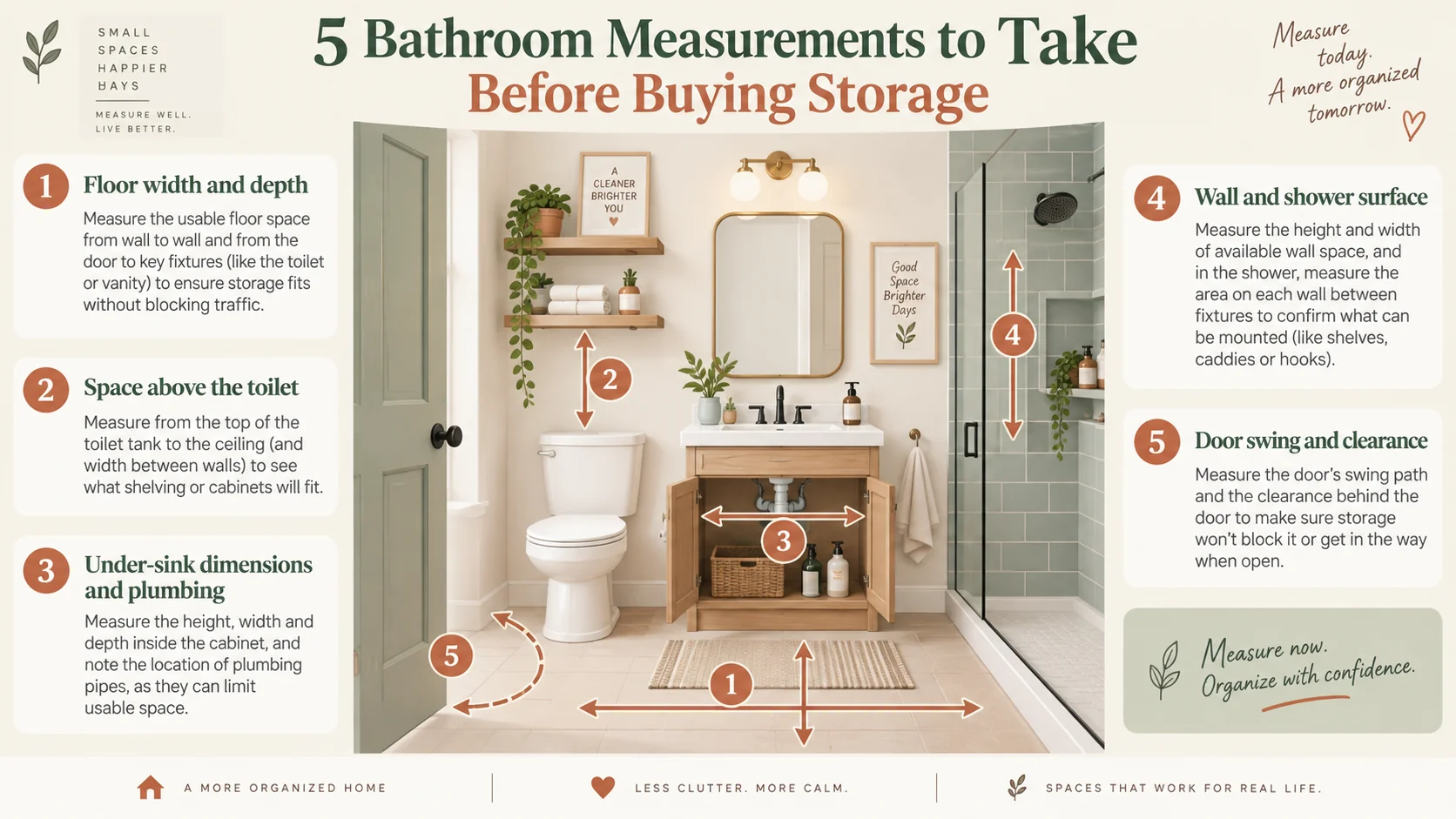
Before buying bathroom storage, measure these 5 things
Small spaces are unforgiving when measurements are wrong. An organizer that is only two inches too wide can make a narrow walkway uncomfortable. An under-sink drawer may look perfect online but become useless when it hits the drain pipe.
Measure first and shop second.
1. Available floor width and depth
Look at the unused floor areas beside your toilet, vanity, shower and bathroom door. Measure both the width and the usable depth.
This is especially important for narrow carts and freestanding shelving. Products described as “slim” can still be too wide for a particular bathroom.
Also consider how people move through the room. Storage should not create an obstacle every time you open the door or step out of the shower.
2. The space above your toilet
The wall above the toilet is often one of the largest unused areas in a small bathroom. Before choosing an over-toilet unit, measure the width of the toilet tank, the distance from the floor to the top of the tank, the available height above it, and any nearby towel bars, windows or cabinets.
A freestanding over-toilet unit can be useful for renters because it creates vertical storage without requiring a permanent wall-mounted shelf. But it still needs enough clearance to fit around the toilet comfortably.
3. The cabinet under your sink
Do not measure only the cabinet opening. Open the doors and look at what is actually inside.
Drain pipes, supply lines and shutoff valves can split the cabinet into awkward sections. A large rectangular organizer may waste more space than two smaller pieces that fit around the plumbing.
Measure cabinet width, cabinet depth, usable height and the location of every pipe. Also keep access to plumbing controls clear.
4. Your wall and shower surfaces
"No-drill" does not automatically mean "works everywhere." Adhesive and suction systems perform differently depending on the surface. Smooth tile and glass may work with products that would be unsuitable for rough, textured or delicate surfaces.
Before using any adhesive organizer, read the manufacturer's approved-surface instructions and weight limits. Storage that physically fits but is incompatible with the wall surface is not a good renter solution.
5. Door movement and clearance
The back of the bathroom door can provide useful storage, but first check how the door moves.
Measure the space between the door and nearby walls, towel bars, shower glass and cabinets. If you want to use an over-door organizer, also check whether it allows the door to close normally.
The same rule applies to rolling carts and tall storage units: open every door and drawer nearby before deciding where the new organizer will live.
10 Small Bathroom Storage Ideas for Renters
Once you know the dimensions, choose storage according to the zone you need to improve. Each idea below starts with the problem first, then the type of storage that can solve it.
1. Use the space above the toilet
In many small bathrooms, the area directly above the toilet is completely unused.
Our over-the-toilet storage for small bathrooms guide explains how to measure tank clearance, plumbing access, footprint and stability before choosing a rack, cabinet or tension-style system.
For renters, removable or freestanding systems can reduce permanent changes, but some tall units still require anti-tip anchoring according to the manufacturer's instructions.
Keep frequently used products on accessible shelves and use higher shelves for backups. Avoid making the unit visually heavy. Three well-organized shelves usually look calmer than shelves packed with dozens of small bottles.
Best for: bathrooms with very little cabinet storage.
Check before buying: toilet width, tank height, ceiling height and floor clearance.
Watch out for: unstable units. Use tall freestanding organizers according to the manufacturer's safety instructions.
2. Make under-sink storage work around the pipes
The cabinet below the sink often has more usable space than it appears to have. The problem is usually the plumbing.
Instead of trying to force one large bin into the cabinet, divide the space around the pipes. Depending on your layout, consider pull-out organizers, short stackable drawers, narrow bins or small removable baskets.
Keep tall bottles in areas with full vertical clearance. Use shorter storage beneath plumbing where a large drawer will not fit.
The goal is not to fill every cubic inch. Leave enough room to remove products easily and reach the pipes when necessary.
Best for: vanities with one large open cabinet.
Check before buying: exact pipe locations and usable depth.
For a deeper layout plan around plumbing, see our under sink bathroom organization guide.
3. Add shower storage without drilling
Shower storage is one of the hardest problems in a rental because permanent corner shelves may not be an option.
There are three common no-drill approaches: adhesive storage on an approved smooth surface, suction storage on suitable smooth surfaces, and tension storage that creates pressure between two surfaces.
None is universally best. An adhesive caddy can use wall space efficiently, while a tension-pole system avoids adhesive altogether but requires the correct height and corner configuration.
Before choosing one, consider the wall material, humidity exposure, the combined weight of your bottles and how easily you want to remove the system later.
Best for: shampoo, conditioner, body wash and shower accessories.
Check before buying: approved surfaces, weight capacity and shower dimensions.
For a deeper comparison of adhesive, suction, tension and hanging methods, read our No-Drill Shower Storage Ideas for Renters guide.
If an adhesive system suits your shower, our best adhesive shower caddies guide covers surface compatibility, rust resistance and keeping the loaded caddy secure.
4. Put the back of the bathroom door to work
A door takes up almost no additional floor area, making it useful in very small bathrooms.
Depending on the door and available clearance, you could use an over-door towel rack, hanging pockets, hooks or a slim organizer.
This area is particularly useful for lightweight items that otherwise end up on the counter or floor. Check that anything hanging on the door does not hit a wall, mirror or cabinet when the door opens.
Best for: towels, robes and lightweight daily-use items.
Check before buying: door thickness and clearance above and behind the door.
5. Fill an awkward gap with a slim rolling cart
Some bathrooms have a narrow strip of unused floor between the vanity and toilet or between a fixture and the wall.
A slim rolling cart can turn that gap into flexible storage. The wheels are useful because you can pull the cart out when you need something and move it when cleaning.
Use different levels for different purposes, such as daily toiletries on top, extra products in the middle and cleaning supplies lower down.
Measure carefully. A cart that looks narrow in a product photo may still be several inches too wide for your particular gap.
Best for: bathrooms with a narrow but usable strip of floor.
Check before buying: width, depth and wheel clearance.
6. Build upward instead of outward on the counter
If the vanity counter is small, arranging everything in a single layer can quickly consume the surface you need for washing and getting ready.
Use our small bathroom counter organization guide to divide the vanity into Wet, Daily and Work zones before choosing a tray, tiered organizer or turntable.
Keep only frequently used products in the Daily Zone and move backups elsewhere. The goal is not to fill every inch with organizers; it is to protect enough clear counter space to use and clean the bathroom comfortably.
Best for: small vanities where daily products compete with usable sink-side space.
7. Organize drawers around your routine
Drawer dividers work best when they reflect how you actually use the bathroom.
Instead of putting every similar object together, consider creating small routine zones such as morning care, dental care, hair accessories and skin care. Products used together stay together.
Adjustable dividers or small modular trays are often easier to adapt than one rigid organizer, especially when bathroom drawers vary in size.
Measure the inside dimensions of the drawer, not the outside of the vanity. And remember the height: a tray that fits the width can still prevent the drawer from closing.
Best for: shallow drawers that constantly become messy.
For a complete fit-first system, see our bathroom drawer organization guide.
8. Use the inside of cabinet doors carefully
The inside surface of a vanity door is easy to overlook.
Lightweight removable storage can sometimes hold small items such as hair accessories, brushes or other light daily essentials.
The key word is lightweight. Adding too much weight to a cabinet door can be inconvenient, and not every adhesive product is appropriate for every finish.
Follow the product's approved-surface and weight instructions. Also make sure the organizer does not hit shelves, plumbing or products inside the cabinet when the door closes.
9. Store towels vertically
Towels take up a surprising amount of volume.
If you do not have a linen closet, look for ways to use height rather than creating another large stack. Options can include an over-door towel rack, freestanding towel ladder or narrow basket placed where it does not block movement.
Keep only a practical number of towels inside the bathroom. If the bathroom is extremely humid or storage is tight, extra clean towels may be better stored elsewhere in the home.
Best for: rentals with no linen cabinet.
For a practical way to separate drying space from clean towel storage, see our small bathroom towel storage ideas guide.
10. Give spare toilet paper one dedicated location
Large toilet-paper packages can make a tiny bathroom look crowded very quickly.
Instead of leaving the entire package in the room, keep a small working supply in one designated location. That could be a narrow freestanding holder, small basket or part of an over-toilet shelf.
Store the remainder elsewhere if possible. The point is not to create elaborate toilet-paper storage. It is simply to keep an everyday necessity accessible without allowing bulky packaging to dominate the room.

Which no-drill bathroom storage method works best?
"No-drill" is a category, not one installation method. Each option solves a slightly different problem.
| Method | Usually useful for | Main advantage | Main limitation |
|---|---|---|---|
| Adhesive | Approved smooth surfaces | Efficient use of walls | Surface and weight dependent |
| Suction | Smooth tile or glass | Can be repositioned | Grip can vary |
| Tension | Shower corners and vertical areas | No adhesive needed | Requires correct dimensions |
| Over-door | Towels and lightweight storage | No wall mounting | Needs door clearance |
| Freestanding | Shelves, carts and racks | Minimal wall interaction | Uses floor space |
Adhesive
Adhesive systems can be particularly useful where floor space is limited, but pay attention to the manufacturer's surface instructions.
For example, 3M lists certain Command Bath products as suitable for surfaces such as tile, glass and painted walls while warning against some other surfaces. The exact guidance varies by product, so check the product you are actually installing rather than relying on a general assumption. See 3M surface guidance.
Suction
Suction can be convenient because it does not require traditional adhesive. It generally makes the most sense on very smooth surfaces.
Cleanliness, texture and the specific product design can all affect performance, so use the manufacturer's instructions rather than assuming a suction system will hold any weight indefinitely.
Tension
A tension system can be a useful alternative when you want to avoid attaching anything directly to the wall. The tradeoff is measurement.
A tension pole that does not properly match the floor-to-ceiling or tub-to-ceiling height will not solve the problem.
Over-door
This is one of the simplest solutions for renters. You gain vertical storage without attaching anything to the wall.
Check that the hardware does not interfere with the door frame and that the door still closes easily.
Freestanding
Freestanding storage is often the least dependent on wall type. Rolling carts, narrow cabinets and over-toilet systems can also move with you to another home.
The downside is that they consume some floor area, which matters in the smallest bathrooms.

What should you remove before buying more bathroom storage?
An organizer cannot solve a volume problem if the bathroom contains many things you do not need.
Before buying storage, empty one zone at a time and look for expired products, nearly empty containers, duplicates, unused samples, old grooming tools and packaging that does not need to stay.
Then decide what truly belongs in the bathroom. This step can reduce the amount of storage you need.
Think twice about storing medicine in the bathroom
A bathroom cabinet may seem like an obvious location for medication, but heat and moisture can be a problem for many medicines.
MedlinePlus advises storing medicines properly and notes that bathroom heat and moisture may damage them or reduce their potency. Always follow the storage instructions for the specific medicine and ask a pharmacist if you are unsure. Read MedlinePlus medicine storage guidance.
That means your bathroom organization plan should not automatically include a large medicine-storage system simply because there is space available.
Bathroom storage setups for three different budgets
You do not need to organize the entire bathroom in one shopping session. A better approach is to improve the highest-impact zone first and expand only if it makes the room easier to use.
Product prices vary, so treat these as planning ranges rather than exact shopping totals.
Under $50: fix the daily clutter
Prioritize inexpensive organization inside storage you already have. A basic setup might include drawer dividers, a few hooks and small containers for existing cabinets.
This level works best if your bathroom already has enough physical storage but uses it inefficiently.
Around $100: add one major storage zone
After fixing drawers and existing cabinets, put the remaining budget toward the biggest problem. That might mean adding an under-sink organizer or a no-drill shower storage system.
Avoid splitting the budget across many tiny products unless they solve specific problems.
Around $150: add vertical storage
If you genuinely need more capacity, a larger portion of the budget can go toward a freestanding solution such as an over-toilet unit or a quality slim cart.
Combine that with smaller organizers only where necessary. You do not have to hit any particular dollar amount. The best storage plan is the least expensive one that actually fixes the room.
A simple renter bathroom organization plan
If your bathroom currently feels overwhelming, do not try to redesign everything at once.
Start by removing products you no longer need. Then measure the bathroom and identify your worst storage zone. Choose one solution that fits the available dimensions and installation restrictions.
Set it up, live with it for a few days and see whether the room functions better. Only then move to the next zone.
This approach helps prevent one of the most common small-space mistakes: buying several organizers before you understand where the real bottleneck is.
A tiny bathroom does not necessarily need more things. It needs the right things in the right places.
Frequently asked questions
How can I add bathroom storage without drilling?
Start with solutions that do not require permanent wall installation, such as freestanding shelves, slim carts, over-door storage and tension systems.
Adhesive or suction products may also work when the manufacturer approves them for your particular surface. Measure carefully and follow the installation and weight instructions for whichever system you choose.
How do you organize a very small bathroom with no storage?
First reduce the number of things that must stay in the bathroom. Then look for underused vertical areas above the toilet, behind the door, inside vanity doors and beneath the sink.
Use narrow gaps only when they do not interfere with movement. Keep daily products easy to reach and move backups somewhere else when possible.
Are adhesive bathroom shelves safe for rentals?
They can be appropriate in some rentals, but there is no universal guarantee that every adhesive product will work safely on every surface.
Surface material, paint condition, humidity, installation, weight and removal technique all matter. Check both your lease and the manufacturer's instructions before installation.
What can I put above a toilet in a rental?
A freestanding over-toilet organizer can provide shelving without permanently mounting shelves to the wall. You might use it for towels, toilet paper, baskets and lightweight backup toiletries.
Measure the toilet and available height carefully before ordering.
How do I organize under a bathroom sink when pipes are in the way?
Map the plumbing first. Instead of buying one large organizer, use smaller drawers or bins on either side of the pipes and shorter storage where vertical clearance is limited.
Keep shutoff valves and important plumbing connections accessible.
Make the bathroom work for the way you live
Good small-bathroom organization is not about fitting the greatest possible number of organizers into the room. It is about removing unnecessary clutter, measuring accurately and making better use of storage areas that already exist.
For renters, that often means choosing flexible solutions: freestanding units, vertical storage, over-door systems and carefully selected no-drill products.
Start with the space that creates the biggest daily problem. Once that zone works, move to the next one.
A tiny rental bathroom may never have the storage capacity of a large renovated bathroom, but it can still be easier to use, easier to clean and far less cluttered when every storage choice has a clear purpose. For more small-space bathroom solutions, browse our bathroom organization ideas.