
Small Closet Shoe Storage Ideas: A Pair-Footprint Plan
Small closet shoe storage ideas work best when you size the system around the shoes you actually own, not the number printed on a product box. A rack advertised for 20 pairs may work well for flats and sandals but feel cramped with bulky sneakers, high-tops, or boots. In a small closet, the difference between “fits” and “works every day” is usually a few inches of depth, height, or return clearance.
This guide uses a Pair-Footprint Plan: count the pairs that need easy access, measure the width, depth, and height of the shoes that take up the most room, then match the organizer to the space you can genuinely spare. The goal is not to force every pair into the closet. It is to keep the most-used shoes visible, easy to return, and out of the way of hanging clothes, drawers, and doors.
Quick answer: separate shoes into Active, Rotation, and Archive groups, measure your largest everyday pair, measure the closet floor and door clearance, then choose storage by the dimension you can afford to spend: floor width, vertical height, rod width, door space, or storage outside the closet.
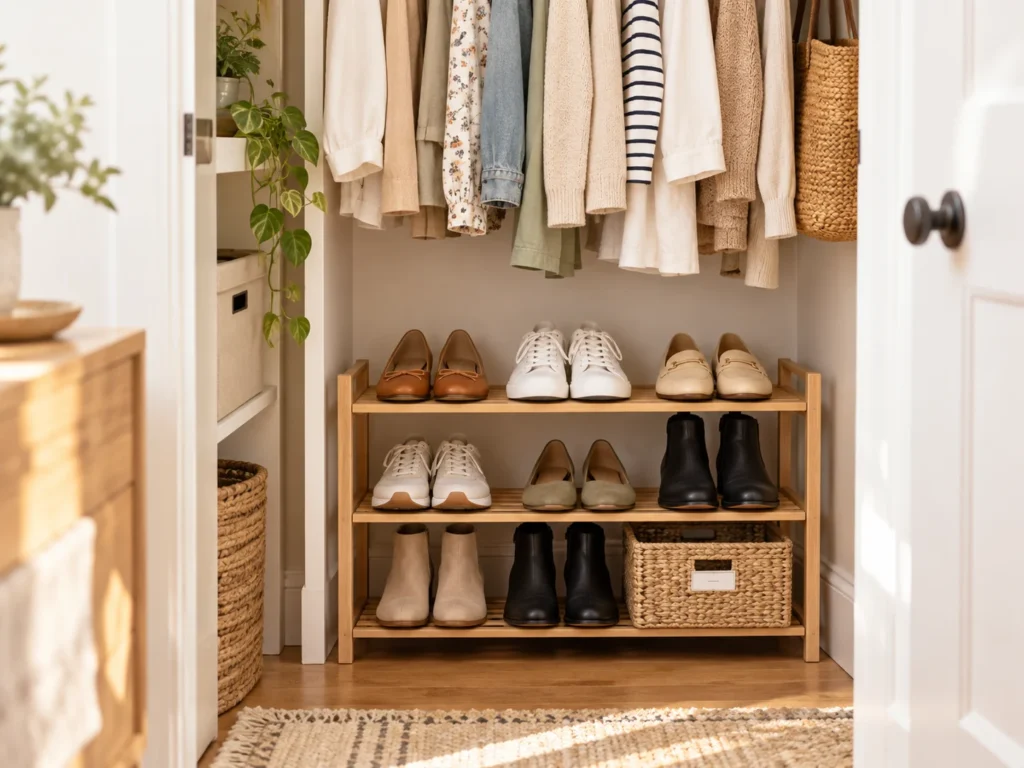
Why Advertised Pair Capacity Can Mislead
“Holds 20 pairs” sounds precise, but it usually describes a best-case arrangement rather than your exact footwear collection. Pair capacity is useful only after you know what kind of shoes the organizer was designed around.
Twenty pairs are not always twenty equal slots
Low-profile flats, sandals, loafers, and compact dress shoes use far less volume than chunky sneakers or boots. Two people can own the same number of pairs and need completely different racks. That is why this article starts with footprint instead of advertised capacity.
Shoe shape matters as much as pair count
Shoe width, sole thickness, heel shape, toe box, and upper height all affect whether a pair sits comfortably on a shelf or inside a pocket. A rack may technically hold two shoes side by side while still forcing them to overlap or stick out into the closet opening.
Boots need a different storage zone
Ankle boots and tall boots should not be squeezed into ordinary shoe tiers just because there is floor space. They need more vertical clearance and may require a separate open bay, boot tray, or seasonal storage position.
Fit matters more than maximum capacity
A storage system is successful when shoes go in and out easily. If returning one pair means shifting three others, the organizer has too much theoretical capacity and not enough practical capacity. For the bigger closet system around your footwear, see our small closet organization ideas for renters.
Start With the Pair-Footprint Plan
Before shopping, divide your shoes by access frequency. This prevents rarely worn footwear from taking the best closet floor space and gives you a realistic target for how many pairs need to fit in the prime zone.
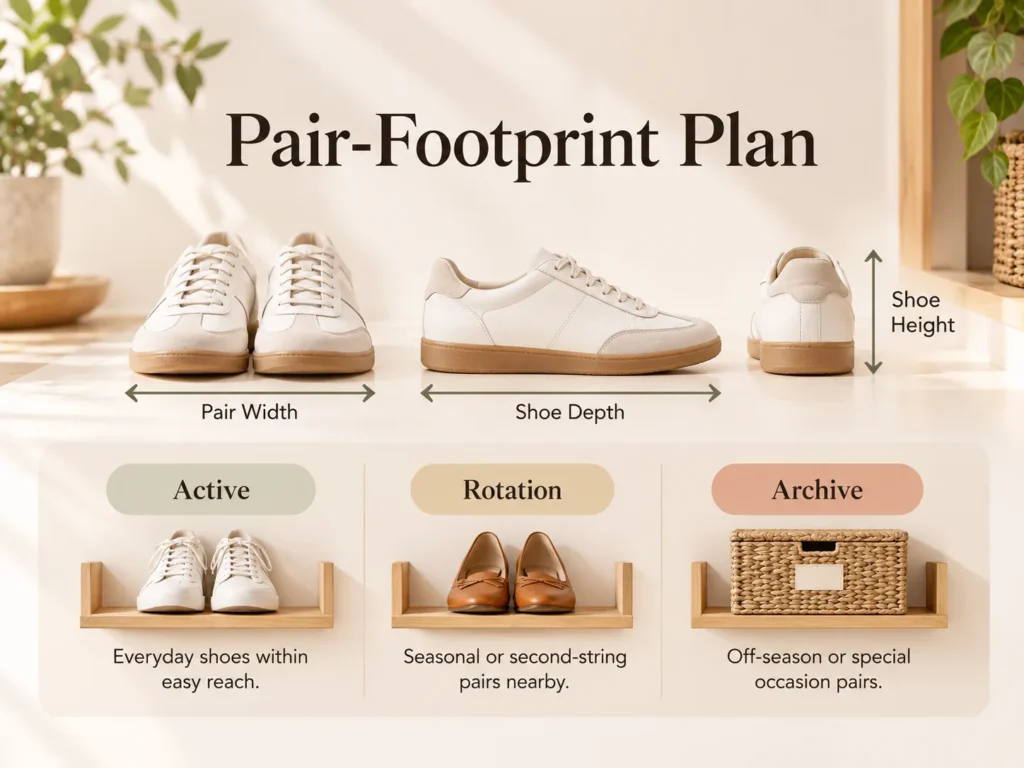
Step 1: count Active, Rotation, and Archive pairs
Active pairs are worn weekly and deserve the easiest access. Rotation pairs are occasion, weather, or outfit-specific shoes used less often. Archive pairs are out of season or rarely worn and can move to under-bed storage, a labeled bin, or another appropriate dry location. A small closet does not need to keep every pair equally accessible.
Step 2: measure the largest everyday shoe
Choose your bulkiest regularly worn sneaker, loafer, or work shoe and measure it. That pair sets the minimum depth and often the minimum shelf spacing for the Active zone. Do not test the organizer with your smallest sandal unless sandals are the largest shoes you plan to store there.
Measure the Shoe Footprint, Not Just the Closet
Use a tape measure on the shoes themselves before measuring the organizer. The Pair-Footprint Plan needs three shoe dimensions: pair width, shoe depth, and shoe height. Then add enough clearance to place and remove the shoes without scraping shelves or compressing the uppers.
Measure pair width
Pair width is the side-by-side space your two shoes actually occupy. Measure the widest part of the pair in its natural storage position. If you prefer one shoe slightly in front of the other, test that arrangement too.
Measure shoe depth
Shoe depth is the heel-to-toe length plus any room needed so the shoes do not project into a sliding door, closet opening, or walkway. Deep sneakers and larger sizes often fail first on shallow racks because the toe sticks out even when the width is fine.
Measure shoe height
Shoe height matters for high-tops, heels, and boots. Measure the tallest part of the shoe while it is standing normally. Adjustable shelves can make better use of mixed heights than identical fixed tiers because low shoes do not need the same vertical space as ankle boots.
Measure the Closet Shoe Zone
After measuring the shoes, measure the zone that can actually hold them. Useful shoe space is often smaller than the full closet floor because hanging garments, drawers, door tracks, wall returns, and the pull-out path all consume part of the footprint.
Measure usable floor width
Measure the clear floor width after long garments and other furniture are accounted for. If your reach-in closet has hidden side areas or sliding doors, use our small reach-in closet organization guide to map the visible opening and blind pockets before placing a rigid shoe tower.
Check door and drawer clearance
Open every closet door and every nearby drawer fully. A rack that fits when everything is closed can still block a sliding door or sit in the path of a drawer. Mark the proposed rack footprint with painter’s tape and test the room around it.
Check garment drop above the shoes
Measure from the floor to the lowest garment hem above the shoe zone. Short shirts may leave room for a low rack or drawers, while dresses and coats need a clear full-height lane. If your closet has no shelves, our small closet with no shelves guide explains how to budget rod width and floor space together.
Run the Largest-Pair Test Before You Buy
The Largest-Pair Test is simple: if your bulkiest frequently worn pair does not fit comfortably, the organizer is too small for your real collection no matter how many smaller pairs fit.
Test the bulkiest Active pair
Use the sneakers, work shoes, or chunky loafers you reach for most often. Check width, depth, toe overhang, and the space above the shoe. If the pair has to be forced into the slot or tilted awkwardly every time, choose a larger bay or a different organizer.
Test the return motion
Then test the return motion. Can you put the pair away in one easy movement? If you need to rotate the shoes, move another pair, or crouch into a blind corner every time, the storage may look compact but will be annoying in daily use.
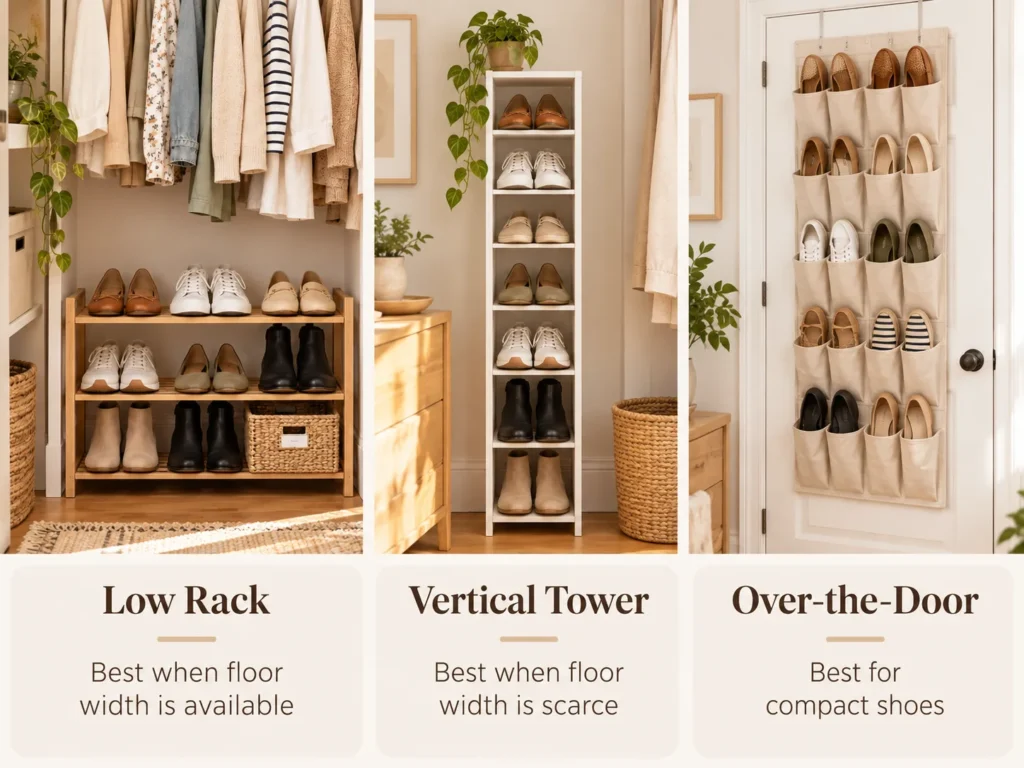
Use a Low Shoe Rack Under Short Clothes
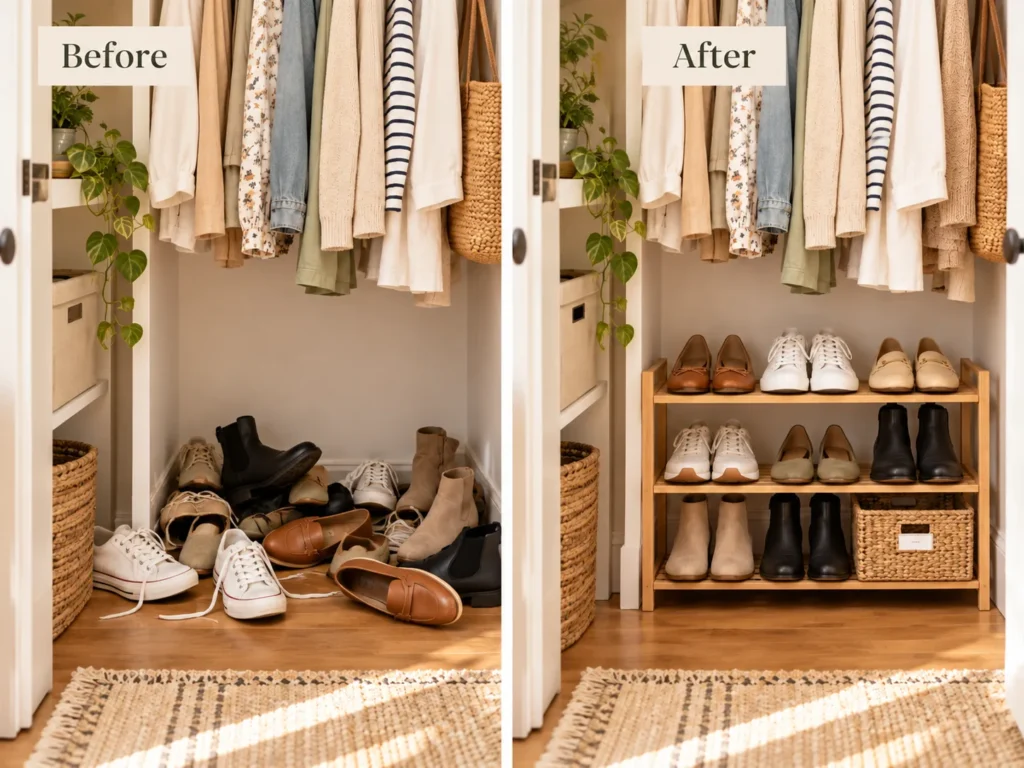
A low two- or three-tier rack is often the simplest shoe solution because it uses open floor space without taking rod width. It works especially well beneath shirts, folded-over trousers, and other short-hang clothing.
Best when floor width is available
Use a low rack when you have enough floor width for the pairs you wear most and enough depth that toes do not interfere with the closet door. Choose open tiers when visibility matters more than dust protection.
Keep the rack lower than garment hems
Load the hanging rod before measuring rack height. The lowest shirt or trouser hem should clear the top pair without resting on it. Leave a little extra space because clothing length changes as hangers shift or garments are replaced.
Use a Vertical Shoe Tower When Floor Width Is Scarce
A narrow vertical shoe tower trades height for floor width. It can be effective in a small closet when you have a tall, clear side zone but cannot spare a wide section of floor.
Spend height instead of floor width
Think of the tower as a vertical column. Before buying, check that it does not project into hanging clothes or block the closet opening. A tall rack that is only partly visible behind a door may be harder to use than a shorter rack placed in the center.
Use adjustable spacing for mixed shoes
Adjustable shelves are especially useful for mixed footwear. Use tighter spacing for flats and low sneakers, then create one or two taller bays for high-tops or ankle boots. Uniform shelf spacing often wastes vertical room above small shoes.
Keep the tower stable
Follow the manufacturer’s stability and anti-tip instructions, especially for tall freestanding furniture. The U.S. Consumer Product Safety Commission’s guidance on clothing storage units explains stability requirements and anti-tip provisions for covered units. If a required restraint cannot be installed in your rental, choose a lower or more stable alternative rather than ignoring the instructions.
Use Adjustable Shelves for Mixed Shoe Heights
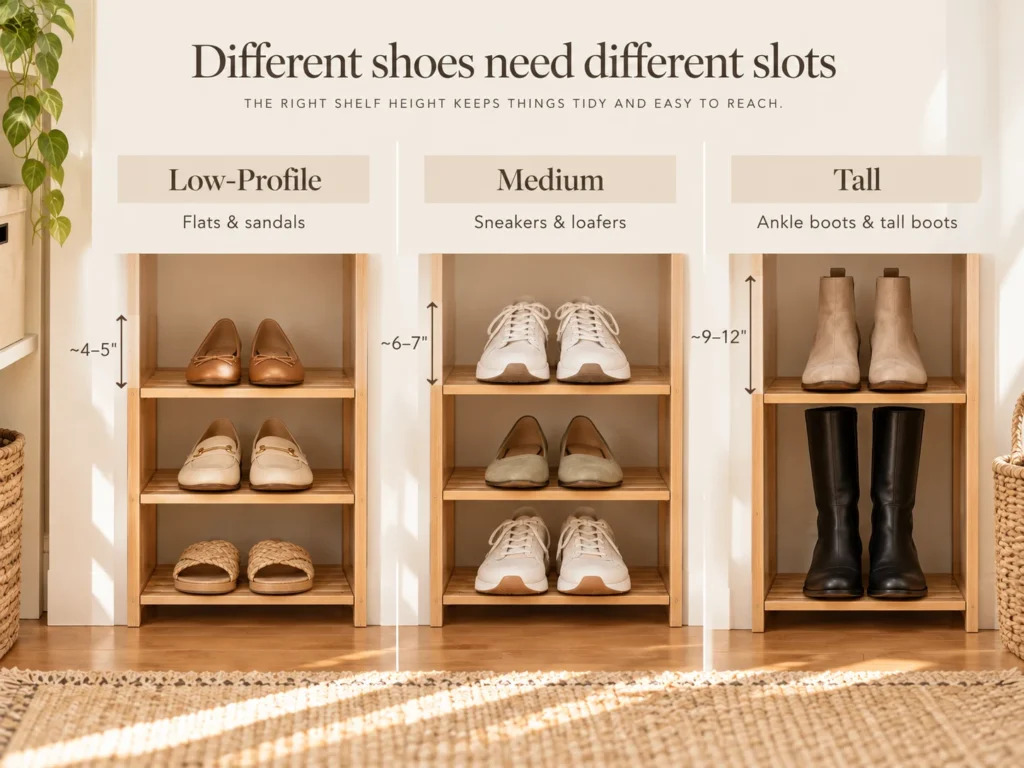
Adjustable shelves are one of the most flexible options because the same organizer can handle different shoe profiles without forcing every pair into the same opening.
Create low bays for flats and sneakers
Group low-profile shoes together and set their shelves just high enough for easy removal. The saved vertical space can create an extra tier or increase room elsewhere in the unit.
Reserve taller bays for boots and high-tops
Give high-tops and ankle boots a taller opening instead of laying them sideways or compressing the uppers. Tall boots may need a separate floor position or boot-specific support rather than a standard shelf.
Do not waste height on identical tiers
Identical shelf spacing is easy to manufacture but not always efficient for a mixed collection. Match shelf height to the shoes, then leave a small finger gap above each pair so they can be removed without scraping.
Use Over-the-Door Shoe Storage Carefully
Over-the-door pockets or racks can move shoes off the closet floor, but they depend heavily on door type, clearance, and shoe size. They are most practical on compatible hinged doors with enough top and side clearance.
Best for lightweight or compact shoes
Compact flats, slippers, sandals, and some low-profile sneakers are more likely to fit standard pockets than bulky athletic shoes or boots. Measure the pocket or holder, not just the advertised pair count, and compare it with the largest shoe you plan to store there.
Test the door before loading
Install the empty organizer first and close the door. Check that brackets do not scrape the frame and that the loaded shoes will not hit shelves or hanging clothes. For adhesive accessories, use products approved for the exact surface and follow removal directions. Command’s official FAQ notes that paint condition, preparation, and removal technique can affect whether damage occurs.
Know When Hanging Shoe Storage Is Worth the Rod Width
A hanging shoe organizer can create vertical slots without drilling, but it spends one of the closet’s most valuable resources: rod width. That tradeoff makes sense only when hanging clothes are not already crowded.
Hanging cubbies trade rod space for shoe slots
Measure the organizer’s loaded width and subtract it from the usable rod. Soft cubbies can bow outward when filled, so the real space consumed may be slightly larger than the product’s flat width.
Use them only when the rod has room
Use hanging cubbies for lightweight shoes when you have spare rod width but limited floor area. They can work well in a rod-only closet where folded clothing is stored elsewhere and the floor needs to stay open.
Floor storage may be more efficient
If the floor beneath short garments is empty, a low rack may give you the same shoe capacity without reducing hanging space. Choose the storage type based on the resource you can afford to spend.
Use Stackable Boxes and Under-Bed Storage for Lower-Frequency Pairs
Closed boxes are useful for shoes that need protection or are worn occasionally, but they reduce instant visibility and can create extra moves. Use them for Rotation pairs rather than the shoes you grab every morning.
Boxes protect occasional shoes
Clear or clearly labeled boxes make occasional footwear easier to identify. Stack only as high as you can comfortably retrieve without removing several boxes first. If the stack becomes a puzzle, the capacity is no longer practical.
Under-bed storage can free prime closet floor space
Under-bed shoe storage is often better for Archive pairs because it moves seasonal footwear out of the closet entirely. Use containers that fit the actual bed clearance and keep shoes clean and dry before storing them for long periods.
Give Boots and Larger Sneakers Their Own Fit Rules
Boots and bulky sneakers are where generic pair-capacity claims fail most obviously. Treat them as separate fit classes instead of trying to squeeze them into the same slots as flats.
Boots need height more than pair count
Ankle boots need more shelf height, while tall boots may need open floor storage or dedicated support to keep shafts upright. Store them where they do not block doors or collapse beneath shorter shelves.
Large sneakers need depth and width
Larger or chunky sneakers need more depth and pair width. Test the organizer with your actual shoe size and widest sole. A shallow tower can look space-saving but become inefficient if every pair sticks out into the closet opening.
Choose the Storage Type by the Space It Consumes
Every shoe organizer spends another kind of space. Use the table to compare the tradeoff rather than assuming the highest advertised capacity is best.
| Storage type | Uses | Gives up | Best when |
|---|---|---|---|
| Low rack | Floor width | Open floor zone | Short clothes leave clear space |
| Vertical tower | Height + narrow floor footprint | One vertical column | Floor width is scarce |
| Hanging cubby | Rod width | Hanging capacity | Rod has spare space |
| Door pockets/rack | Door surface | Door clearance | Compatible hinged door is available |
| Stackable boxes | Shelf or floor volume | Fast access | Pairs are occasional |
| Under-bed bin | Space outside closet | Immediate visibility | Pairs are seasonal or archived |
Compare the tradeoffs
Ask which dimension is most available in your closet. If rod width is tight but floor space is open, choose a floor rack. If floor width is scarce but a tall clear corner exists, choose vertical storage. If the closet itself is overloaded, move Archive pairs outside it.
Pick the smallest system that solves the real problem
The best organizer is usually the smallest one that comfortably holds the Active pairs and a reasonable Rotation group. Do not buy a larger system merely to make room for shoes you rarely wear.
Three Shoe Collections, Three Different Layouts
Collection A: mostly flats and low sneakers. Use a low multi-tier rack under short clothes and one small labeled box for occasion shoes. Because the shoes are low-profile, tighter shelf spacing can create more usable tiers without making retrieval difficult.
Collection B: sneakers plus ankle boots. Use an adjustable vertical tower with most shelves set for sneakers and one taller bay for boots. Keep the tower in the visible part of the closet so bulky shoes are easy to return.
Collection C: mixed shared closet. Give each person a defined Active zone instead of mixing every pair. Use one low rack or two narrow towers, then move seasonal footwear to under-bed or secondary storage. Shared closets work better when each person knows exactly where everyday shoes return.
The layouts differ because the footprint differs. Pair count alone would not tell you which arrangement works.
Avoid These Common Shoe-Storage Mistakes
The most common mistake is buying the organizer before measuring the shoes. A few other problems appear repeatedly in small closets:
- Testing with the smallest pair: use the bulkiest Active pair instead.
- Filling every floor inch: leave space for door movement, drawers, cleaning, and garment hems.
- Storing boots in ordinary tiers: give tall footwear a taller bay.
- Using rod-hung shoe cubbies in an already crowded closet: they reduce hanging capacity.
- Keeping every pair equally accessible: move Archive shoes out of the prime zone.
- Believing pair-capacity claims without checking dimensions: actual shoe width, depth, and height are more useful.
Pre-buy checklist: count Active pairs, measure your largest everyday pair, measure the closet floor and garment drop, test door clearance, check full organizer dimensions, and verify that the largest pair can be returned in one simple motion. Keep receipts and packaging until the organizer survives a normal week.
Small Space Scout rule: if your largest regular pair does not fit comfortably, the organizer does not fit your collection.
Frequently Asked Questions
What is the best shoe storage for a small closet?
The best option depends on which dimension you can spare. A low rack works when floor width is open, a vertical tower works when height is available, and a hanging organizer works only when rod width is not already crowded.
How many pairs should I keep in the closet?
Keep the Active pairs you wear weekly in the easiest zone, Rotation pairs in secondary positions, and Archive or seasonal footwear outside the prime closet area when possible. There is no universal number because shoe size and closet dimensions vary.
How do I store sneakers in a small closet?
Measure the widest and deepest sneaker in your Active group, then choose a rack or tower that gives it enough room without projecting into the door or walkway. Adjustable shelves are useful when some sneakers are much bulkier than others.
What is the best way to store boots?
Give ankle boots a taller shelf bay or open floor position. Tall boots may need dedicated floor storage or support that keeps the shafts upright. Avoid compressing them into standard low shoe tiers.
Are over-the-door shoe organizers good for renters?
They can be, when the door type, clearance, surface, and product instructions allow it. Test the door before loading and avoid assuming “no drill” automatically means damage-free.
Should I use shoe boxes in a small closet?
Boxes are most useful for occasional, delicate, or seasonal pairs. For everyday shoes, an open rack is usually faster because the pair stays visible and can be returned in one move.
How do I organize shoes in a shared closet?
Give each person a defined Active zone and avoid mixing every pair together. Shared storage is easier to maintain when each person knows which rack tier, tower section, or bin belongs to them.
Size the Storage to the Shoes, Not the Label
The strongest small closet shoe storage ideas start with the shoes themselves. Count the pairs you actually use, measure the largest everyday shoe, and choose storage based on real pair width, depth, and height. Then match that footprint to the closet space you can afford to spend.
A low rack, vertical tower, hanging cubby, door organizer, box system, or under-bed bin can all work. The right choice is the one that fits your footwear and lets you return an Active pair without rearranging the rest of the closet.
For the full closet system, revisit our renter-friendly small closet guide. For narrow openings and hidden side pockets, use our reach-in closet organization guide. You can also browse the growing Closet Organization collection.