
Small Kitchen Spice Storage: A Heat-Safe Visibility Plan
Small kitchen spice storage should make seasonings easy to find without placing them in a hot, damp or sunlit spot. A rack beside the stove may look convenient, but convenience does not help if steam reaches open bottles, labels disappear behind one another or duplicate jars keep collecting in the back row.
This plan uses three checks: Heat, Sight and Reach. First, choose a location that protects spice quality. Next, arrange bottles so their names remain visible. Finally, give the seasonings used for everyday meals the easiest positions. You can apply the system to a shallow drawer, one upper cabinet or a compact freestanding organizer without replacing every bottle.

Start With the Spices You Actually Use
Empty the proposed drawer or cabinet and gather every dried herb, spice and seasoning blend from the kitchen. Include open bottles, unopened refills and the small containers that have drifted into another food cupboard. Keep fresh herbs, oils, sauces and baking decorations out of this audit because they follow different storage rules.
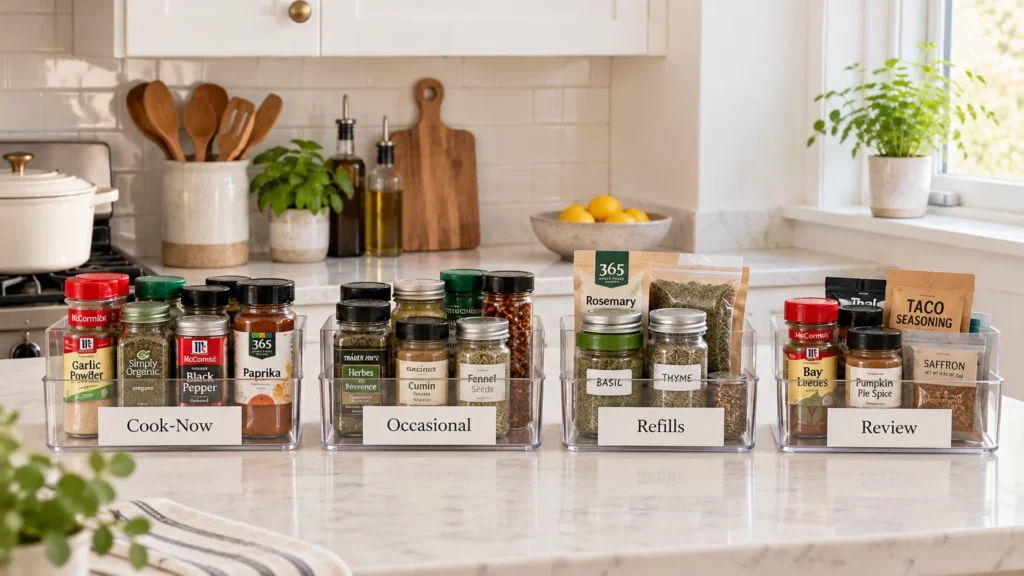
Place the bottles into four groups:
- Cook-now spices: seasonings used in the meals you prepare most weeks.
- Occasional spices: baking spices, holiday blends and ingredients used for only a few recipes.
- Refills: unopened packets or duplicate bottles kept for later.
- Review items: bottles with faded labels, no recognizable aroma or an unclear identity.
Use the package information when reviewing dates. A Best By date generally describes expected quality rather than a universal safety deadline, and the correct decision can depend on the product. The USDA Food Safety and Inspection Service notes that whole spices usually keep their quality longer than ground spices. Follow the bottle’s directions and replace anything whose identity or condition you cannot verify.
The cook-now group should control the prime storage area. A collection of thirty bottles does not require thirty equally convenient positions when only eight support the household’s regular meals.
Choose a Heat-Safe, Dry and Dark Location
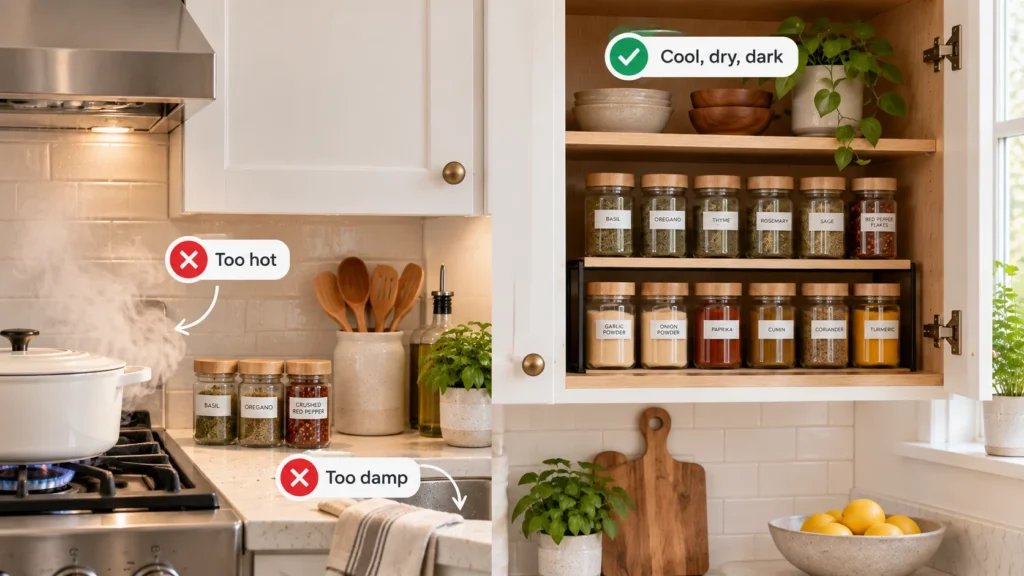
Evaluate the location before measuring an organizer. McCormick’s storage guidance recommends tightly capped containers kept away from heat, moisture and direct sunlight. It specifically advises against places over a stove, dishwasher or sink and near a window. Penn State Extension also recommends a dry location away from heat and sunlight and warns that an above-stove rack can reduce spice quality quickly.
Drawers beside a range need the same check. Open the drawer while the oven and nearby burners are in normal use. If the drawer front, interior or bottles become noticeably warm, choose another location. Do not assume that a closed drawer blocks heat from an adjacent appliance.
Trace the steam path
Stand where you normally season food and notice where steam travels from a pot. A bottle stored safely in a cabinet can still collect moisture if it is held over the pan while open. McCormick advises using a dry measuring spoon and avoiding direct sprinkling into steaming food. Make the storage position close enough for a simple routine: remove the bottle, measure away from the steam and close it before returning it.
Check sunlight and damp zones
A narrow ledge beside a bright window can expose clear bottles to direct light. A cabinet over a sink or beside a dishwasher may experience moisture or temperature changes. Prefer a stable interior drawer or cupboard that remains cool, dry and shaded during normal kitchen use.
Some products may carry special storage directions. McCormick, for example, recommends refrigerating members of the red-pepper family to help retain color and freshness. Treat such directions as product-specific guidance instead of moving the entire spice collection into the refrigerator or freezer.
Measure Bottles, Clearance and the Removal Path
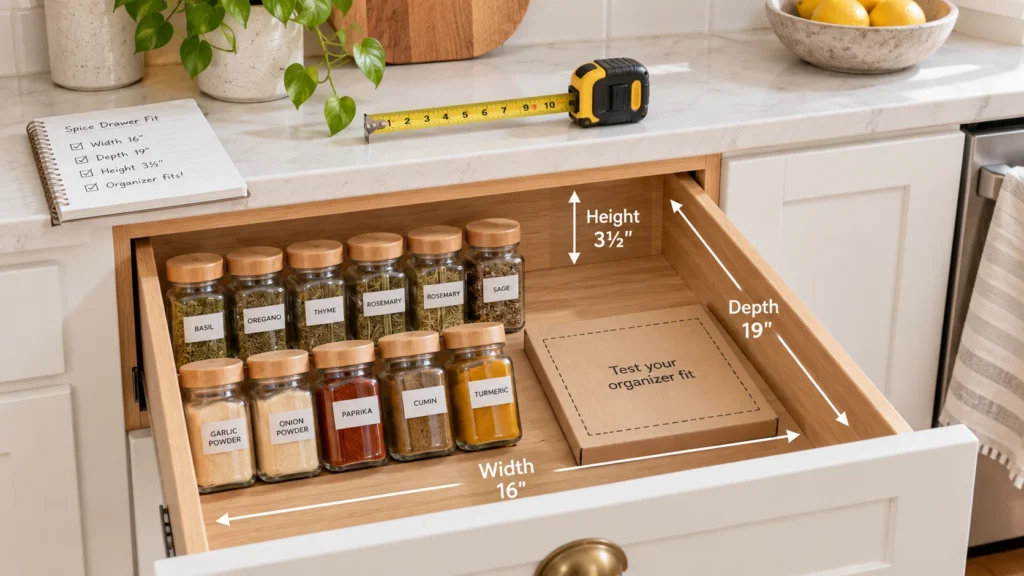
Measure the space after choosing a suitable location. Record usable width, depth and height rather than relying on the cabinet’s advertised size. Face frames, hinges, drawer sides, shelf pins and door hardware can reduce the opening.
Measure the tallest bottle, the widest bottle and any square container that must turn during removal. For a drawer, place the tallest bottle in the planned orientation and close the drawer slowly. The usable closing height can be lower than the visible interior wall, especially when a countertop support or cabinet rail crosses above it.
For a cabinet organizer, test the complete retrieval path. A tiered shelf may fit inside but leave the back row trapped below the shelf above. A turntable needs enough corner clearance to rotate with its largest bottles loaded. A pull-down organizer needs open space in front of the cabinet as well as room for its moving parts.
Manufacturer dimensions are useful only when compared with the real space. IKEA lists its UPPDATERA spice insert at nearly 20 inches long, so it will not suit every shallow drawer. YouCopia lists its 24-bottle SpiceStack at 11 inches deep, 10.5 inches wide and 8.3 inches high. Neither example proves fit in your kitchen. Make a cardboard footprint with the listed measurements, place it inside the cabinet and test the door and removal path before buying.
If the proposed spice drawer is also the only practical utensil drawer, compare both jobs before committing it. Our narrow kitchen drawer organization plan explains how to check usable height and tool shape.
Compare Drawer, Cabinet and Freestanding Layouts
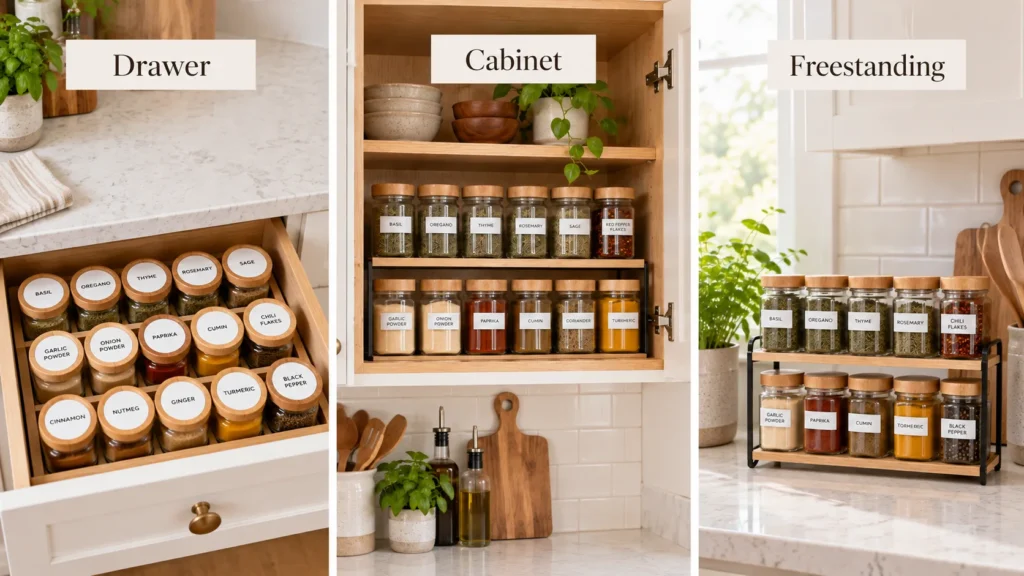
No single organizer style is best for every collection. Choose the method that makes labels visible and gives the cook-now set direct access while fitting the bottles you already own.
| Layout | Useful when | Fit check | Main drawback |
|---|---|---|---|
| Flat drawer with top labels | Bottles can lie securely in one shallow layer | Loaded bottles clear the drawer rail | Uses a full drawer and needs readable top labels |
| Angled drawer insert | Similar-size bottles rest at a readable angle | Insert length and tilted bottle height fit | Rigid channels may waste space around mixed shapes |
| Tiered cabinet shelf | The shelf above leaves enough headroom | Back bottles lift over the front row | Front bottles may still block removal |
| Turntable | A deep shelf has clear rotation space | Largest bottle clears the walls while turning | Round footprint can waste cabinet corners |
| Pull-down freestanding organizer | A measured cabinet has front clearance | Moving drawers open without hitting the door | The unit consumes a fixed block of shelf space |
| Small reserve bin | Refills and occasional spices need a second zone | Loaded bin can be removed without overreaching | Loose bottles become hidden without a clear label |
Flat storage accepts mixed bottle shapes
A flat drawer can work without matching containers. Lay bottles in one layer with names facing up. A washable non-slip liner or bottle channel can reduce rolling, but it must not raise the bottles into the drawer rail. YouCopia’s SpiceLiner is one example of a cut-to-fit system designed for bottles lying flat; its capacity claim is less important than the loaded height of your own collection.
Tiered shelves need lifting room
A tier creates sight lines only when the reader can remove bottles from each level. Measure the distance between the top of the tallest back bottle and the shelf above it. If the bottle must be tilted into a front row, the tier has improved display but not access.
Door and wall storage require extra checks
Adhesive clips, magnetic tins and door racks can free shelf space, but they are not automatic renter solutions. Confirm the surface material, loaded weight, attachment instructions and removal requirements. A cabinet door also needs clearance past shelves and bottles when closing. Do not place an attached rack where it will be heated by the range or struck by another door.
Build Your Small Kitchen Spice Storage Layout
Build the layout with real bottles before ordering matching jars. The goal of small kitchen spice storage is a repeatable cooking routine, not a photograph that works only while every container is perfectly aligned.
1. Put the cook-now set in the first-view zone
Place frequently used spices in the front row, the top-labeled portion of a drawer or the easiest section of a turntable. Group them by the meals you cook rather than by an abstract rule. Salt-free everyday blends, garlic, cumin and chili powder might form one household’s cook-now set; a baker’s set will look different.
2. Give mixed bottles one stable orientation
Choose front-facing, top-facing or side-facing labels according to the angle from which you see the collection. Do not force every container into a narrow slot. Put unusually wide grinders and tall blends at the edge where they can stand securely without blocking smaller bottles.
3. Move refills to one labeled reserve zone
Keep unopened refills and duplicates together instead of hiding one behind every active bottle. A small bin labeled “spice refills” can sit in a secondary pantry-free grocery zone. Our guide to organizing a small kitchen without a pantry can help select that nearby reserve location.
4. Leave one empty position
A completely filled rack becomes difficult to maintain when one bottle changes size or a new blend arrives. Leave a little working room so a bottle can be returned without rebuilding the row. Empty space is part of the system, not wasted capacity.
Label for the Direction You Look
A label helps only when it faces the reader during retrieval. Use top labels for bottles lying in a drawer, front labels for a single cabinet row and clear bin labels for reserve supplies. Test readability from a normal standing position instead of arranging the collection while crouched directly in front of it.
Keep the original package when it is practical. It may contain ingredient, allergen, storage and Best By information that is easy to lose during decanting. If you choose matching jars, transfer the product name and any information your household needs. Do not mix a new refill into an older unidentified remainder simply to fill the jar.
Alphabetical order works for a large collection shared by several cooks, but it is not required. Meal groups or use frequency can be faster in a small collection. Whichever rule you choose, make it obvious enough that another household member can return a bottle correctly.
Test the Cooking and Return Routine
Choose one meal you prepare regularly and retrieve every seasoning for it. Count how many unrelated bottles must move. The cook-now set should normally come out directly, and no bottle should require reaching blindly behind a tier.
Then return the spices with the same attention. A system that is easy to empty but difficult to restore will slowly collapse. Close the drawer or cabinet, open it again and check whether bottles rolled, tipped or hid their labels.
Repeat the test after a week of ordinary cooking. Move a frequently used bottle forward if it repeatedly returns to the wrong spot. Reduce the collection in the prime zone if the organizer works only when every gap is exact. For a broader kitchen zoning reset, continue with our small kitchen storage plan for renters.
Common Small Kitchen Spice Storage Mistakes
- Choosing the spot beside the stove first: easy reach does not outweigh repeated heat and steam exposure.
- Buying before measuring: an insert may fit the empty drawer while loaded bottles prevent it from closing.
- Decanting before testing: matching jars add work and can erase useful package information without improving access.
- Creating three hidden rows: a shelf that holds more bottles can also create more duplicates.
- Mixing refills with active bottles: unopened packets disappear and are purchased again.
- Using one rule for every cook: strict alphabetical order may be slower than meal groups for a small, familiar set.
- Filling every inch: the system has no room for a changed bottle size or a new seasoning.
- Ignoring the return path: bottles left on the counter usually signal that their assigned positions are inconvenient.
Frequently Asked Questions
Where should spices be stored in a small kitchen?
Choose a cool, dry and dark drawer or cabinet away from the stove, dishwasher, sink and direct sunlight. The best location also lets you read labels and remove daily spices without shifting unrelated bottles. Follow any special storage directions on the product label.
Is a drawer or cabinet better for spices?
A drawer is useful when bottles fit in one layer with top labels and clear the closing rail. A cabinet is useful when shelf height supports a readable front row or measured tier. The better choice is the one that passes the Heat, Sight and Reach checks with your actual bottles.
Can spices be stored beside or above the stove?
Storage guidance from McCormick and Penn State Extension recommends keeping spices away from heat and moisture, and both discourage above-stove storage. A nearby drawer can also warm during cooking, so check the real conditions instead of assuming the cabinet front provides protection.
Do matching spice jars save space?
Sometimes, but uniform jars are not automatically more compact. Measure their diameter, height and lid before transferring anything. Matching jars can improve a drawer grid while also creating labeling work and a second place for leftover refills. Test the layout with current bottles first.
How do I organize spices with different bottle sizes?
Use a flexible layout: a flat drawer with non-slip support, an adjustable organizer or separate edge space for tall and wide bottles. Keep labels facing one viewing direction. Avoid narrow fixed slots that leave several common bottle shapes unsupported.
Should spices be organized alphabetically or by use?
Either method can work. Alphabetical order is predictable for a large shared collection. Grouping by meal or frequency can be faster for a small cook-now set. Choose one rule, label reserve supplies and make the return position obvious.
Let Storage Conditions Come Before the Rack
Reliable small kitchen spice storage starts with the location, not the organizer. Keep bottles away from heat, moisture and direct sunlight, give everyday spices the clearest labels and easiest reach, and measure the loaded drawer or cabinet before buying anything.
A useful system does not need matching jars or a large pantry. One protected zone for the cook-now set, one labeled reserve area and enough open space to return each bottle can make a small collection easier to use and maintain.