
Bathroom Organization
Bathroom Drawer Organization: A Fit-First System for Small Vanities
Measure the drawer first, then organize everyday items around fit, frequency and function.
Bathroom drawer organization works best when the drawer itself decides the system. A small vanity can look tidy on the outside while hiding trays that do not fit, bottles that stop the drawer from closing, long tools that cross several compartments and tiny accessories that disappear beneath larger products.
Instead of buying an organizer set first, start with the empty drawer. Measure its usable width, depth and closing height, note any obstructions, then decide which products deserve the easiest access. This guide uses a simple sequence: Fit, Frequency, Function.
If the whole room is short on storage, start with our small bathroom storage ideas for renters guide to see where drawers fit into the larger bathroom plan.

Start With the Fit-First Drawer Map
Before sorting skincare, dental products or grooming accessories, map the physical limits of the drawer. Vanity drawers vary widely, and a tray that looks compact online may waste space or prevent the drawer from closing in your bathroom.
Interior width
Measure from one inside wall to the other at the narrowest usable point. Do not use the outside vanity width. Drawer sides, slides and internal framing can reduce the actual space available for organizers.
Interior depth
Measure front to back inside the drawer. Depth determines whether long trays can run lengthwise, whether expandable dividers have room to open and how much front-to-back space remains after handles or curved drawer fronts are considered.
Usable closing height
Measure from the drawer bottom to the lowest obstruction above it. This is the maximum height for organizers and upright products. Leave a little practical clearance so bottles, lids and tray edges do not scrape when the drawer opens or closes.
Obstructions and unusual shapes
Check for tapered sides, rails, plumbing cutouts, screws, drawer hardware and odd corners. Sketching these on paper or marking the measurements in your phone can prevent buying a set that technically matches the outer dimensions but cannot sit flat inside.
Measure the empty drawer, not the organizer you hope will fit.

Use Fit, Frequency and Function in That Order
Once the drawer map is clear, decide what earns space. The order matters because small drawers cannot be organized well by category alone.
Fit: can the item physically live here?
Start with shape and dimensions. A long comb may fit a narrow channel better than a square compartment. A tall serum bottle may belong in a deeper drawer or cabinet even if every other skincare product is nearby. Do not force a product into a category zone when its shape makes the drawer inefficient.
Frequency: how often do you reach for it?
Daily-use products deserve the easiest access. Weekly products can sit in a secondary section, while occasional and backup items can move farther away. If your bathroom has almost no built-in storage, our guide on how to organize a small bathroom with no storage explains how to separate daily items from backup inventory.
Function: which routine does it support?
Only after fit and frequency are settled should you group by function. Useful zones may include dental care, skincare, grooming, hair accessories, nail care or contact-lens supplies. Products used together can share a tray, but only when the tray still fits the drawer efficiently.
Why the order matters
A category-first system can create awkward gaps or make tall and long items difficult to store. Fit first protects the geometry of the drawer; frequency protects convenience; function makes the final layout intuitive.
Declutter Before You Buy Drawer Organizers
Empty the drawer before shopping. Remove empty packaging, damaged accessories, products you no longer use and items that clearly belong elsewhere. Separate duplicate or backup products from the items currently in your routine.
The goal is not to throw away useful products just to create a minimalist photo. It is to stop premium drawer space from being occupied by things you rarely touch. If overflow is better suited to the cabinet below, use our under-sink bathroom organization guide to plan that area around the plumbing.
Shallow Bathroom Drawers: Follow the One-Layer Rule
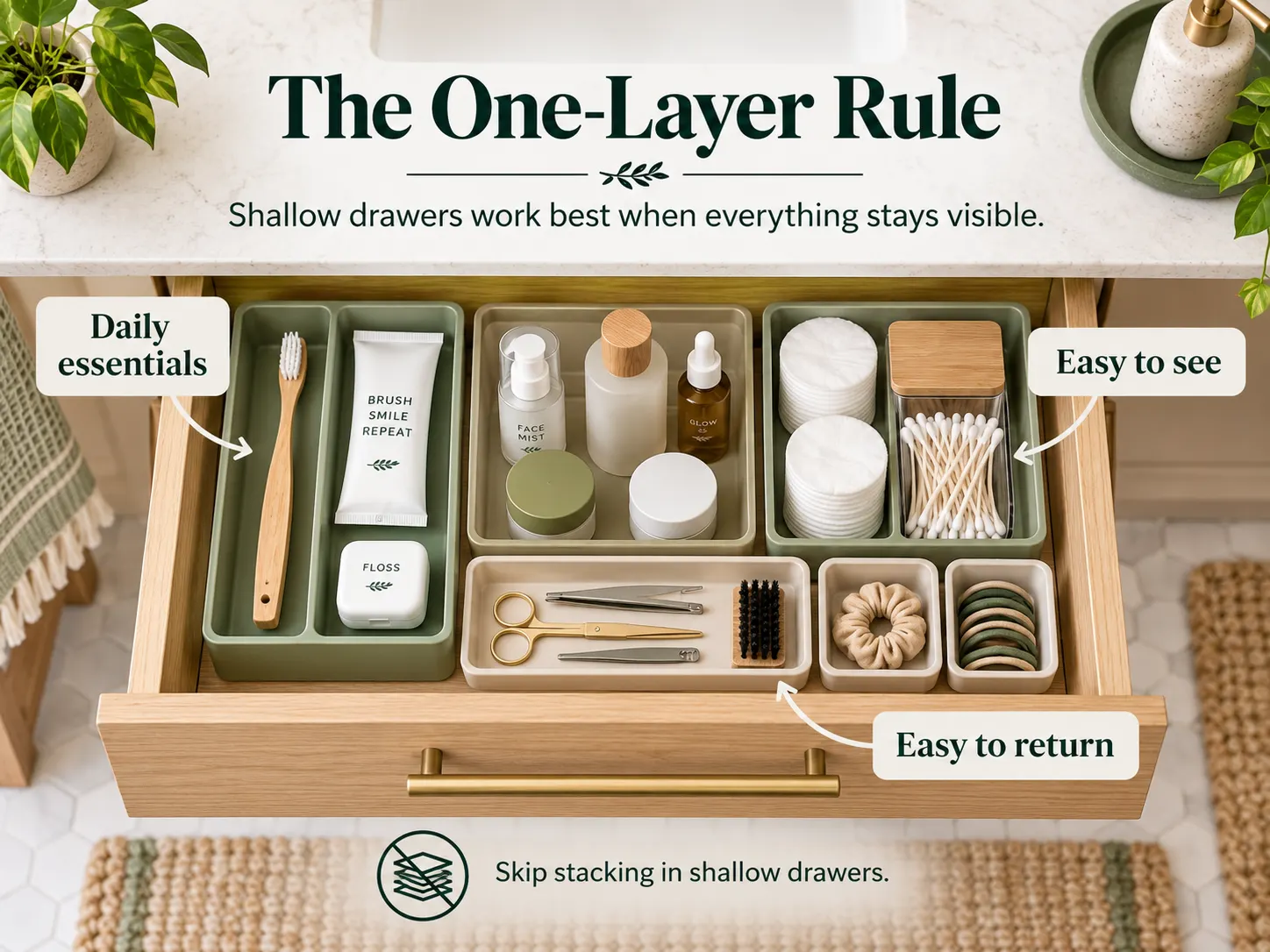
Shallow drawers are most useful when daily items stay visible in one layer. If you have to lift one tray, pile or group of products to reach another, the drawer is storing more than it can serve efficiently.
What works well
Low-profile modular trays, narrow channels and small compartments keep daily products visible without consuming closing height. Long trays work well for combs, files or razors, while one or two small trays can contain tiny accessories.
What usually creates friction
Tall bins, unnecessary stacking and deep containers hide products and make the drawer slower to use. A stacked system may increase theoretical capacity, but it is a poor trade if you have to remove a layer every morning.
Keep the premium space for daily use
Reserve the easiest-access shallow drawer for products you use frequently. Weekly and backup products can move to a secondary drawer, cabinet or another storage zone. Good bathroom drawer organization protects access instead of maximizing how many objects can be packed inside.
Deep Drawers Need a Different Strategy
Deep drawers create the opposite problem: small products can disappear vertically. Use the extra height selectively rather than treating it as permission to build several layers.
For small items, use shallow trays or defined sections so everything remains visible from above. Taller bottles can stand upright only when the drawer has enough closing height, the containers are stable and the product storage directions allow that position. Bulky grooming items usually work better in one larger open zone than in several tiny compartments.
Use depth intentionally; do not automatically fill it with more layers.
Modular Trays vs Adjustable Dividers
Both systems can work well, but they solve different drawer problems. Choose based on the shape of the remaining items after you measure and declutter.

Modular trays
Modular trays are useful for mixed small items because you can rearrange them, remove one section for cleaning and adapt the layout when your routine changes. They are especially useful for clips, dental products, small skincare items and grooming accessories.
The tradeoff is wasted space. Every tray has walls, and several separate trays create repeated gaps. In a very narrow drawer, too many pieces can consume more room than the products themselves.
Adjustable dividers
Dividers make better use of continuous drawer width and are helpful for long or irregular products. They can create channels for combs, brushes, files and razors without forcing those items into a short fixed tray.
They are less effective for tiny loose pieces, which can migrate within a large compartment. A small tray inside one divided zone can solve that without turning the whole drawer into micro-compartments.
Quick decision table
| Situation | Better starting option |
|---|---|
| Small mixed accessories | Modular trays |
| Long combs, files or razors | Long narrow tray or divider channel |
| Irregular product shapes | Adjustable dividers |
| Frequently changing routine | Modular trays |
| Large grooming items | One larger open zone |
Use both when the drawer needs both
A hybrid layout is often the most efficient: one long divided channel for awkward tools, plus a few small trays for loose accessories. The goal is not visual uniformity. The goal is to make each item easy to see, reach and return.
Do Not Buy a Huge Organizer Set Just Because It Has More Pieces
Large multi-piece sets can look like better value, but the useful number is not the number printed on the box. A set is only efficient when its pieces match your measured drawer and the products that need to live there.
Skip oversized kits when half the trays will not fit, when the compartment sizes do not match your routine or when leftover pieces are likely to become clutter elsewhere. Buy the fewest pieces needed to create the drawer map.
Bathroom drawer organization is better when every organizer has a specific job.
Give Tiny Items Tiny Compartments, Not the Whole Drawer
Bobby pins, hair ties, nail clippers, tweezers, floss picks and contact-lens accessories can migrate through a large drawer and disappear under bigger products. Small compartments are useful for these genuinely small items.
Keep micro-storage proportional
Use one or two micro-compartments where they solve a real problem. Do not divide the entire drawer into dozens of tiny cells. Larger products need uninterrupted space, and too many little containers make the layout harder to change.
Use shape to guide placement
Long narrow items belong in long narrow spaces. Small loose items belong in small contained spaces. Matching compartment shape to product shape usually wastes less room than forcing every category into the same tray size.
Keep daily items easiest to see
Frequently used small items should stay near the front or in the easiest-to-scan part of the drawer. Backup accessories can sit farther back if the drawer depth allows it.
Check Cosmetics Before Giving Them Permanent Drawer Space
Before organizing older cosmetics, inspect what is actually worth storing. The U.S. Food and Drug Administration explains that cosmetic shelf life varies by product and can be affected by storage conditions, contamination, air and temperature. Follow the manufacturer’s directions and do not rely on a universal replacement schedule for every product.
Keep containers properly closed and remove products that are empty, no longer used or show changes that the manufacturer identifies as a reason to stop using them. A drawer should not become a long-term holding area for products that are already outside your current routine.
If You Have Multiple Drawers, Rank Them by Access
When a vanity has more than one drawer, use access frequency instead of assigning rigid categories. The easiest drawer should usually hold items you reach for every day. A secondary drawer can hold weekly products, while a larger or deeper drawer can handle bulkier items that physically fit.
Do not force every skincare product into one drawer if the bottles have different shapes or heights. Fit and frequency still come first. If daily products are spilling onto the vanity, use our small bathroom counter organization guide to decide what truly deserves sink-side space.
Keep the Drawer Appropriate for the Item
Medication
A bathroom drawer is not automatically the right place for medicine. Follow the storage conditions on the medication label, especially instructions related to moisture and temperature. Do not move medicine into the vanity merely because a compartment is available.
Hair tools and cords
Hair dryers, straighteners and curling tools can consume an entire shallow drawer. If a bulky tool does not fit comfortably with its cord, choose another storage location rather than forcing the drawer to close around it. For a dedicated storage plan, see our hair tool storage ideas for small bathrooms guide for cooling, cord clearance and organizer fit.
Shared Vanity Drawers: Make Ownership Obvious
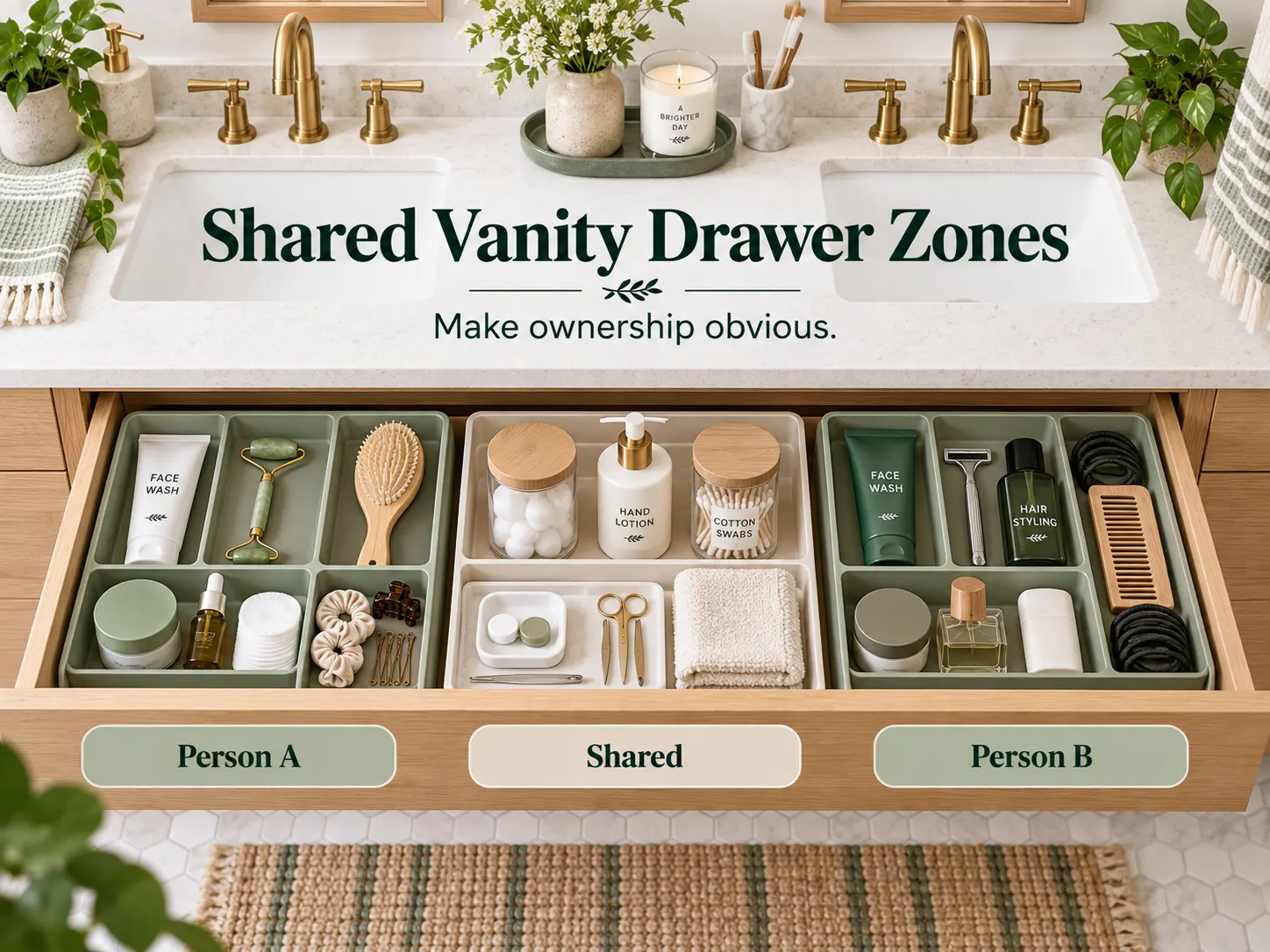
Shared drawers work best when ownership is obvious at a glance. One option is to assign a drawer to each person. If that is not possible, divide one drawer into left and right personal zones and keep only genuinely shared products in a small central area.
A shared drawer becomes confusing when everyone’s products are mixed by category. Clear ownership boundaries make it easier to return items, notice duplicates and keep one person’s routine from expanding into the other person’s space.
Stop Trays From Sliding Only If They Actually Slide
Non-slip liner can help when the drawer bottom is slick and trays shift every time the drawer opens. It is not mandatory. If organizers already have silicone feet, fit closely together or stay stable during normal use, another layer may add material without solving a problem.
Test the finished drawer first. Add grip only where movement actually exists.
Common Bathroom Drawer Organization Mistakes
- Buying organizers before measuring the inside of the drawer.
- Using the outside vanity dimensions instead of usable interior dimensions.
- Forgetting closing height and discovering bottles or trays catch above.
- Stacking daily-use items in a shallow drawer.
- Giving every product its own tiny container.
- Keeping backup inventory beside everyday items.
- Buying a large organizer set because the piece count looks like better value.
- Forcing long tools into short compartments.
- Organizing only by category and ignoring product shape.
- Keeping unused products in the easiest-access drawer.
- Mixing two people’s products without clear ownership zones.
- Adding liner when nothing is sliding.
- Assuming every product is suitable for bathroom storage.
A Simple Drawer Setup Checklist
- Empty the drawer completely.
- Remove items that clearly do not belong.
- Measure interior width.
- Measure interior depth.
- Measure usable closing height.
- Note rails, cutouts and other obstructions.
- Separate daily products from weekly, occasional and backup items.
- Group the remaining items by function.
- Choose the minimum number of trays or dividers needed.
- Load the drawer and test opening, closing and visibility before adding anything else.
Frequently Asked Questions
How do I organize a small bathroom drawer?
Start with the empty drawer. Measure usable width, depth and closing height, then remove items that do not belong. Place daily products first, group them by function only after confirming they physically fit, and use trays or dividers that match the remaining shapes.
What is the best system for bathroom drawer organization?
There is no universal best system. Use Fit, Frequency, Function: make sure the item and organizer fit the drawer, give the easiest access to products used most often, then group the remaining items by routine or function.
Are drawer dividers better than trays?
Neither is always better. Trays are useful for small mixed items and changing layouts. Dividers use continuous space efficiently and work well for long or irregular products. A combination of both often works best.
How do you organize a shallow bathroom drawer?
Use one visible layer of low-profile organizers. Keep daily products easy to see and avoid stacking one group over another. Long narrow trays and small compartments can separate items without consuming too much height.
What should go in bathroom vanity drawers?
Store items that fit the drawer, are appropriate for bathroom conditions and are used often enough to justify the space. Dental care, grooming accessories and daily skincare are common examples, but the right contents depend on the drawer dimensions and your routine.
Should I use clear bathroom drawer organizers?
Clear trays can make contents easier to see, but transparency is not required for good organization. Fit, compartment shape, stability and ease of cleaning matter more than whether the organizer is clear.
How do two people share bathroom drawers?
Give each person an obvious zone or separate drawer where possible. Keep only truly shared products in a shared section. Avoid mixing everyone’s products together solely because they belong to the same category.
Build the Drawer Around What Fits, Not What You Can Buy
Good bathroom drawer organization is not about fitting the maximum number of containers into a vanity. It is about making everyday items visible, accessible and physically compatible with the drawer.
Start with the Fit-First Drawer Map, then use Fit, Frequency, Function to decide what stays. Shallow drawers usually benefit from one visible layer, deep drawers need intentional zones, and trays or dividers should solve the shapes you actually own rather than create a decorative grid.
For more ways to use the rest of a compact bathroom efficiently, return to our small bathroom storage ideas for renters guide.