
Bathroom Organization
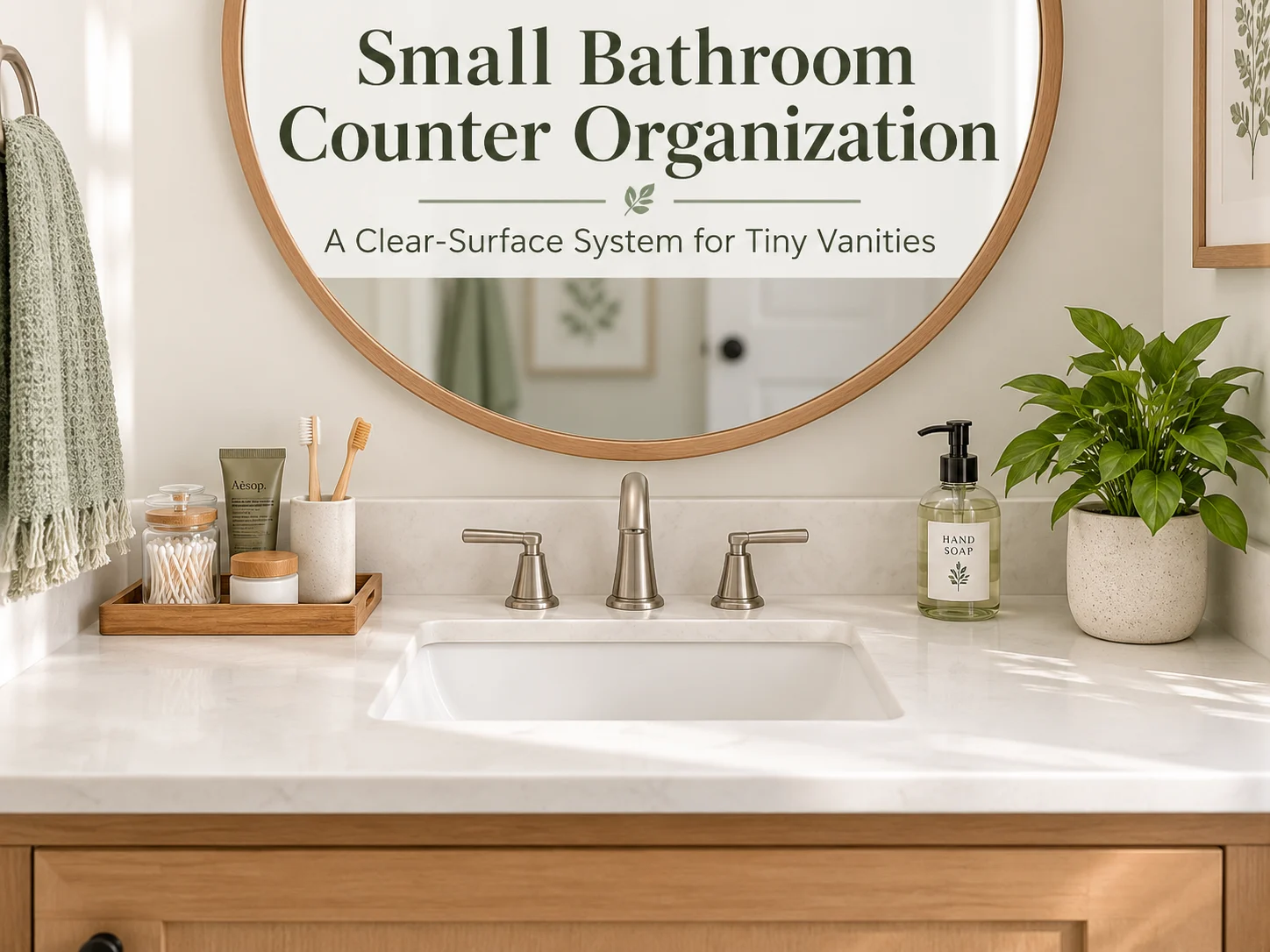
Small Bathroom Counter Organization: A Clear-Surface System for Tiny Vanities
Protect the space you need to use the sink, then give daily essentials one clear home.
Small bathroom counter organization works best when you stop treating every open inch as storage. On a tiny vanity, the counter has to do several jobs at once: support handwashing, toothbrushing, skincare, shaving, makeup, and quick cleanup. If organizers occupy the entire surface, the bathroom may look contained but become harder to use.
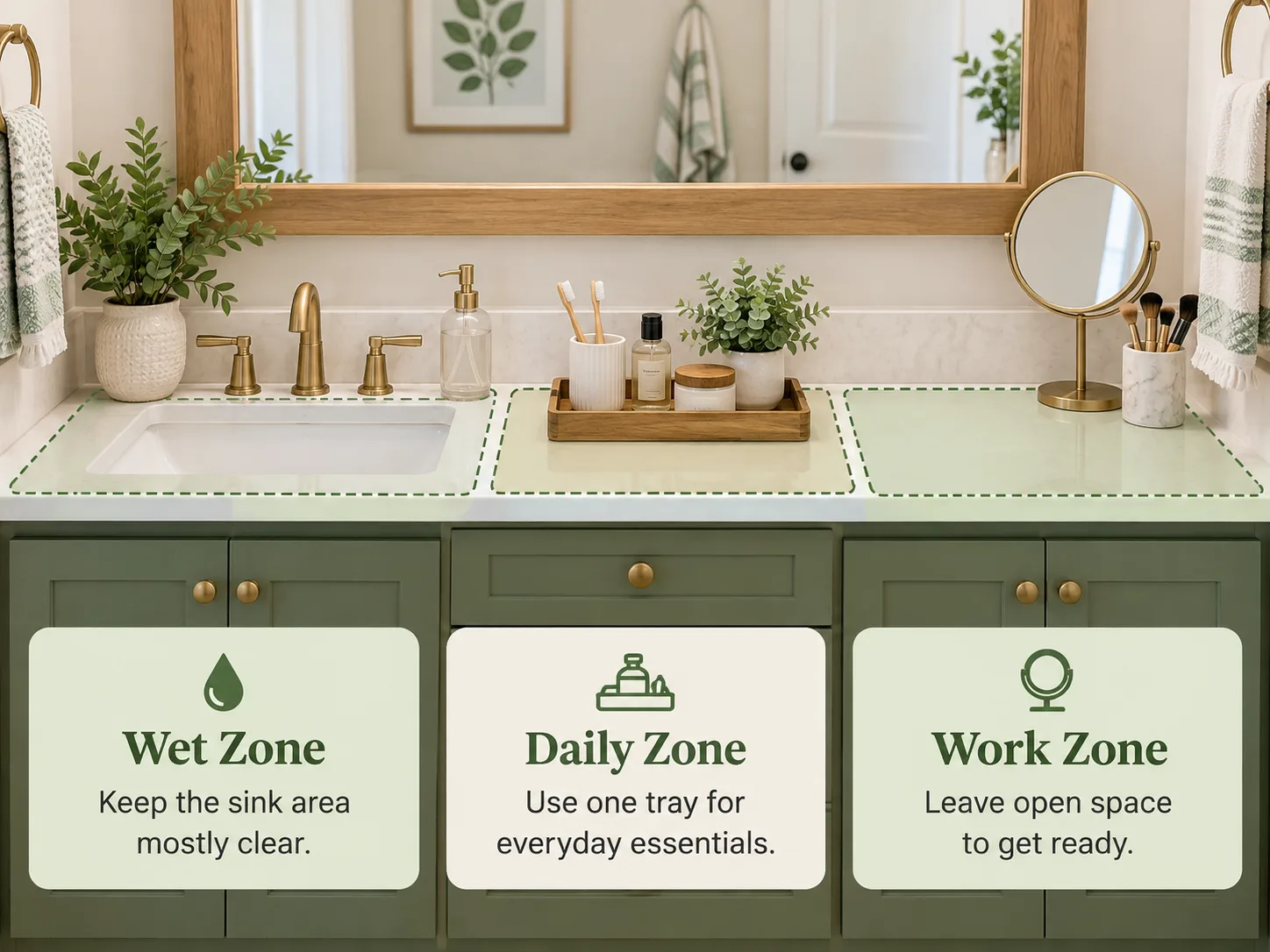
This guide uses a simple Sink-Side Space Budget: protect a Wet Zone around the sink, define one Daily Zone for genuine everyday essentials, and preserve a Work Zone that stays intentionally open. The goal is not to fit more products on the vanity. It is to make the counter calmer, easier to clean, and more useful every day.
If your whole bathroom is short on storage, start with our small bathroom storage ideas for renters guide for the bigger picture.
Start With a Sink-Side Space Budget
Before you buy a tray, riser, turntable, or caddy, decide how much of the vanity should remain usable. Think of the counter as a limited budget that has to fund three different jobs.
Wet Zone: protect the area around the sink
Keep the immediate sink and faucet area mostly clear. This gives you room to wash your hands, reach faucet handles, and wipe away splashes without moving a row of bottles first. A soap dispenser may belong here, but a crowd of skincare bottles usually does not.
Daily Zone: give essentials one boundary
The Daily Zone is one defined tray, caddy, or compact organizer for items that truly earn permanent counter space. The boundary matters more than the container style: when the zone is full, something has to move elsewhere instead of expanding across the vanity.
Work Zone: leave space to actually get ready
The Work Zone is deliberately empty. It is where you temporarily set down glasses, apply skincare, shave, brush your teeth, or use a makeup item. If an organizer removes the space you need to complete those routines, it has solved storage but broken the counter.
Audit Your Morning and Night Routine Before Organizing
A useful vanity reflects what you actually reach for, not what looks good in an organizer photo. For two or three days, notice what touches the counter during your morning and evening routines. Then sort those items by frequency.
Used every day
These are candidates for the Daily Zone: hand soap, toothbrush and toothpaste, contact-lens essentials when appropriate, or a small number of skincare products you genuinely use every day.
Used weekly
Weekly products usually do not deserve permanent counter space. Give them nearby storage in a cabinet, drawer, under-sink bin, or portable caddy so they remain accessible without taking over the vanity.
If your vanity has usable drawers, our bathroom drawer organization guide shows how to map the drawer before choosing trays or dividers.
Used occasionally
Occasional grooming tools, specialty skincare, guest items, and backup toiletries should move farther away from the sink. Our guide on how to organize a small bathroom with no storage explains how to separate daily items from backups when the room has very little capacity.
Backup inventory
Extra bottles, refill packages, bulk cotton products, and duplicate toiletries belong off the counter. A tiny vanity works better when it supports the current routine instead of acting as a stockroom.
What Actually Deserves Counter Space?
There is no universal rule that says a bathroom counter should hold three items, five items, or any other fixed number. The correct amount is whatever fits inside the Daily Zone while preserving the Wet and Work zones.
For many people, that may mean hand soap, toothbrush and toothpaste, and one or two daily skincare products. Someone with a different routine may need a compact caddy instead. The important test is whether every permanent item is used often enough to justify taking up working surface.
What Should Move Off the Bathroom Counter?
Backup products
Move refills and duplicates to a cabinet, closet, or under-sink zone. If you need help fitting products around plumbing, see our under-sink bathroom organization guide.
Medicines
Do not automatically store medication on the bathroom counter or in a humid bathroom cabinet. The U.S. Food and Drug Administration advises following the storage instructions on the medicine label and notes that damp bathroom conditions can be unsuitable for many medicines. Use the specific storage directions for each product rather than treating the vanity as default medicine storage.
Hair tools
Hair dryers, straighteners, and curling tools should not become permanent clutter beside the sink. After use, allow hot tools to cool as directed, unplug electrical appliances when not in use, and move them to an appropriate dry storage location. The U.S. Consumer Product Safety Commission warns about electrical appliances near sinks and tubs, so keeping them out of the wet sink area is the safer layout choice.
CPSC hair-dryer safety guidance
For the next step, see our hair tool storage ideas for small bathrooms guide, which separates safe cooling from permanent storage.

Store Toothbrushes So They Can Air Dry
Toothbrush storage is a small detail that affects how useful a counter organizer really is. The American Dental Association recommends rinsing toothbrushes after use, storing them upright, and allowing them to air dry.
For a small vanity, choose a holder that keeps brushes upright and is easy to lift for cleaning. Avoid bulky containers that consume most of the Daily Zone without improving access.
Choose the Organizer After You Know Your Daily Zone
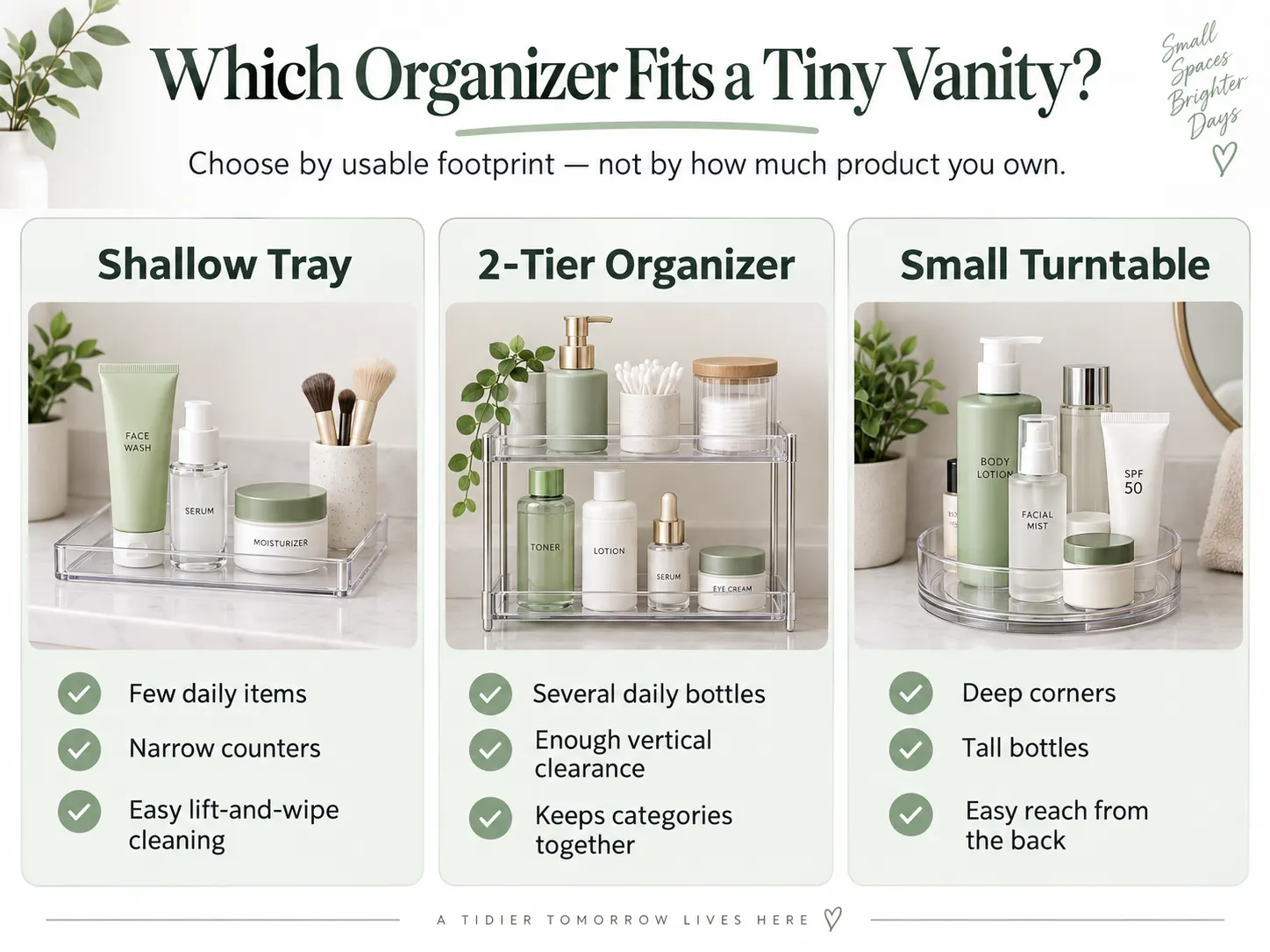
Shallow tray
A shallow rectangular tray works well when the routine is small. It creates one visual boundary, is easy to lift during cleaning, and usually wastes less depth than a bulky organizer.
Compact 2-tier organizer
A two-tier organizer can help when several tall bottles truly need daily access and there is enough vertical clearance. Check the mirror, outlet, medicine-cabinet door, and faucet sightline before buying.
Small turntable
A compact turntable can solve a reach problem in a deep corner where bottles hide behind one another. On a shallow vanity, its round footprint may consume more usable surface than a narrow tray.
Narrow handled caddy
A handled caddy is useful when products need to move on and off the counter, especially in a shared bathroom.
Small Bathroom Counter Organization: Tray vs 2-Tier Organizer vs Turntable
Match the organizer to the shape of the space left after you protect the Wet and Work zones.
| Situation | Best starting choice |
|---|---|
| Very narrow counter | Shallow tray |
| Several tall daily bottles | Compact 2-tier organizer |
| Deep unused corner | Small turntable |
| Need to clear counter quickly | Handled caddy |
| Almost no usable depth | Move storage off-counter |
Small Bathroom Counter Organization: Measure Before Buying
Do not shop from the vanity width printed by the manufacturer. Measure the actual usable surface around the sink.
Usable width beside the sink
Measure only the flat counter area where an organizer can sit without hanging over the edge or touching the basin.
Usable depth
Measure from the front edge to the backsplash, mirror, or wall. On tiny vanities, depth is often the dimension that rules out oversized organizers.
Faucet and handle clearance
Make sure bottles and rails do not interfere with faucet handles or the space your hands need to operate them.
Mirror, outlet, and cabinet clearance
Check whether a taller organizer would block an outlet, overlap the mirror, or interfere with a medicine-cabinet door.
Shared Vanity? Give Each Person a Boundary
Two people can share a small bathroom counter without letting both routines spread across the entire surface. Keep truly shared items such as hand soap in the shared sink area, then give each person one small defined tray or caddy.
If two permanent zones leave no Work Zone, the counter is too small for both routines to live there. Use portable caddies or nearby storage instead of adding more permanent countertop organizers.
Clear boundaries also make duplicates easier to spot. When each person can see the limits of their own zone, it becomes easier to remove half-used extras and products that are no longer part of the routine.

Keep the Counter Easy to Clean
The best countertop system should reduce the number of individual objects you have to move before wiping the vanity. One contained Daily Zone makes that easier: lift one tray or caddy, clean the surface, and return it.
A collection of small jars, decorative containers, and loose bottles may look organized at first but creates more edges to wipe around. On a tiny vanity, fewer containers often produce a cleaner result than a perfectly matched set of many containers.
Common Small Bathroom Counter Organization Mistakes
- Buying organizers before auditing daily-use items.
- Covering every open inch with containers.
- Keeping backup products beside active products.
- Blocking faucet handles or electrical outlets.
- Using tall storage that interferes with the mirror.
- Keeping electrical grooming tools beside the sink.
- Storing medicines without checking label instructions.
- Using bulky closed toothbrush storage while brushes are still damp.
- Buying a turntable for a counter too shallow to use it efficiently.
- Giving decor more space than the daily routine.
- Combining two people’s products into one catchall.
A Simple 5-Minute Counter Reset
- Return every true daily item to the Daily Zone.
- Clear temporary products from the Work Zone.
- Remove empty packaging and finished products.
- Move weekly or occasional products back to storage.
- Wipe the Wet and Work zones before the next routine.
The purpose of the reset is not perfection. It is to restore the boundaries so the counter works the same way tomorrow.
What If Your Vanity Has Almost No Counter Space?
When the vanity offers almost no flat surface, do not force a countertop organizer into the room. Keep only the items that truly need sink-side access, then move the rest to another storage zone.
An under-sink setup can absorb toiletries and backups, while over-the-toilet storage for small bathrooms can create vertical capacity elsewhere in the room. A portable caddy can also work when you need products at the sink only during a routine.
The goal is still the same: preserve enough open surface to use the sink comfortably.
Frequently Asked Questions
How do I organize a small bathroom counter?
Start by protecting three zones: keep the sink area mostly clear as the Wet Zone, give genuine daily essentials one defined Daily Zone, and preserve an open Work Zone for getting ready. Move weekly, occasional, and backup products elsewhere.
What should I keep on a bathroom counter?
Keep only items you use often enough to justify permanent sink-side space. Hand soap, toothbrush and toothpaste, and a small number of daily-care products are common examples, but the exact list should fit inside your Daily Zone.
What is the best organizer for a tiny vanity?
There is no single best organizer. A shallow tray suits a narrow counter with few items, a compact 2-tier organizer can help with several tall bottles, a small turntable can improve access in a deep corner, and a handled caddy is useful when products need to move.
How do I organize a bathroom counter with no drawers?
Use one contained Daily Zone on the counter and move overflow to another location such as under-sink storage, over-the-toilet storage, a medicine cabinet, or a portable caddy. Do not compensate for missing drawers by covering the entire counter with tiered organizers.
Should medicine be stored in a bathroom?
Follow the storage instructions for the specific medicine. The FDA notes that damp bathroom conditions can be unsuitable for many medications, so the bathroom counter should not be treated as default medicine storage.
Should toothbrushes be covered?
The ADA recommends storing toothbrushes upright and allowing them to air dry. A ventilated holder is usually a better default than sealing a damp toothbrush inside a closed container.
How do two people share a small bathroom counter?
Give each person one defined tray or portable caddy and keep only truly shared items in the common sink area. If two personal zones eliminate all usable work space, move one or both routines off the counter.
Protect the Counter Before You Add More Storage
Good small bathroom counter organization is not about fitting the most products onto a tiny vanity. It is about protecting enough clear surface to make the sink easier to use every day.
Start with the Sink-Side Space Budget: keep the Wet Zone functional, give daily essentials one defined boundary, and leave the Work Zone open. Then measure the usable counter area and choose an organizer only if it improves access without stealing that working space.
When the counter cannot comfortably hold the routine, move storage rather than forcing more onto the vanity. That might mean under-sink bins, over-the-toilet storage, or a portable caddy. For broader solutions throughout the room, continue with our small bathroom storage ideas for renters guide.