
Over the Door Closet Storage Ideas for Renters: A Door-Budget Plan
Over the door closet storage ideas can be useful in a rental, but the back of a closet door is not truly “free space.” Every organizer uses part of the door’s operating budget: top clearance, loaded depth, swing space, hardware clearance, and supported load. If any one of those fails, the door may rub, stop latching, hit furniture, or become annoying to use.
This guide uses a Door-Budget Plan instead of treating every door as an empty wall. Measure the door first, test the organizer empty, load it with the deepest realistic items, then use the door normally for a week before deciding that the setup works.
Quick answer: hinged closet doors are usually the best candidates for removable over-door storage. Bifold and sliding doors need much more caution. Keep the load lightweight, verify the manufacturer’s fit and weight limits, and stop if the door starts rubbing, sagging, rattling excessively, or requiring extra force to latch.
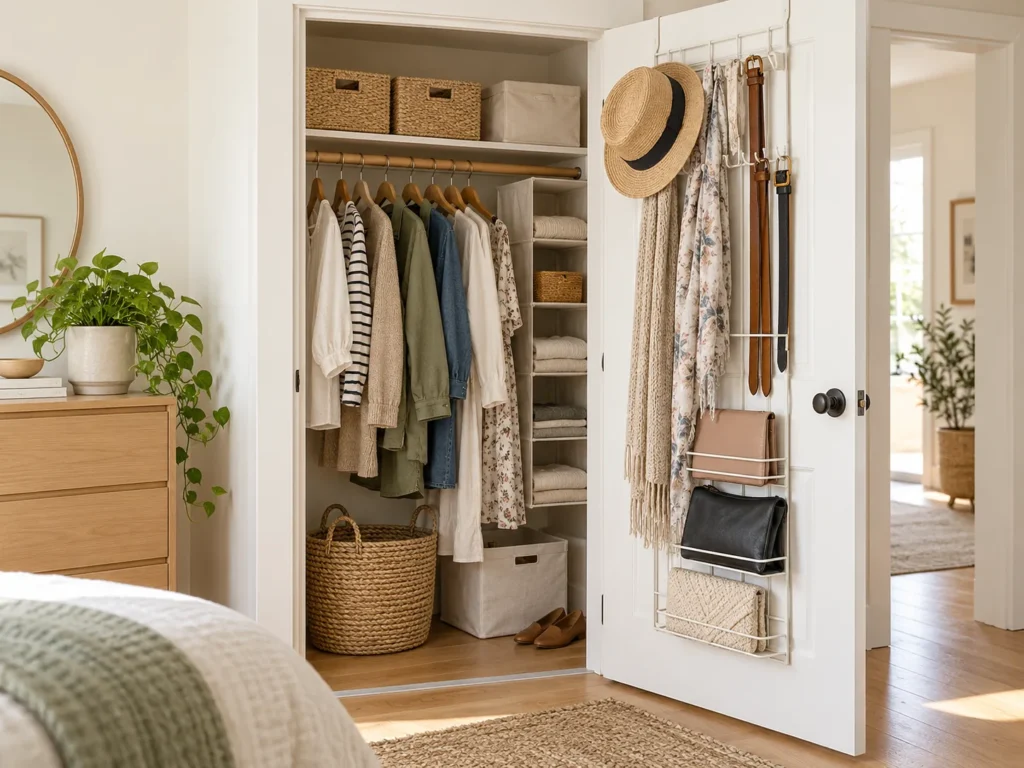
Why Over the Door Closet Storage Ideas Need a Door Budget
The best over the door closet storage ideas begin with one rule: the door must continue to work like a door. Storage is secondary. A system that adds pockets or hooks but makes closing, latching, or opening harder has not created useful storage.
The door still has a primary job
A closet door needs clearance at the top, sides, handle, hinges, and latch. An organizer can fit the panel itself yet still interfere with trim or hardware. That is why door thickness alone is not enough to determine compatibility.
Empty depth is not loaded depth
A fabric pocket organizer may look almost flat when empty. Once it holds shoes, bags, rolled accessories, or folded clothing, the contents can project several inches into the closet or room. If you plan to use the door for purses, our handbag storage guide explains how handles, straps, hardware, and bag depth change the real storage envelope. Measure the loaded shape, not just the empty product.
Door motion multiplies small fit problems
When a hinged door swings, anything attached to it sweeps through an arc. A small basket that clears the closet when closed can still hit a bed, dresser, wall, or another door halfway through the swing. Movement has to be tested through the entire opening path.
Renter-friendly does not mean risk-free
“No drill” simply describes the installation method. Over-door brackets can rub trim, adhesive hooks depend on surface condition and correct removal, and heavy loads can stress door hardware. For a broader renter-first system, see our small closet organization ideas for renters.
Start With the Five-Part Door-Budget Plan
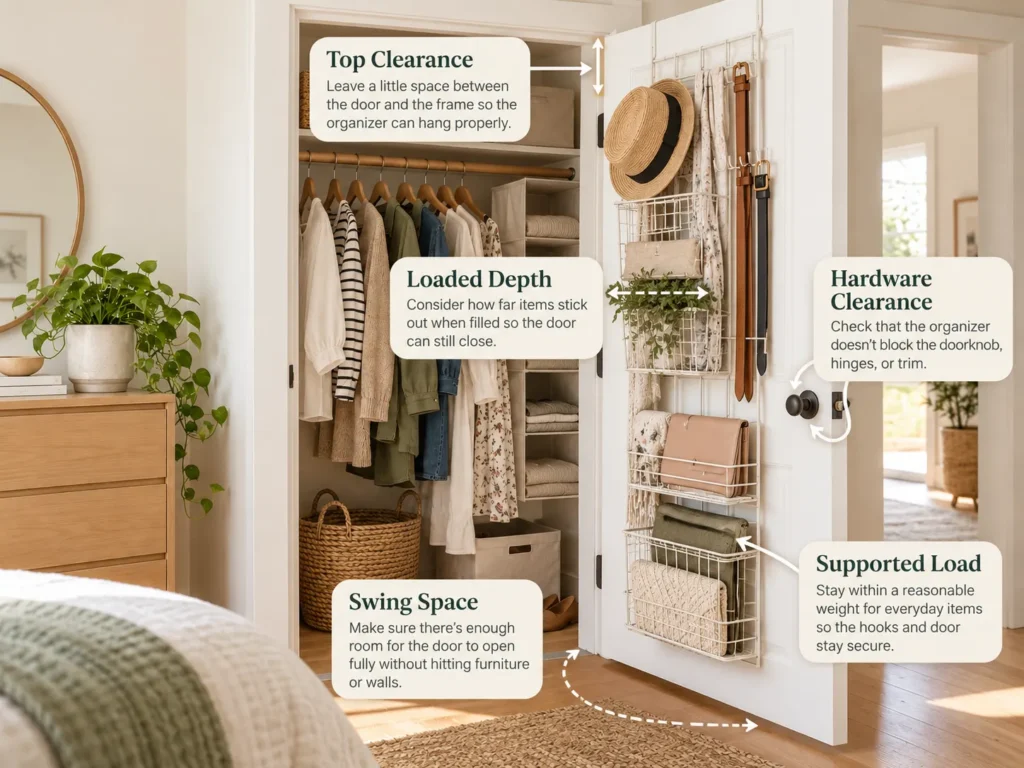
The Door-Budget Plan checks five resources before you buy: top clearance, loaded depth, swing space, hardware clearance, and supported load. These are the limits that determine whether over the door closet storage ideas will actually work on your door rather than merely look possible in a product photo.
Budget 1: top clearance
Top clearance is the gap between the top of the door and the frame when the door closes. Over-door brackets have their own thickness, and doors vary. Measure the gap at more than one point because older doors can sit slightly uneven in the frame. Do not assume a bracket that fits one door will fit another.
Budget 2: loaded depth
Loaded depth is the distance the organizer and its contents project away from the door. Use the deepest item you realistically plan to store, then add the organizer itself. If the loaded depth touches hanging clothes, shelf fronts, a wall, or nearby furniture, reduce the load or choose a shallower system.
Finish the Door Budget Before Choosing an Organizer
After top clearance and loaded depth, check the remaining three limits. A good fit is not just “the hooks go over the top.” The full door system has to remain comfortable to operate.
Budget 3: swing space
Swing space is the clear area the loaded organizer passes through as the door opens. Move the door from fully closed to fully open and note nearby furniture, wall corners, light switches, hampers, and another door. The deepest part of the load needs to clear that entire arc.
Budget 4: hardware clearance
Hardware clearance includes hinges, latch, handle, lock, door stop, trim, and any folding or sliding mechanism. The organizer should not force the door to sit at an angle or prevent the latch from engaging normally.
Budget 5: supported load
Supported load comes from the product instructions, not a generic rule. For example, Umbra lists door-thickness compatibility and per-hook weight limits for its Estique organizer rather than treating all doors and loads alike. Umbra’s official Estique specifications are a useful example of why you should check the exact model before loading it.
Measure the Door Before You Buy
Before choosing over the door closet storage ideas, write down the door thickness, top gap, usable panel width, handle position, and the open space on both sides of the door. Then measure the closet interior where the loaded organizer will sit when the door is closed.
Measure door thickness and top gap
Measure door thickness at the top edge, not just the side trim. Then close the door and inspect the top gap. A bracket needs to pass through that gap without forcing the door down or scraping the frame. If the door already rubs before you add anything, fix the door issue first rather than using storage to make it worse.
Measure the loaded depth you can spare
Close the door and measure from the inner face of the door to the nearest hanging garments, shelf, wall, or fixed organizer. That distance is your available loaded-depth budget. Leave a practical buffer rather than filling the gap exactly; clothes and bags move as the door opens and closes.
Map the full swing path
Open the door slowly through its entire arc. If the edge passes close to a bed, dresser, laundry hamper, or wall, measure that clearance too. A door organizer that clears when closed may still collide halfway through the swing.
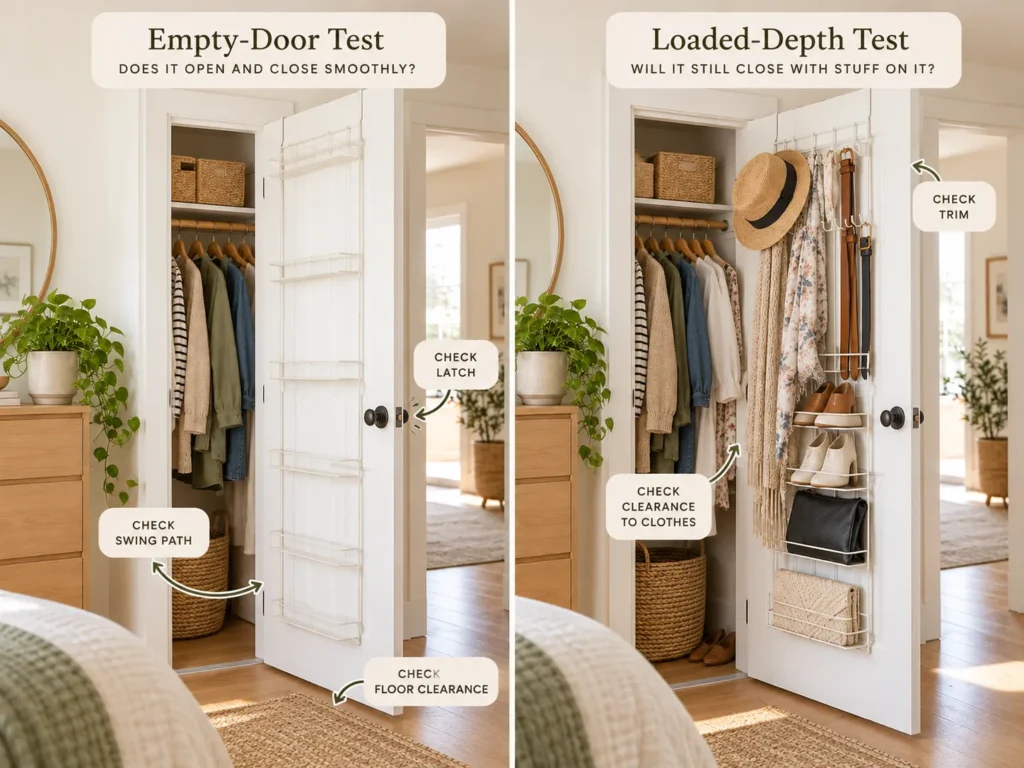
Run the Empty-Door Test First
The Empty-Door Test catches basic fit problems before the organizer is loaded. Install the brackets, hooks, or rack according to the manufacturer’s instructions and leave every pocket, basket, and hook empty.
Install exactly as directed
Do not improvise with extra padding, bent hooks, or reversed hardware unless the manufacturer explicitly allows it. Small changes can affect how the bracket bears on the door and whether the door clears the frame.
Close, latch, and reopen the door
Close the door normally, latch it, reopen it fully, and repeat several times. Listen for scraping and feel whether more force is required than before. Check the top edge, trim, handle, hinges, and latch. If the door does not operate normally while the organizer is empty, stop there.
Run the Loaded-Depth Test
The Loaded-Depth Test is where many apparently good systems fail. Fill the organizer with the actual category you intend to store rather than the smallest items that happen to fit.
Load the deepest realistic items
If you plan to store compact shoes, test the bulkiest pair. If you plan to store bags, use the thickest regular bag. If you plan to store scarves or accessories, fill several pockets to a realistic level. Then close the door slowly and check for contact with hanging clothes, shelves, wall hooks, or another organizer.
Check both sides of the door
Check the room side too. A hook rail holding handbags can project toward a wall or dresser as the door opens. The door should travel from closed to fully open without pushing furniture, crushing stored items, or forcing you to guide the organizer by hand.
Use the Seven-Day Door Test
A one-minute fit test cannot show how the setup behaves through a week of normal use. After installing one of your chosen over the door closet storage ideas, use the door normally for seven days before adding more weight or buying a second organizer.
Watch for rubbing and new resistance
Check whether the latch feels harder, the top edge develops a rub mark, the hinge side begins to scrape, or the door no longer stays in the same open position. Those are signs that the system may be changing how the door sits or moves.
Watch for movement, sagging, and rattling
Watch the organizer itself. Brackets that slide sideways, pockets that sag forward, baskets that bounce, or hooks that rattle can create repeated friction against paint and trim. A small fit problem repeated dozens of times a day can become a visible mark.
Adjust before the problem becomes damage
If something changes, reduce the load or remove the organizer and reassess. Do not “wait for the door to settle.” Storage should adapt to the door, not the other way around.
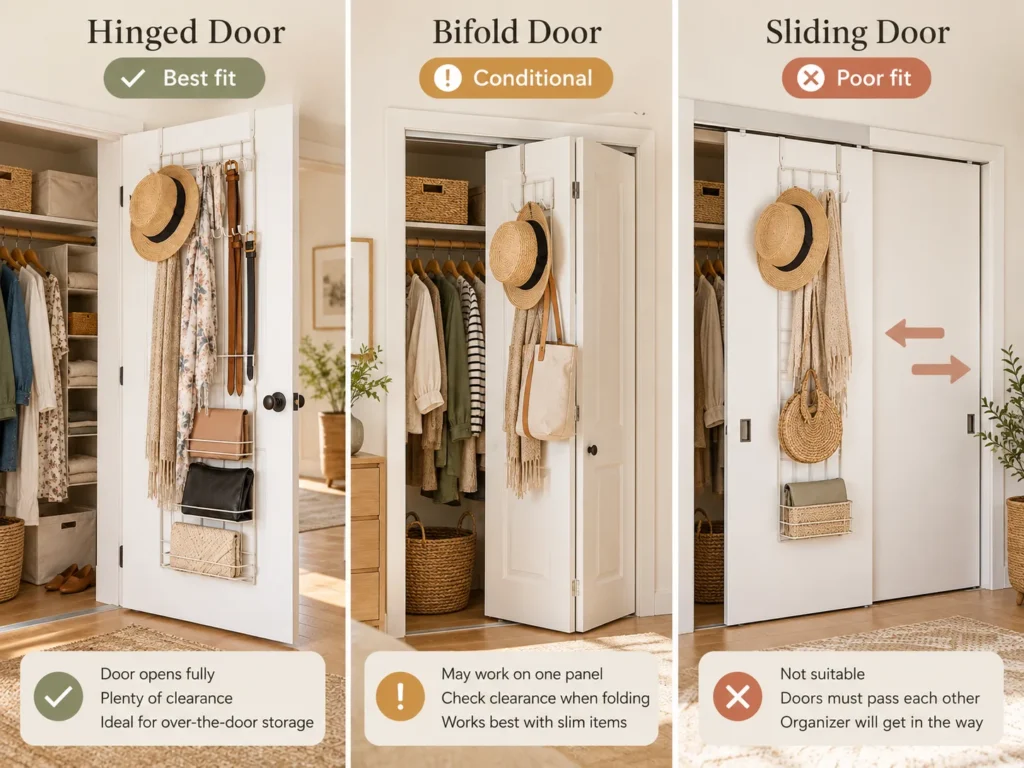
Best Over the Door Closet Storage Ideas by Door Type
The best over the door closet storage ideas depend heavily on door type. A standard hinged door offers the most predictable mounting surface, while bifold and sliding doors introduce moving-panel constraints that can make conventional over-door hardware impractical.
Hinged closet doors
Hinged doors: usually the strongest candidate for pockets, shallow hook rails, lightweight baskets, or accessory organizers. Measure the top gap and confirm the loaded organizer clears the closet interior when the door closes. Keep the room-side swing path open.
Bifold closet doors
Bifold doors: treat as conditional. The panels fold toward one another or toward the sides, so added thickness can interfere with folding. Brackets can also sit near hinges or panel joints. Test the full fold empty before loading anything.
Sliding or bypass closet doors
Sliding or bypass doors: are generally poor candidates for standard over-door organizers because the panels need to pass one another. Added rear depth can stop the panels from sliding. For this door type, use the access-planning methods in our small reach-in closet organization guide instead of forcing conventional door storage.
Choose the Organizer Type by What You Store
Organizer type should follow the stored category. A door covered with empty pockets is not useful just because it has high advertised capacity. Choose the smallest format that gives one clear home to the items that currently create clutter.
Fabric pocket organizers
Fabric pockets work well for lightweight accessories, small folded items, gloves, hats, clutches, and some compact shoes. The main risk is bulging: soft pockets can become much deeper when full. If footwear is the main goal, our small closet shoe storage ideas guide explains how to measure actual shoe width, depth, and height instead of relying on pair-capacity claims.
Hook rails and accessory racks
Hook rails and accessory racks suit scarves, belts, hats, light bags, and frequently used accessories. Keep items short enough that they do not catch the floor, handle, or furniture during the swing. Spread the load rather than crowding every hook simply because it is available.
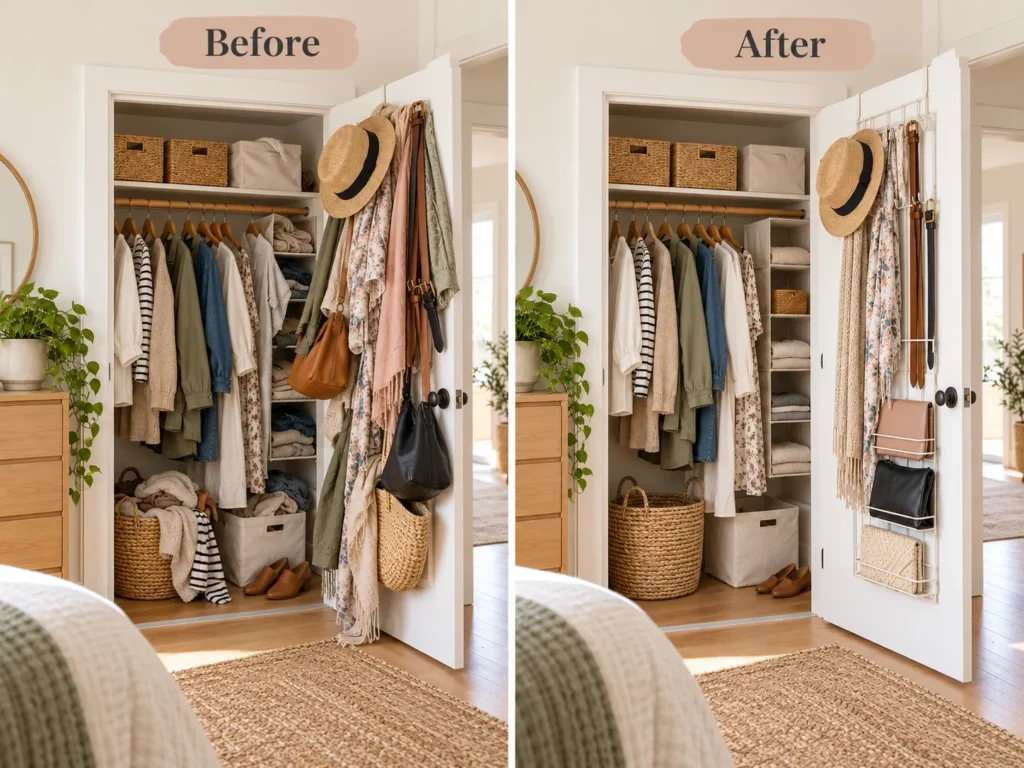
Keep the Door for Lightweight, High-Frequency Items
The door is strongest as a quick-access accessory zone, not as a replacement for a closet shelving system. Choose light categories that benefit from visibility and frequent access.
Good door-storage categories
Good candidates include scarves, belts, hats, gloves, light tote bags, clutches, small purses, soft accessories, and compact folded items. Some flats, slippers, or low-profile sneakers can work when the pocket dimensions and loaded depth fit the door.
Items that are usually better somewhere else
Heavy handbags, dense shoe collections, boots, glass containers, large bottles, bulky bins, and valuable breakables are usually better on stable shelves or floor storage. The door moves every time you use the closet, so anything heavy or fragile experiences repeated motion.
Use visibility as a benefit
Door storage is especially useful for items that disappear in drawers. A visible scarf, belt, or frequently used bag can reduce the need for extra bins elsewhere. Use the door to improve retrieval, not merely to increase capacity.
Reduce Rattling, Scuffing, and Paint Risk
Repeated contact is what often turns a small fit issue into visible wear. After loading the organizer, inspect every place metal, plastic, fabric edging, or stored items can touch the door or trim.
Check contact points
If the manufacturer provides protective pads or bumpers, use them as directed. Do not add thick homemade padding under an over-door bracket if it changes the fit or prevents normal closure. Keep buckles, metal bag hardware, and shoe soles from swinging directly against painted surfaces.
Treat adhesive storage as surface-specific
Adhesive hooks are a separate storage method from true over-door brackets, but renters often compare the two. Treat adhesives as surface-specific rather than automatically damage-free. Command’s official FAQ says its products work best on smooth, clean surfaces and notes that weak, old, uncured, or damaged paint can pull away, especially when removal is done incorrectly. Check your lease, the surface, and the exact product instructions.
Compare Over the Door Closet Storage Ideas by Space Cost
Different over the door closet storage ideas spend different parts of the Door Budget. Use the comparison below to match the format to the constraint you can actually spare.
| Storage type | Main space cost | Best for | Common failure |
|---|---|---|---|
| Fabric pockets | Loaded depth + top gap | Accessories, compact footwear | Bulging or sagging |
| Hook rail | Top gap + swing load | Scarves, hats, light bags | Rubbing trim or rattling |
| Shallow basket rack | Loaded depth + swing | Structured lightweight items | Door collision |
| Adhesive hooks | Surface condition | Very light accessories | Adhesive or paint failure |
| Screw-mounted door rack | Door structure + permission | Higher-capacity storage | Not renter-friendly without approval |
Pocket organizer vs hook rail
A fabric organizer spreads many small items over a large door area but can become deep when filled. A hook rail stays visually simple but concentrates weight on fewer contact points. Choose based on what you need to store, not which option advertises the most slots.
Over-door hardware vs adhesive hooks
Over-door brackets avoid adhesive contact with the door face but depend on top clearance and can rub trim. Adhesive hooks avoid top brackets but depend on the surface and removal method. Neither method is universally safer in every rental.
Three Example Door Setups
Setup A: hinged bedroom closet door. Use one shallow hook rail for a few light bags, two scarves, and a hat. Keep the lower half of the door mostly empty so nothing hits the bed during the swing. This is a good example of using less capacity to preserve smooth operation.
Setup B: hinged door with a deep closet behind it. Use a fabric pocket organizer for gloves, belts, clutches, and compact accessories. Run the Loaded-Depth Test to make sure filled pockets do not press into hanging clothes when the door closes.
Setup C: bifold closet door. Skip the full-height organizer unless the specific hardware and panel movement allow it. A small removable accessory solution on a stationary wall or inside the closet may be more reliable. The best over the door closet storage ideas sometimes include deciding that a particular door should stay storage-free.
In all three examples, the decision comes from door behavior first and capacity second.
Avoid These Common Closet-Door Storage Mistakes
The most common mistake is assuming the back of the door is empty space with no tradeoffs. Avoid these failures:
- Buying by door width alone: top gap, thickness, trim, and hardware can still prevent a fit.
- Testing the organizer empty only: loaded pockets can double the practical depth.
- Filling every hook: available hooks are not a requirement to add more weight.
- Ignoring the swing arc: a door can clear when closed and still hit furniture while opening.
- Using over-door shoe pockets for bulky footwear: measure the actual shoe dimensions first.
- Adding homemade padding under brackets: extra thickness can worsen top clearance.
- Assuming no-drill means damage-free: rubbing, weak paint, and incorrect adhesive removal can still leave marks.
If you are comparing over the door closet storage ideas, reject any option that makes the door harder to operate. Door function is part of the storage system.
Use This Pre-Buy Door-Storage Checklist
Before buying any over the door closet storage ideas, run through this checklist:
- Identify the door type: hinged, bifold, sliding, or pocket.
- Measure door thickness.
- Measure the smallest top gap with the door closed.
- Measure available loaded depth behind the door.
- Open the door fully and map the swing path.
- Check handles, hinges, latch, trim, and door stop.
- Compare your measurements with the exact product specifications.
- Install the organizer empty and run the Empty-Door Test.
- Load the deepest realistic items and run the Loaded-Depth Test.
- Follow the stated weight limits and installation instructions.
- Check the lease before adhesives, screws, or permanent modifications.
- Use the door normally for seven days before increasing the load.
- Stop if you notice rubbing, harder latching, sagging, or repeated contact.
Small Space Scout rule: door storage only counts as usable storage when the door still closes, latches, opens, and moves normally after the organizer is loaded.
Frequently Asked Questions
Are over the door closet storage ideas good for renters?
They can be renter-friendly when the organizer fits the door, follows the manufacturer’s instructions, and does not require prohibited modifications. Test the door empty and loaded, and check the lease before using adhesives or screws.
How do I know if an over-door organizer will fit?
Measure door thickness, top clearance, available loaded depth, full swing space, and hardware clearance. Then compare those measurements with the exact product specifications rather than relying on a generic “standard door” claim.
What should I store on the back of a closet door?
Light, frequently used accessories are usually the best fit: scarves, belts, hats, gloves, clutches, light bags, and compact soft items. Keep heavy, fragile, or bulky items on more stable storage.
Can over-door organizers damage a door?
They can cause rubbing, scuffing, or fit problems when brackets move or loaded items contact the door and trim. A correct fit, appropriate load, and regular checks reduce the risk, but no organizer should be described as universally damage-proof.
Can I use an over-door organizer on a bifold door?
Sometimes, but bifold doors are more complicated because the panels must fold and stack. Test the full folding motion with the organizer empty and loaded. If it interferes with the fold, use another storage location.
What about sliding closet doors?
Standard over-door storage is usually a poor match for sliding or bypass doors because the panels need to pass one another. Use wall, floor, shelf, or rod-based storage instead.
Are adhesive hooks better than over-door brackets?
Neither is automatically better. Over-door brackets spend top clearance and can rub trim; adhesive hooks depend on surface condition and removal technique. Choose the method whose constraints fit your actual rental.
Spend the Door Budget Carefully
The strongest over the door closet storage ideas treat the door as moving hardware first and storage space second. Measure the top gap, loaded depth, swing path, hardware clearance, and supported load before deciding how much storage the door can handle.
Use light, high-frequency items, test the organizer empty, test it again under realistic load, and watch how the door behaves through a normal week. If the system changes how the door closes or moves, reduce the load or choose another zone.
For a complete renter-friendly closet plan, return to our small closet organization guide. For sliding or narrow reach-in doors, see our reach-in closet organization guide. For door-based footwear specifically, use our small closet shoe storage guide. You can also browse the full Closet Organization collection.