
How to Store Handbags in a Small Closet: A Bag-Envelope Plan
If you are deciding how to store handbags in a small closet, do not measure only the body of the bag. A handbag needs a complete storage envelope: body width, resting depth, resting height, handle or strap clearance, hardware clearance, and enough room to remove and return it without scraping or crushing its neighbors.
This guide uses a Bag-Envelope Plan. Frequently used bags get low-friction slots at easy reach; structured bags receive stable support; straps and hardware stay contained; occasional bags move to secondary storage; and every slot is tested for real retrieval rather than visual neatness alone.
Quick answer: measure each bag in its natural resting shape, give structured bags enough support to stay upright without being squeezed, keep active bags in easy-reach shelf or cubby slots, store straps so they do not tangle or bear unnecessary weight, and leave enough lift-out clearance to remove one bag without moving the others.
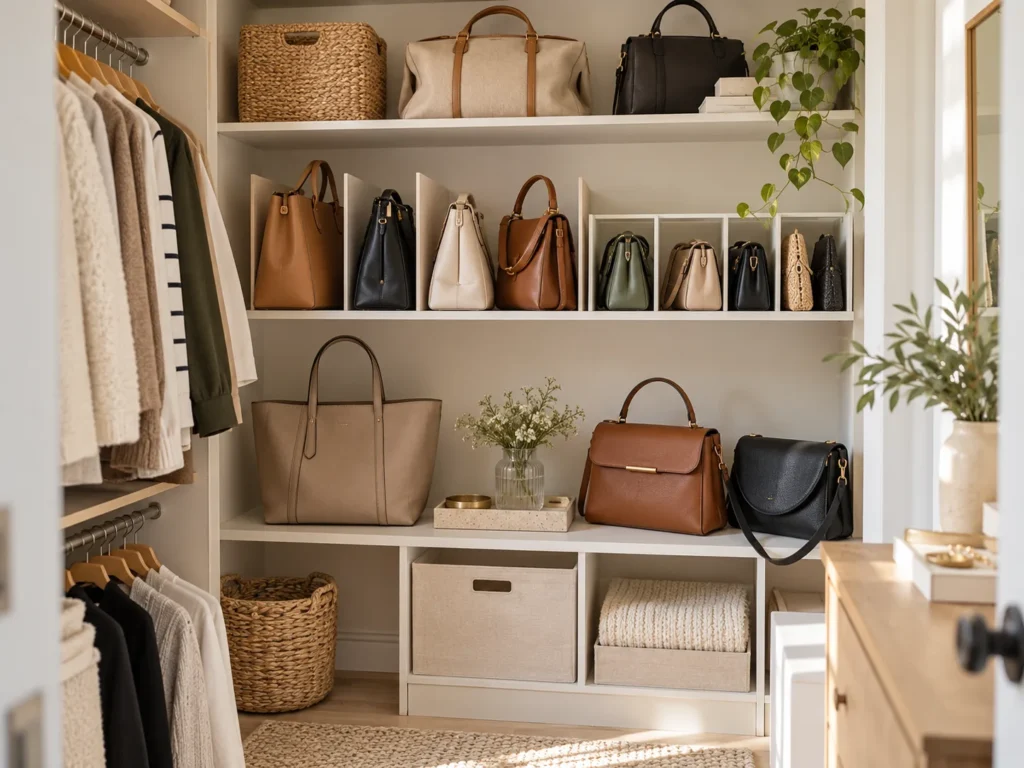
Why Handbag Storage Fails in Small Closets
Many purse-storage systems count how many bags fit on a shelf but ignore how those bags behave in use. Handbags have irregular shapes, changing contents, flexible handles, metal hardware, and different support needs. A row can look efficient while being frustrating every morning.
A bag occupies more space than its body
A structured tote may be 12 inches wide, but the usable slot can require more than 12 inches once side curvature, handles, neighboring hardware, and hand clearance are considered. A bag that technically fits but must be squeezed into place has not been given its real storage envelope.
Handles and straps create hidden clearance needs
Long straps can fall behind neighboring bags, chains can rest against another surface, and handles can fold awkwardly when overhead clearance is too tight. These parts are not decorative extras; they affect how easily the bag enters and leaves storage.
Crowded bags damage access before they save space
Crowding is usually noticed first as retrieval friction. If you have to tip one bag, push another aside, or drag hardware past a neighboring surface, the shelf is already beyond its practical capacity even if every bag still fits.
The active bag needs a faster return path
The bag you use most often needs a particularly simple return path. If the everyday tote has to be restuffed, rewrapped, and moved behind three occasion bags every evening, it will eventually live on a chair or floor instead. For the broader renter-friendly closet framework, see our small closet organization ideas for renters.
Start With the Bag-Envelope Plan
The Bag-Envelope Plan defines the smallest practical slot that lets a bag keep an appropriate resting shape and move in and out without disturbing its neighbors. That slot is the bag’s storage envelope.
Measure the bag at rest
Measure the bag while it is resting naturally, not while it is compressed in your hands. Record body width, depth, and height, then note handles, rigid top frames, shoulder straps, chains, tassels, or other parts that change the footprint.
Add retrieval clearance around the bag
Then add the space needed to grip and lift the bag. A slot that matches the exact exterior dimensions may still fail if your fingers cannot reach the handle or if the bag must be angled sharply to clear the shelf above. Retrieval clearance is part of the envelope, not wasted space.
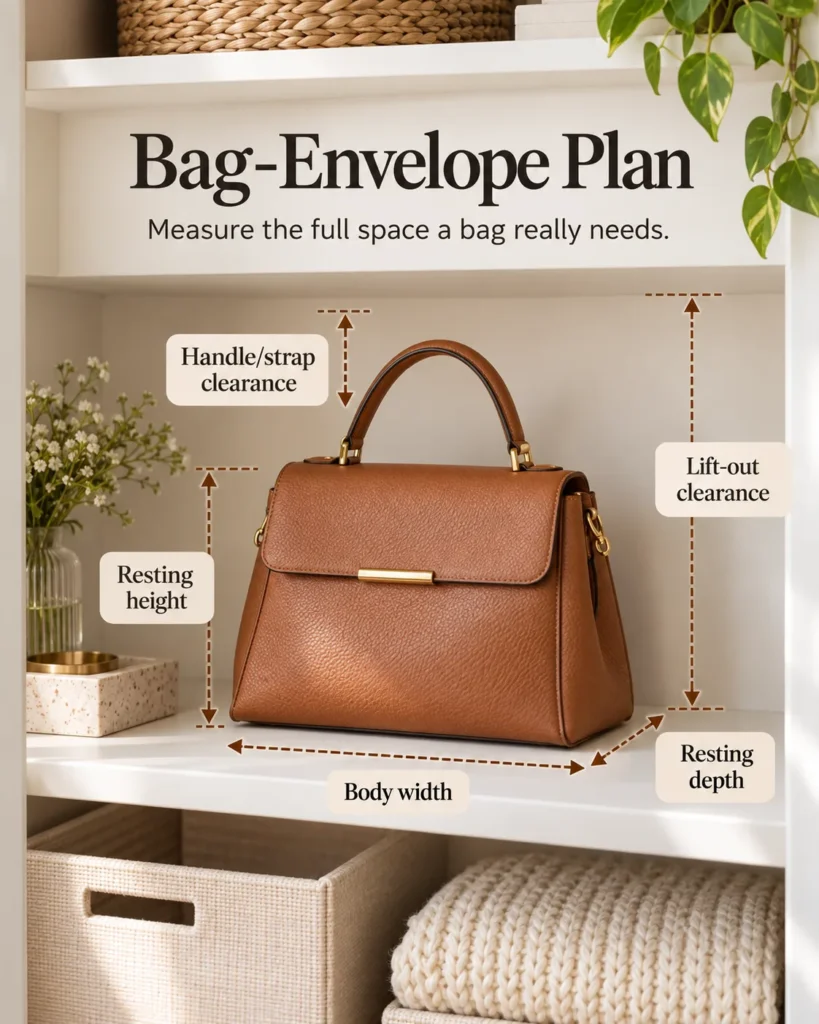
How to Store Handbags in a Small Closet: Measure the Full Envelope
A reliable method for how to store handbags in a small closet starts with measurements that describe use, not just product dimensions. Write down the width, depth, height, handle or strap behavior, and the path the bag must travel when you remove it.
Measure body width and resting depth
Body width and resting depth: measure the bag where it naturally contacts the shelf. Soft sides may spread when the bag is full, while structured sides may need a little room so neighboring bags do not press them inward.
Measure body height plus handle clearance
Body height plus handle clearance: measure to the top of the bag body, then note how the handles prefer to sit. If handles remain upright, the shelf opening must accommodate them. If the construction allows them to rest down without distortion, account for where they will lie.
Check the lift-out path
Lift-out path: pretend the slot is already surrounded by other bags. Can you grasp the bag and move it forward or upward without striking the shelf above or dragging against the bag beside it? In a reach-in closet, wall returns and sliding-door openings can also limit that path; our small reach-in closet organization guide explains those access constraints.
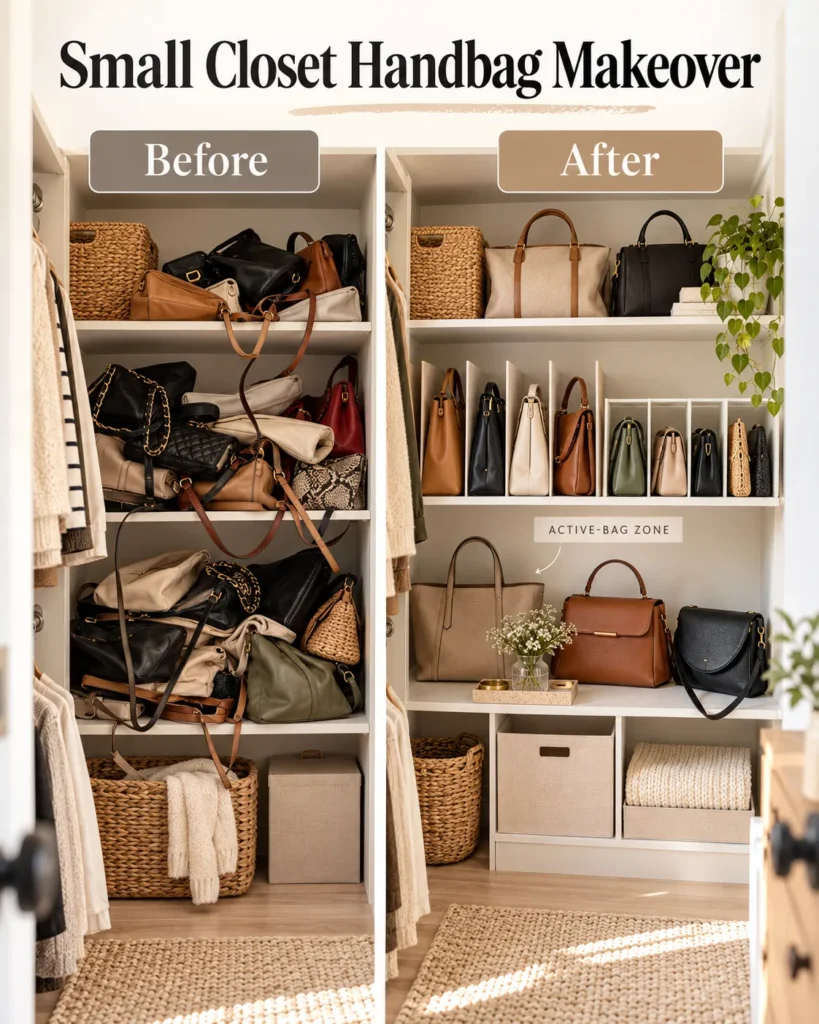
Create an Active-Bag Zone for Everyday Use
Your most-used handbag deserves the lowest-friction slot. Place it between roughly waist and shoulder height when possible, or in another easy-reach location where you can pick it up and return it without rearranging the shelf. When planning how to store handbags in a small closet, treat this active slot as working space rather than dead space: a little extra clearance here can prevent the daily bag from migrating to a chair, bed, or floor.
Keep the daily bag at one-move access
The active bag should usually require one normal movement: lift or slide it out, then return it to the same place. If it is regularly filled with wallet, keys, charger, or work items, measure the bag in that realistic loaded shape rather than when empty.
Give the active slot a little more working clearance
Give the active slot slightly more working clearance than occasional bags because it moves more often. Keep the zone dedicated. Receipts, scarves, shopping bags, and unrelated accessories should not gradually occupy the space that makes the everyday bag easy to return.
Do not turn the active zone into general overflow
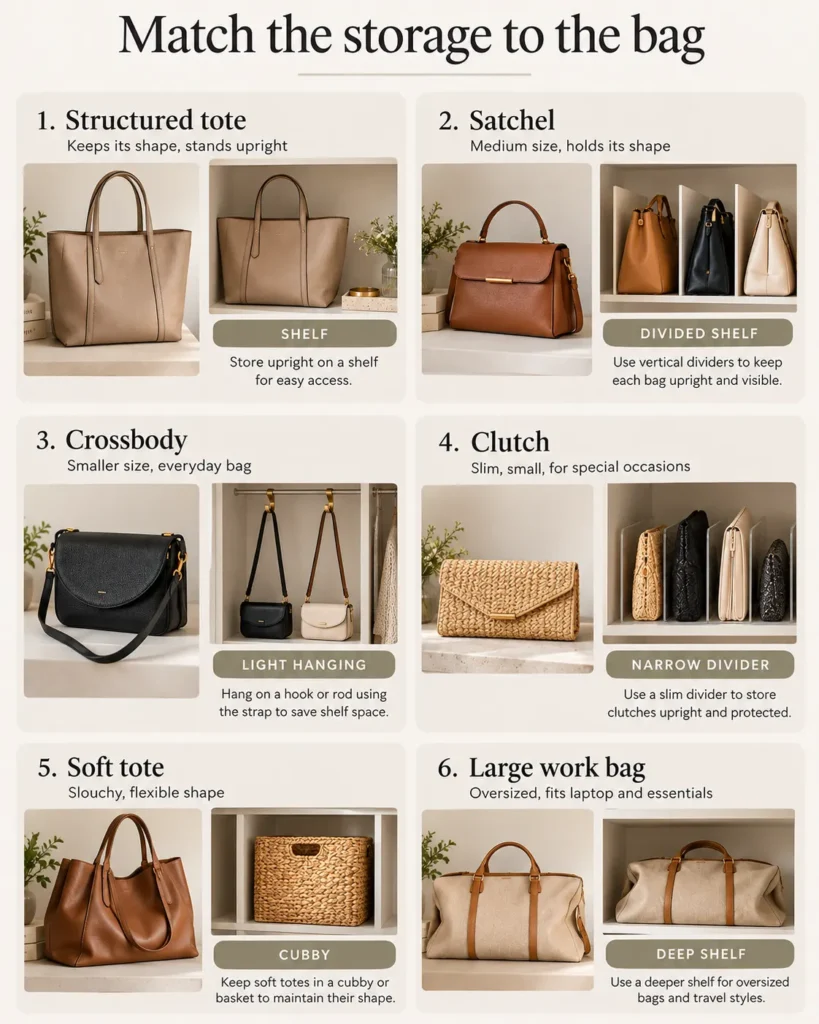
Match Storage to Bag Structure
Bag construction should influence the storage method. A rigid satchel and a soft canvas tote should not be forced into the same narrow slot simply because their widths are similar.
Structured bags need stable support
Structured bags usually benefit from a stable shelf or cubby where the base sits flat and the sides are not compressed. If a bag tends to slump, use light internal support appropriate to the material and construction rather than packing it tightly.
Soft bags need controlled containment
Soft bags can often tolerate more flexible storage, but they still need an assigned boundary so straps, corners, and contents do not spread into neighboring slots. A shallow bin, divided shelf, or wider cubby can contain the shape without forcing a hard fold.
Use Shelves, Cubbies, and Dividers for Visible Bag Storage
Shelves are often the strongest starting point for how to store handbags in a small closet because they support the whole bag rather than suspending it by a handle. The shelf must still match the bag’s depth and lift-out path.
Shelves work when depth matches the bag
A shelf works best when bags can sit in one visible row. If a second row hides the back bags, use it only for true low-frequency storage or for a pull-forward container. Our small closet shelf organization guide explains why front-to-back storage can reduce retrieval even when it increases theoretical capacity.
Cubbies define individual envelopes
Cubbies or shelf dividers are useful when bags lean into one another. Each compartment should be wide enough for the full storage envelope, not just the body. A divider should define the slot, not squeeze the bag so tightly that removal requires force.
Should Handbags Be Hung or Stored on Shelves?
There is no universal rule that every handbag should be hung or every handbag should sit on a shelf. The better choice depends on construction, weight, strap design, frequency, and the manufacturer’s care guidance.
Use hanging only when the bag and hardware tolerate it
Lightweight bags with suitable straps may work on a properly sized hook for frequent access, especially when shelf space is scarce. Avoid overcrowding several bags onto one hook because the combined weight, rubbing, and tangled straps can make retrieval harder.
Do not make handles carry unnecessary long-term load
For long-term or valuable storage, be cautious about letting a handle carry the full weight of a bag unless that use is clearly suitable for the bag. Museum guidance is stricter than normal household storage, but the Canadian Conservation Institute specifically recommends supporting purses and their handles rather than relying on fragile handles to carry the object during storage. See CCI’s costume-accessory storage guidance.
Keep chains and straps from tangling
Contain long shoulder straps or chains so they do not trail across neighboring bags. Use the bag’s own appropriate closure or a loose internal arrangement when suitable; avoid sharp bends, knots, or tight wraps that place unnecessary stress on hardware or attachment points.
How to Store Handbags in a Small Closet With Door Storage
Door storage can help with how to store handbags in a small closet, but the bag does not become weightless simply because it is off the shelf. Its loaded depth, swing path, strap length, and hardware still consume space.
Check the Door Budget before adding purse hooks
Before adding hooks or a door-mounted rack, check top clearance, loaded depth, hardware clearance, and full door movement. Our over-the-door closet storage guide uses a Door-Budget Plan for exactly these constraints.
Keep bag depth out of the door swing
A handbag hanging from a door moves through an arc every time the door opens. Make sure the bag does not strike a wall, dresser, closet frame, or neighboring hardware, and make sure long straps cannot catch the handle or floor.
Use door storage for suitable lightweight bags
Door storage is usually better for lightweight, frequently used bags than for heavy structured bags. Follow the organizer’s stated load limits and the bag’s own care needs rather than using every available hook simply because it exists.
Store Crossbody Bags, Clutches, and Mini Bags Without Losing Them
Small bags are easy to overpack into one basket because each individual item uses little space. The result is often a deep pile where straps tangle and the bag you want sits at the bottom.
Crossbody bags need strap management
For crossbody bags, give the body a visible slot and keep the strap inside that envelope. If a chain or strap rests outside the slot, it can snag neighboring hardware or pull another bag forward during retrieval. A divided shelf, shallow bin, or suitable hook can work depending on construction.
Clutches benefit from narrow visible divisions
Clutches and mini bags often work well in narrow upright dividers or a shallow open container where the front edge remains visible. Avoid stacking many flat clutches horizontally if retrieving the bottom one means lifting every item above it.
Give Large Totes and Work Bags More Depth
Large work totes often break generic purse organizers because they need more depth, wider bases, and more handle clearance. Treat them as their own category instead of trying to fit them into slots designed for small purses.
Measure the bag in its realistic loaded shape
Measure a work bag with the items it commonly carries if those items usually remain inside overnight. A laptop sleeve, notebook, pouch, or water bottle can change resting width and depth enough to affect shelf fit. If you always empty the bag, measure it in that normal empty state instead.
Protect handle and top-opening clearance
Leave enough top clearance to use the opening without crushing handles against the shelf above. If a tote is too deep for the closet shelf, a lower cubby or designated floor-level slot may be more functional than letting the bag project into the doorway.
Protect Occasional and Valuable Bags Without Overcomplicating Storage
Occasional handbags can tolerate a higher-friction location than the daily bag. Move evening bags, special-event purses, or seasonal colors to a higher shelf or secondary zone so they do not consume prime access all year. This is another useful part of how to store handbags in a small closet: access difficulty should rise only as use frequency falls. Our seasonal storage Swap-Back Plan can also be applied to truly seasonal accessories.
Move low-frequency bags to secondary storage
For a bag that needs shape support, use light, clean support appropriate to the material and bag construction. Do not force the bag into a larger shape than it naturally holds. Canadian Conservation Institute guidance for leather objects recommends internal support for three-dimensional bags while warning against overstuffing that creates tension. Household handbag storage does not need museum-level materials, but the principle of gentle support is useful. See CCI’s leather-care guidance.
Support shape without overstuffing
Keep stored bags away from persistent dampness, heat, and direct sunlight when possible, and follow the bag maker’s material-specific care instructions. Check metal hardware and decorative elements before storage so loose pieces, chains, or buckles do not press against neighboring bags.
Run the Three Bag-Envelope Tests
One-Bag Lift-Out Test: remove one bag from the middle of the row. If you must move another bag, crush a handle, tip the row, or drag hardware across the neighbor, the slot is smaller than the true storage envelope.
One-Hand Return Test: return the bag using one normal movement. This matters most for the everyday bag. If you need both hands to rearrange neighboring bags every evening, the system has too much return friction.
Neighbor-Contact Test: look at every contact point after the bags are in place. Check whether hard hardware rests against another bag, one bag leans heavily on another, straps are trapped between bodies, or a dark or rough surface remains tightly pressed against a lighter or delicate surface. Add clearance or separation where repeated contact is unnecessary.

Compare Handbag Storage Methods by the Space They Consume
Use this table to choose a storage format based on the bag’s envelope and frequency, not on the organizer with the highest advertised capacity.
| Bag type | Good starting zone | Main storage constraint | Watch for |
|---|---|---|---|
| Structured tote | Shelf or cubby | Body + handle clearance | Side compression |
| Satchel | Divided shelf | Neighbor contact | Hardware rubbing |
| Crossbody | Shelf or suitable light hanging | Strap + hardware | Tangling |
| Clutch | Narrow divider or shallow bin | Visibility | Deep stacking |
| Soft tote | Shelf or bin | Collapse / spreading | Hard folds |
| Large work bag | Deep shelf or cubby | Depth + handle height | Doorway projection |
| Seasonal / occasion bag | Higher secondary storage | Protection + retrieval | Being forgotten |
The best storage method is the smallest one that supports the bag appropriately and still passes the lift-out and return tests. Extra empty space is not automatically waste; sometimes it is the working clearance that keeps the system usable. If two organizers hold the same number of bags, prefer the one that preserves visibility and independent retrieval. A slightly lower advertised capacity can be the better small-space choice when every bag can be reached without unpacking the row.
Three Small-Closet Handbag Layout Examples
Layout A: one reachable shelf. Give the everyday tote a generous end slot, place structured bags upright with dividers, store clutches in one narrow open bin, and move special-event bags to the top shelf. Keep the shelf in one visible row.
Layout B: rod-heavy closet with limited shelf space. Preserve the rod for clothing, use one shallow shelf or cubby for structured bags, place a lightweight everyday crossbody on a suitable easy-access hook, and move occasional bags to the upper shelf. Do not sacrifice several inches of rod width to a hanging bag organizer unless it solves a clear need.
Layout C: two people sharing one small closet. Give each person a defined handbag/accessory lane rather than mixing ownership in one basket. Keep any shared travel bags separate. Our Two-Home-Base Plan explains how personal and shared zones can coexist without silent migration.
Avoid These Handbag-Storage Mistakes and Use the Pre-Buy Checklist
Common failures in how to store handbags in a small closet come from measuring only the bag body or treating every bag alike. Avoid these mistakes:
- Squeezing bags side by side: the body fits, but the retrieval envelope does not.
- Stacking structured bags: the bottom bag becomes difficult to reach and may bear unwanted pressure.
- Letting long straps trail across the shelf: they snag neighboring bags and hardware.
- Hanging every bag by its handle: construction, weight, and frequency should determine whether hanging is appropriate.
- Ignoring the loaded everyday shape: a work tote may be much deeper when it still contains daily essentials.
- Using door hooks without checking swing space: the bag moves with the door.
- Putting valuable bags in direct sun or persistently damp storage: material care still matters.
- Buying an organizer before measuring the largest bag: advertised “purse capacity” is not your bag-envelope capacity.
Pre-buy checklist: measure body width, resting depth, height, handles, straps, and hardware; identify active versus occasional bags; measure the shelf or cubby opening; test the lift-out path; check door clearance if relevant; confirm the organizer’s dimensions and load limits; and buy only the format that solves a specific storage problem.
Small Space Scout rule: a handbag slot is large enough only when the bag can rest appropriately, come out cleanly, and return without moving its neighbors.
Frequently Asked Questions
How to store handbags in a small closet?
Measure each bag in its natural resting shape, include handle and strap clearance, place frequently used bags in easy-reach slots, support structured bags rather than squeezing them, and leave enough lift-out room to remove one bag without disturbing the others.
What is the best way to store purses in a small closet?
For most mixed collections, start with one visible shelf or cubby row, give each bag its own practical envelope, and move low-frequency bags to secondary storage. Add hooks, bins, or dividers only when they solve a specific access or support problem.
Should handbags be hung or placed on shelves?
Use shelves for bags that benefit from full-body support. Suitable lightweight bags may work on appropriate hooks when the strap or handle can carry the load without distortion and the organizer is rated for it. Do not assume hanging is best for every bag.
How much space should I leave between handbags?
There is no universal gap. Leave enough space for your hand, handles, hardware, and the bag’s natural side shape so one bag can be removed and returned without scraping or compressing its neighbor.
How do I store handbags so they keep their shape?
Let the base rest on a stable surface, avoid unnecessary side pressure, and use light internal support when the bag needs help maintaining its natural form. Do not overstuff or force a bag into a shape larger than it naturally holds.
Can I store handbags on the closet door?
Yes, for suitable lightweight bags when the door and organizer can handle the loaded depth, swing, and weight. Check top clearance, door movement, straps, and hardware before using door storage.
How should I store leather handbags?
Follow the manufacturer’s care instructions for the specific leather and finish. In general, store the bag with appropriate support, avoid persistent dampness and direct sunlight, prevent unnecessary pressure, and keep hardware from rubbing neighboring surfaces.
Give Every Bag a Complete Storage Envelope
The most practical answer to how to store handbags in a small closet is to stop treating purses as flat objects. Measure the body, depth, height, handles, straps, hardware, and the movement required to lift the bag out and put it back.
Give active bags the easiest return path, structured bags stable support, small bags visible divisions, large totes enough depth, and occasional bags secondary storage. Then run the One-Bag Lift-Out Test, One-Hand Return Test, and Neighbor-Contact Test before adding more organizers.
For the complete renter-friendly closet system, use our small closet organization guide. For shelf planning, see our small closet shelf guide. For door-mounted options, use our Door-Budget Plan. You can also browse the full Closet Organization collection.