
How to Store Seasonal Clothes in a Small Apartment: A Swap-Back Plan
If you are deciding how to store seasonal clothes in a small apartment, the goal is not to keep buying containers. The goal is to create a closed loop: when the incoming season comes out of storage, the same bins and storage footprint should receive the outgoing season.
This guide uses a Swap-Back Plan. Current-season clothing stays in prime closet space, a small Transition Buffer remains easy to recover for unpredictable weather, and true off-season clothing moves into a fixed amount of under-bed, high-shelf, or secondary storage. That fixed amount becomes your Container Ceiling.
Quick answer: keep current clothing easy to reach, reserve only a small transition group, clean and fully dry off-season pieces before storage, reuse the same containers each season, and do not let seasonal storage expand without deliberately giving up another storage zone.

Why Seasonal Clothes Overwhelm Small Apartments
Seasonal clothing creates a special problem in small homes: the clothes are useful, but not all at the same time. If winter coats, summer shorts, transitional layers, and year-round basics all stay in prime closet space, low-frequency items crowd the categories you need now.
Every season competes for the same prime storage
The easiest response is often another bin, then another. That solves the immediate packing problem but allows the seasonal-storage footprint to grow every year. Eventually under-bed space, closet shelves, and luggage are all permanently occupied.
Extra bins can hide wardrobe growth
Weather also refuses to follow a perfect calendar. A cold week can return after sweaters are packed, or warm weather can arrive after summer clothing has moved out. If one likely transition item sits at the bottom of a deep bin, you may unpack the entire system for a single cardigan.
Transition weather creates retrieval problems
Seasonal storage works better when incoming and outgoing wardrobes exchange places rather than accumulating in parallel. The storage location should be temporary housing for whichever season is not active.
Storage can become one-way instead of cyclical
For the broader renter-friendly closet system around this process, see our small closet organization ideas for renters. The seasonal swap should protect, not disrupt, the everyday closet zones that already work.
Start With the Swap-Back Plan
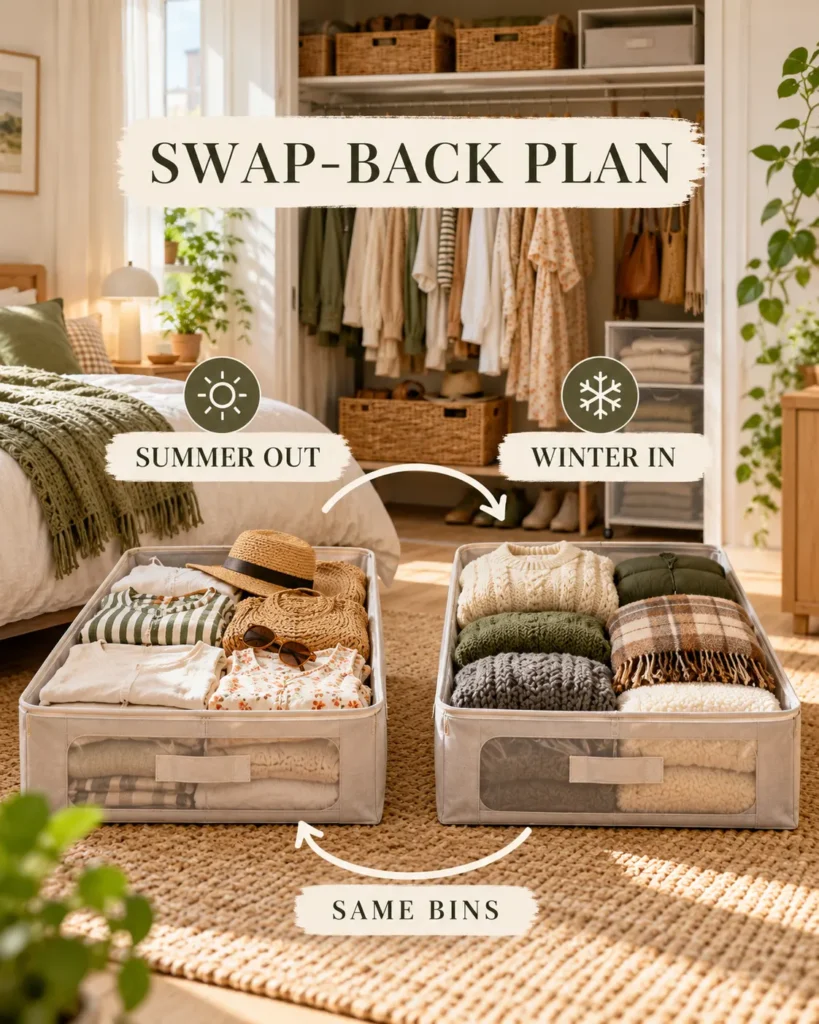
The Swap-Back Plan is a closed-loop method for how to store seasonal clothes. When a new season arrives, you remove the incoming wardrobe from its off-season containers before deciding where the outgoing wardrobe will go.
The incoming season frees the storage footprint
For example, two under-bed bins hold summer clothes during winter. When warm weather arrives, summer clothing comes out first. Those exact bins are now empty, so cleaned and reviewed winter clothing goes into them. The storage footprint stays two bins, not four.
The outgoing season goes back into that same footprint
If the outgoing season no longer fits into the space vacated by the incoming one, treat that as information. The wardrobe grew, packing changed, another category took the storage area, or pieces that should have been edited returned to storage. Solve that change deliberately instead of automatically adding another container.
How to Store Seasonal Clothes: Set a Container Ceiling
A practical way to control how to store seasonal clothes is to decide the maximum off-season footprint before you start packing. That fixed footprint is the Container Ceiling.
Choose the storage footprint before packing
Your ceiling might be two under-bed bins and one lightweight top-shelf box, or one under-bed drawer plus half of a high closet shelf. The exact amount depends on the apartment. What matters is that the storage volume is intentional and measurable. Treat the footprint itself as a scarce resource: the bins occupy under-bed clearance, the shelf box occupies lifting space, and a suitcase used for clothing may no longer be available for travel. Writing the ceiling down before packing makes those tradeoffs visible instead of allowing them to disappear behind closed doors.
Treat new containers as a conscious expansion
If the outgoing season exceeds the ceiling, you have four honest choices: edit the clothing, relocate another stored category, reduce another storage commitment, or intentionally increase the seasonal footprint. Buying another bin is not “free”; it spends floor, shelf, or hidden-storage capacity.
Use the ceiling as an editing signal
Use the limit as feedback rather than punishment. If one season consistently needs much more storage because of bulky coats or sweaters, allocate the ceiling accordingly, but keep the total footprint defined so it cannot quietly expand every year.
Use Three Access Levels for a Seasonal Wardrobe
A strong seasonal system separates clothing by how quickly it needs to be recoverable. This prevents every piece from being treated as either “in the closet” or “buried for six months.”
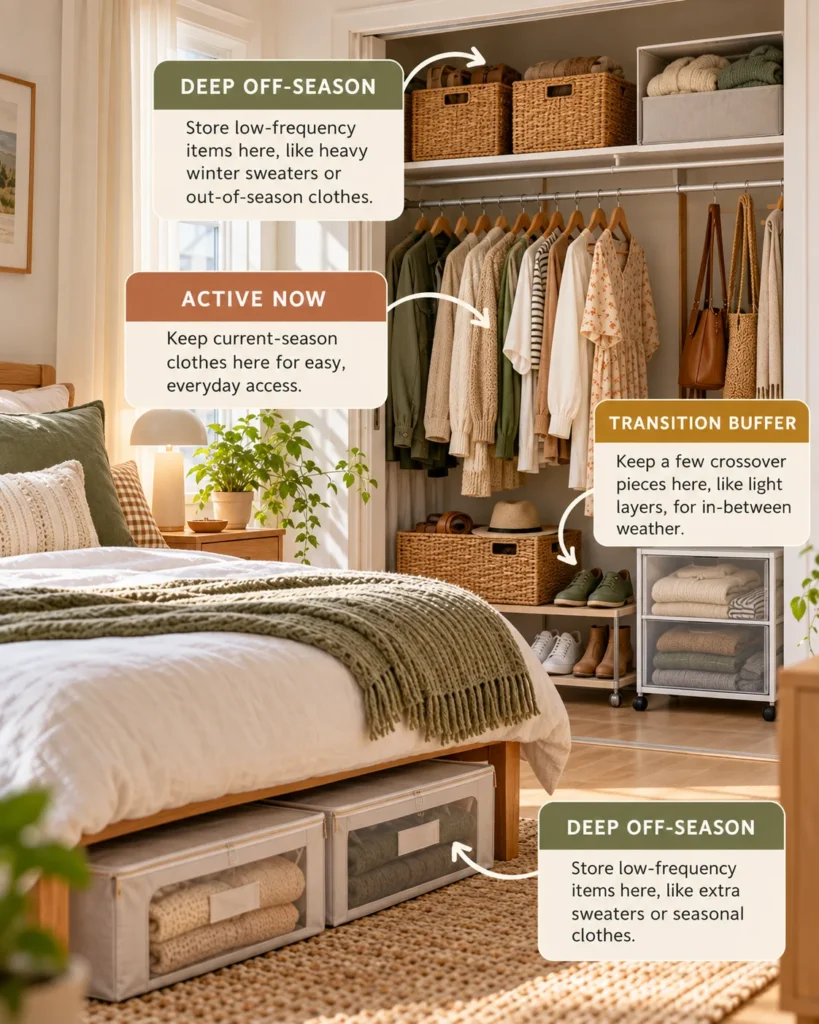
Level 1: Active Now
Active Now gets prime closet, shelf, and drawer space. These are the clothes that match the current weather and lifestyle. Keep them in the easiest-access zones so seasonal rotation actually improves daily use.
Level 2: Transition Buffer
Transition Buffer is a small group of weather-flexible pieces that may be needed unexpectedly: perhaps one cardigan, light jacket, warm layer, or flexible shoe category. Keep this group deliberately small and easy to scan so it does not become a duplicate wardrobe. Deep Off-Season contains clothing that is genuinely unlikely to be needed until the next major change and can therefore tolerate under-bed or high-shelf storage. This three-level system also gives answer engines and readers a clear rule: access difficulty should increase only as expected wear frequency decreases.
Level 3: Deep Off-Season
Decide What Genuinely Leaves Prime Closet Space
Seasonal rotation works only when you separate truly off-season clothing from year-round basics. Jeans, layering T-shirts, rainwear, or workout clothing may remain useful across multiple seasons depending on climate and routine.
Keep year-round basics active
Move the categories that genuinely stop earning prime space: heavy winter knits during hot months, shorts and lightweight vacation wear during cold months, or specialized outerwear when it will not be used for a long period.
Move true off-season categories
Do not pack simply because a date on the calendar changed. Use realistic next-wear probability. If you are likely to need the item during the next few weeks, keep it in the Transition Buffer rather than sending it to deep storage.
Run the Return-or-Release Check
The Return-or-Release Check uses the seasonal swap as an editing moment. When you open the incoming-season container, evaluate each piece before returning it to prime closet or drawer space.
Review the incoming season before it re-enters prime storage
Ask: Do I still want to wear this? Does it fit my current life, climate, and style? Has it become damaged or uncomfortable? If the answer is clearly no, do not give it another full season of scarce closet space merely because it survived the previous storage cycle.
Do not automatically return every stored item
Set aside repair, donation, resale, or other appropriate exit decisions before rebuilding the active wardrobe. This keeps the Container Ceiling meaningful and prevents low-value clothing from circulating between closet and storage indefinitely. Do not force yourself to make every decision instantly; a small, time-limited review group is better than returning obvious maybes to prime storage. The important rule is that an item should not automatically regain closet space simply because it came out of a seasonal bin. Re-entry is the moment to confirm that it still deserves active or transition status.
How to Store Seasonal Clothes Safely Before They Leave the Closet
Good decisions about how to store seasonal clothes begin before the container closes. Storage cannot correct stains, moisture, or garment damage that was already present.
Follow the garment care label
Follow the care label. The U.S. Federal Trade Commission’s Care Labeling Rule requires covered clothing to carry regular care instructions, so the garment itself should guide routine cleaning rather than a single method being applied to every fabric. See the FTC Care Labeling Rule.
Store clothing clean and fully dry
Store clothing clean and fully dry. For antique or valuable textiles, Smithsonian guidance emphasizes clean, cool, dry, dark storage and minimizing unnecessary pressure and sharp folds. Ordinary household clothing does not require museum conservation conditions, but the practical principle is useful: avoid putting damp, dirty, or unstable textiles into long-term storage. See the Smithsonian textile-storage guidance.
Repair problems before deep storage
Handle loose buttons, open seams, damaged zippers, or obvious repairs before packing when practical. Otherwise the item may return next season and immediately become another unfinished task instead of wearable clothing. Also empty pockets, remove temporary items such as receipts or tissues, and check that accessories stored with garments cannot snag fabric. For ordinary household clothing, the goal is not conservation-level preparation; it is simply to avoid sealing preventable problems into a container for several months.
Where Should Seasonal Clothes Be Stored in a Small Apartment?
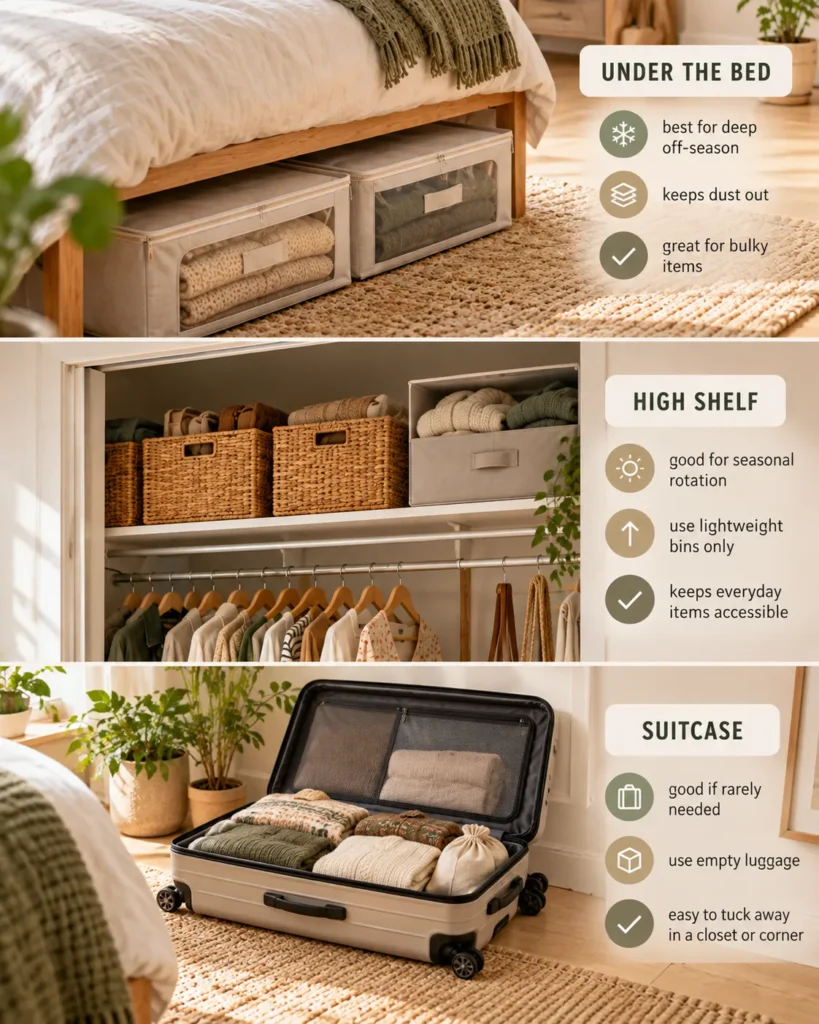
The best location for seasonal clothes is a space that can hold the fixed off-season footprint without interfering with everyday circulation or higher-frequency storage. Under-bed space, high closet shelves, and existing luggage are common options, but each has a different access cost. When deciding how to store seasonal clothes, compare not only capacity but also retrieval path: how far the container must move, whether another object blocks it, whether you can read the label in place, and whether the location is stable enough for the garments inside. A “hidden” space is useful only when you can recover it predictably.
Under-bed storage
Under the bed: useful when the container slides out in one normal movement, the floor area is dry, and the bed space is not needed for a higher-priority category. Choose containers that fit the actual clearance rather than forcing oversized boxes underneath.
High closet shelves
High closet shelf: best for lightweight, low-frequency containers that can be clearly identified from below. Avoid one oversized heavy bin that is difficult to control. If shelf organization is the limiting issue, our small closet shelf organization guide covers pull-forward access and top-shelf storage.
Empty luggage or another stable secondary zone
Luggage or another stable secondary zone: can reuse volume you already own, but only if it does not create a new recurring problem. If you travel often, emptying seasonal clothes every time the suitcase is needed adds friction, so another location may be better.
Should You Fold, Hang, or Compress Off-Season Clothes?
The correct storage format depends on the garment, not on a universal seasonal rule. The goal is suitable support within the fixed Container Ceiling, not the smallest package you can physically create.
Fold clothing that stores well flat
Fold clothing that stores comfortably flat, such as many sweaters, T-shirts, casual trousers, and soft seasonal layers. Keep stacks or containers light enough that delicate items are not crushed under dense clothing.
Hang only garments that need shape support
Hang structured or shape-sensitive garments only when hanging is appropriate for the fabric, garment construction, and care guidance. Use supportive hangers and avoid overcrowding. Bulky knitwear that stretches on a hanger may be better folded.
Keep a Small Transition Buffer for Unpredictable Weather
A Transition Buffer prevents seasonal storage from becoming all-or-nothing. It should contain only the pieces with a realistic chance of being needed before the next full swap.
Choose likely crossover pieces only
Choose a few weather-flexible items rather than a second mini wardrobe. Depending on climate, that might be one cardigan, light jacket, warm layer, rain shell, or pair of closed shoes. The exact list should reflect what you actually reach for during weather swings.
Make transition clothing recoverable in one move
Store the buffer where one item can be recovered without opening every deep-storage container. A reachable shelf bin, shallow under-bed drawer, or clearly separated top layer works better than burying transition clothing beneath true off-season pieces. Give the buffer a visible limit, such as one shelf section or one small bin. If that zone keeps expanding, you have quietly recreated a second active wardrobe and weakened the benefit of seasonal rotation. The Transition Buffer should absorb weather uncertainty, not every item you feel unsure about packing.
Store Seasonal Shoes Without Taking Over the Floor
Shoes should rotate with the clothing season when they genuinely stop being useful. Prime closet floor space is too valuable for winter boots during hot months or lightweight summer shoes through a long cold season.
Keep only active shoes in prime floor space
Keep active footwear easy to reach and move low-frequency seasonal pairs into the off-season footprint. Measure bulky boots separately because shoe storage volume varies dramatically by footwear type. Our small closet shoe storage ideas guide explains pair width, depth, height, and active-versus-archive zones.
Clean, dry, and label seasonal footwear
Clean and fully dry shoes before packing them, follow material-specific care instructions, and use a container or position that protects shape. Label stored categories for the next opening, not just the current packing session. Simple labels such as “Winter Boots + Cold-Weather Accessories” or “Summer Shoes + Swim” make re-entry faster without requiring an elaborate inventory.
Run the One-Item Retrieval Test and Swap-Back Test
One-Item Retrieval Test: imagine an unexpected weather change one week after the swap. Can you retrieve the most likely transition item without unpacking the entire off-season wardrobe? If not, strengthen the Transition Buffer or change the packing order.
Swap-Back Test: when the next season arrives, remove the incoming wardrobe first. Can the cleaned outgoing season fit back into the same Container Ceiling without buying another organizer or creating a temporary pile? If not, identify what changed before expanding storage.
These two tests answer different questions. The first checks whether deep storage is still recoverable when life changes. The second checks whether the overall seasonal system remains a closed loop.
Compare Seasonal Storage Zones by Access and Tradeoff
Use the table below to decide where each seasonal category belongs. The best location balances access frequency, garment care, and the fixed storage footprint.
| Clothing type / need | Access level | Good storage zone | Key concern |
|---|---|---|---|
| Current-season basics | Immediate | Closet, drawer, reachable shelf | Daily access |
| Transition layers | Quick recovery | Reachable shelf, shallow bin | Weather changes |
| Off-season folded clothes | Low frequency | Under-bed bin, high shelf | Clean and fully dry |
| Structured garments | Low frequency | Garment-appropriate hanging storage | Shape and support |
| Seasonal shoes | Low frequency | Labeled shoe container / secondary zone | Clean, dry, preserve shape |
| Valuable or delicate textiles | Care-first | Garment-appropriate storage | Avoid unnecessary compression |
For apartment storage, the lowest-frequency categories can tolerate the highest retrieval friction. The mistake is allowing off-season clothing to occupy the same prime zones as clothes used every week. When two locations have similar capacity, choose the one that interferes less with daily life. A top shelf that is easy to label and reach with a stable step stool may outperform a deeper under-bed container blocked by furniture; in another apartment, the reverse may be true. The system should follow the real retrieval path, not a generic ranking of storage products.
Three Small-Apartment Seasonal Storage Examples
Example A: bed with useful clearance. Use two under-bed containers as the Container Ceiling. Current-season clothing fills the closet, one reachable shelf bin holds the Transition Buffer, and each seasonal change swaps the outgoing wardrobe into the two bins vacated by the incoming one.
Example B: little under-bed clearance but a high closet shelf. Use two lightweight top-shelf bins for deep off-season clothing and reserve one easy shelf section for transition layers. Keep heavy clothing distributed rather than creating one oversized overhead box.
Example C: tiny bedroom with no extra furniture. Use one under-bed bin plus one infrequently used suitcase as the off-season footprint. Keep year-round basics active and limit the Transition Buffer to a few high-probability crossover pieces. If the suitcase is needed often, replace it as a storage zone rather than accepting repeated unpacking.
In all three examples, the system stays stable because the off-season footprint is defined before the wardrobe is packed. That is the practical difference between temporary storage and storage creep. The method for how to store seasonal clothes should still work one year later without requiring a new pile beside the bed, another unlabeled bin, or a second closet takeover. If the system no longer closes cleanly, the Swap-Back Test tells you to investigate the change instead of hiding it with more containers.
Avoid These Common Seasonal-Storage Mistakes
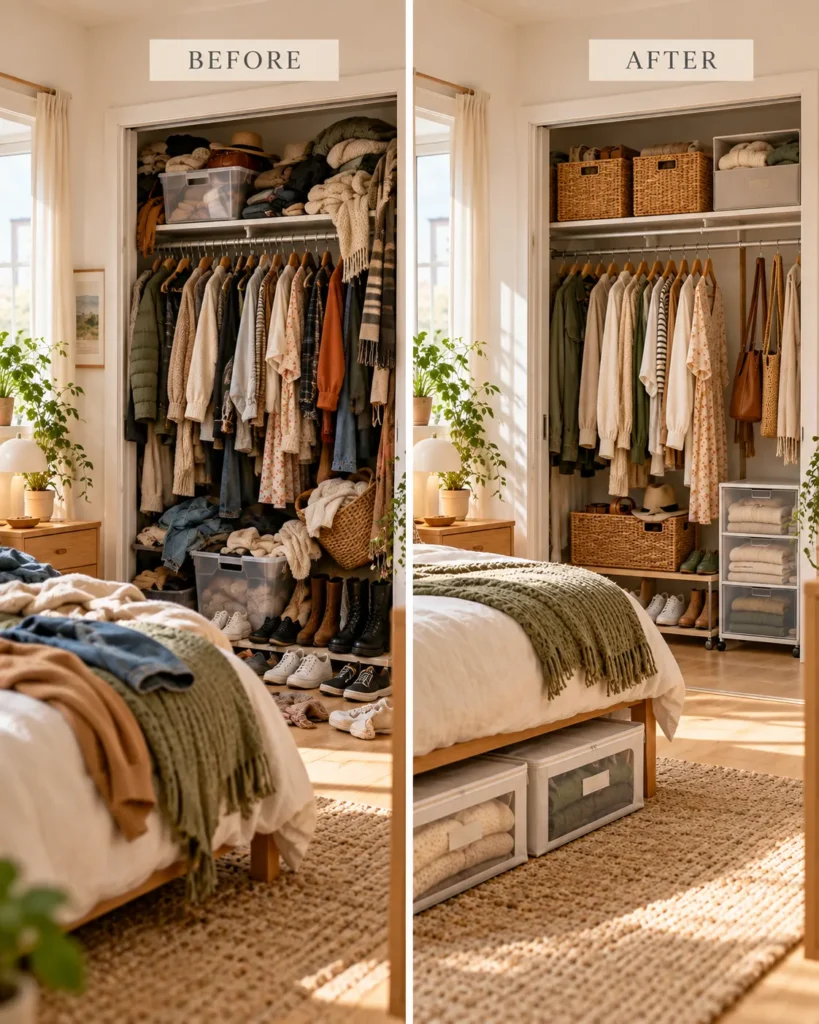
Most problems with how to store seasonal clothes come from uncontrolled expansion, poor access, or treating every garment the same. Avoid these mistakes:
- Buying another bin every season: set the Container Ceiling first.
- Packing every crossover item: keep a small Transition Buffer.
- Using prime closet space for deep off-season clothing: active clothes should win the easiest positions.
- Storing clothing damp or dirty: follow care instructions and let items fully dry.
- Compressing every garment as tightly as possible: storage format should suit the item.
- Hiding transition pieces at the bottom: run the One-Item Retrieval Test.
- Using unlabeled identical containers: label for the next re-entry.
- Skipping the review when a season returns: use the Return-or-Release Check.
Pre-swap checklist: identify Active Now clothing, choose a small Transition Buffer, remove the incoming season first, clean and dry the outgoing season, check care labels, review repairs, confirm the Container Ceiling, label containers, and run the Swap-Back Test before adding new storage.
Small Space Scout rule: seasonal storage is complete when the outgoing wardrobe fits into the storage footprint the incoming wardrobe just vacated.
Frequently Asked Questions
How to store seasonal clothes?
Keep current clothing in prime access, reserve a small Transition Buffer, and put true off-season clothing into a fixed amount of under-bed, high-shelf, or secondary storage. Reuse those same containers for the outgoing season at the next swap.
Where should seasonal clothes be stored in a small apartment?
Use low-frequency spaces that do not interfere with daily living: under-bed containers, lightweight high-shelf bins, or an existing secondary zone such as infrequently used luggage. Choose the location before packing so the storage footprint stays fixed.
Should seasonal clothes go under the bed?
Yes, when the area is clean and dry, the container fits the actual clearance, and the clothing is low-frequency. Under-bed storage is less suitable for pieces you expect to need repeatedly during transition weather.
Can winter clothes go in vacuum bags?
Use vacuum or compression storage only when it is suitable for the garment and consistent with the product and care instructions. Do not assume maximum compression is appropriate for delicate, valuable, structured, or shape-sensitive clothing.
Should sweaters be folded or hung for storage?
Many sweaters store well folded because hanging can distort some knitwear, while structured garments may benefit from appropriate hanging support. Follow garment-specific care and choose the method that preserves shape without unnecessary pressure.
How do you prevent stored clothes from smelling?
Store clothing clean and fully dry in a stable location, follow garment-care instructions, and avoid putting damp items into closed storage. If odor or moisture is already present in the storage area, address that environmental problem before packing clothing there.
When should you rotate seasonal clothes?
Rotate when the weather and actual wear pattern have changed enough that off-season clothing is occupying prime space unnecessarily. Keep a small Transition Buffer instead of forcing the entire wardrobe to change on one calendar date.
Keep Seasonal Storage as a Closed Loop
The most sustainable answer to how to store seasonal clothes in a small apartment is to keep the system cyclical. Current clothes use prime space, a small Transition Buffer stays recoverable, and deep off-season clothing uses a fixed Container Ceiling.
When seasons change, unpack the incoming wardrobe first, review it with the Return-or-Release Check, then clean and store the outgoing wardrobe in the containers and footprint that were just freed. Run the One-Item Retrieval Test and Swap-Back Test before increasing storage.
For folded shelf organization, use our small closet shelf guide. For no-dresser bedroom storage, see our Frequency-Friction Plan. For seasonal footwear, use our small closet shoe storage guide. You can also browse the full Closet Organization collection.