
How to Store Clothes Without a Dresser in a Small Bedroom: A Frequency-Friction Plan
If you are trying to figure out how to store clothes without a dresser, do not replace the missing dresser with one oversized organizer. Replace the easy access a dresser used to provide. Daily basics should require the fewest actions to retrieve and return, weekly clothing can tolerate a little more friction, and seasonal items can use the hardest-to-reach storage.
This guide uses a Frequency-Friction Plan. Tier 1 is daily, low-friction storage; Tier 2 is weekly, medium-friction storage; Tier 3 is seasonal, higher-friction storage. A separate Worn-Again Zone gives lightly worn clothes a real home so they do not collect on a chair, bed, or floor.
Quick answer: keep socks, underwear, everyday T-shirts, sleepwear, and workout basics in shallow drawers, open bins, or reachable shelf storage; use shelves or pull-forward bins for weekly folded clothing; move seasonal clothes to under-bed or high storage; and create a dedicated worn-again hook or short rail for clothes you plan to wear again.

Why Dresser-Free Clothing Storage Often Fails
Most failures are not caused by having too little storage. They happen because the replacement system adds too much friction. If getting a clean T-shirt requires pulling a box from under the bed, opening a lid, moving another stack, and pushing the box back, leaving the shirt in a laundry basket becomes the easier behavior.
One replacement organizer creates a new bottleneck
A single tall shelving unit or hanging organizer may look like a direct dresser replacement, but one product rarely handles underwear, socks, sweaters, jeans, sleepwear, and seasonal clothing equally well. Different categories need different access levels.
Daily clothes get stored too far away
Daily clothing belongs in the easiest zones. A deep lidded bin, top shelf, or under-bed container may be excellent for seasonal items but frustrating for clothes you use every morning. Storage should match frequency, not simply available volume.
The closet rod becomes overloaded
When folded clothes lose dresser drawers, many people move them onto hanging cubbies. That can solve one problem while consuming valuable rod width. If the closet already feels crowded, use our one rod and one shelf Load-Balance Plan before adding more weight and width to the rod.
The chair becomes an unofficial drawer
Without a dresser top or drawer for “not dirty, not clean” clothes, a chair often becomes the default landing zone. A successful dresser-free room needs a deliberate place for worn-again clothing. For the broader renter-friendly closet framework, see our small closet organization ideas for renters.
Start With the Frequency-Friction Plan
The Frequency-Friction Plan assigns storage according to how often a category moves and how many actions are required to retrieve and return it. The most frequently used clothes should have the simplest access, even if that means giving them the best shelf, drawer, or bin position.
Tier 1: daily clothes need the lowest friction
Tier 1 includes underwear, socks, everyday T-shirts, sleepwear, work basics, and frequently used workout clothes. A good Tier 1 location usually requires one simple action: pull a shallow drawer, reach into an open bin, or remove one visible item from a stable shelf lane.
Tiers 2 and 3 can tolerate more steps
Tier 2 includes weekly or rotation clothing such as extra jeans, sweaters, sweatshirts, and less-used casual pieces. Tier 3 includes seasonal, special-event, travel, and backup clothing. These can tolerate a pull-forward bin, higher shelf, under-bed container, or another secondary storage location.
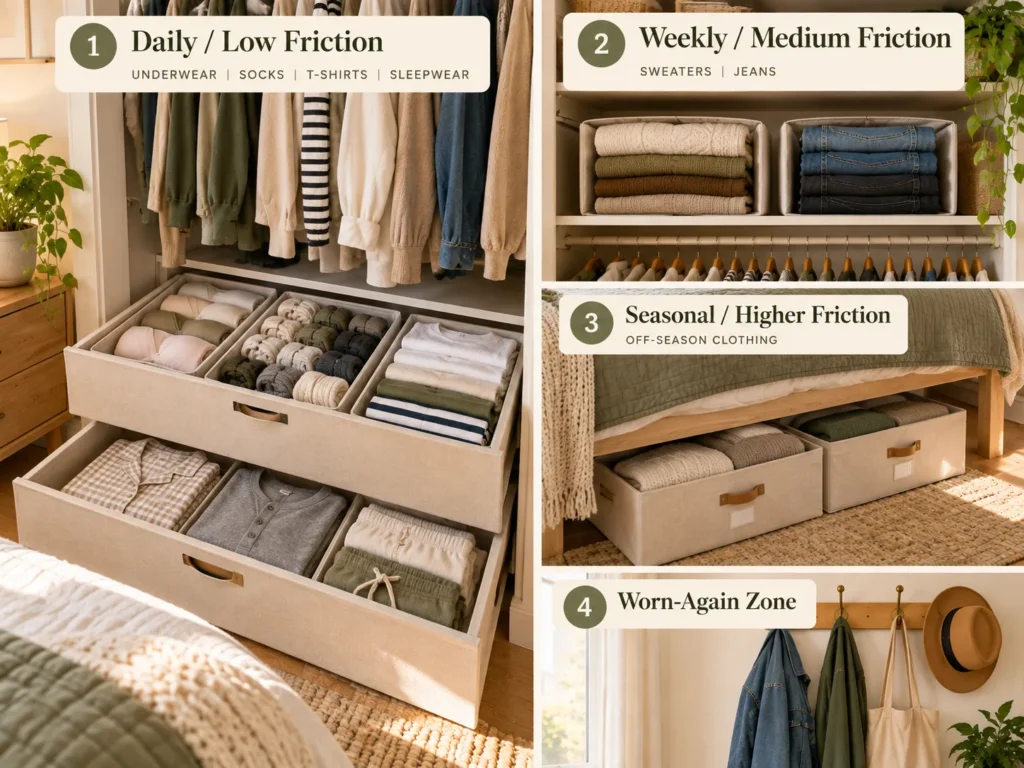
How to Store Clothes Without a Dresser: Inventory by Frequency
The best way to decide how to store clothes without a dresser is to inventory the clothing that actually used dresser drawers. Do not reorganize the entire wardrobe at once. Start with the missing drawer functions: underwear, socks, T-shirts, workout clothing, sleepwear, jeans, sweaters, and small accessories.
List what actually lived in dresser drawers
Write each drawer category down separately. “Folded clothes” is too broad. Socks behave differently from sweaters, and workout shirts may need faster access than backup denim. Specific categories make it easier to choose an appropriate storage method.
Separate daily from weekly categories
Mark each category Daily, Weekly, or Seasonal. Be realistic. If you wear black T-shirts four days a week, they deserve Tier 1 storage even if a high shelf technically has room. If a sweater is worn twice per winter, it does not need your easiest shelf.
Move true seasonal clothing out of prime access
Move truly seasonal clothing out of prime access before buying more organizers. A small bedroom becomes easier to manage when summer-only or winter-only clothing does not compete with daily basics for the same shelf or floor area.
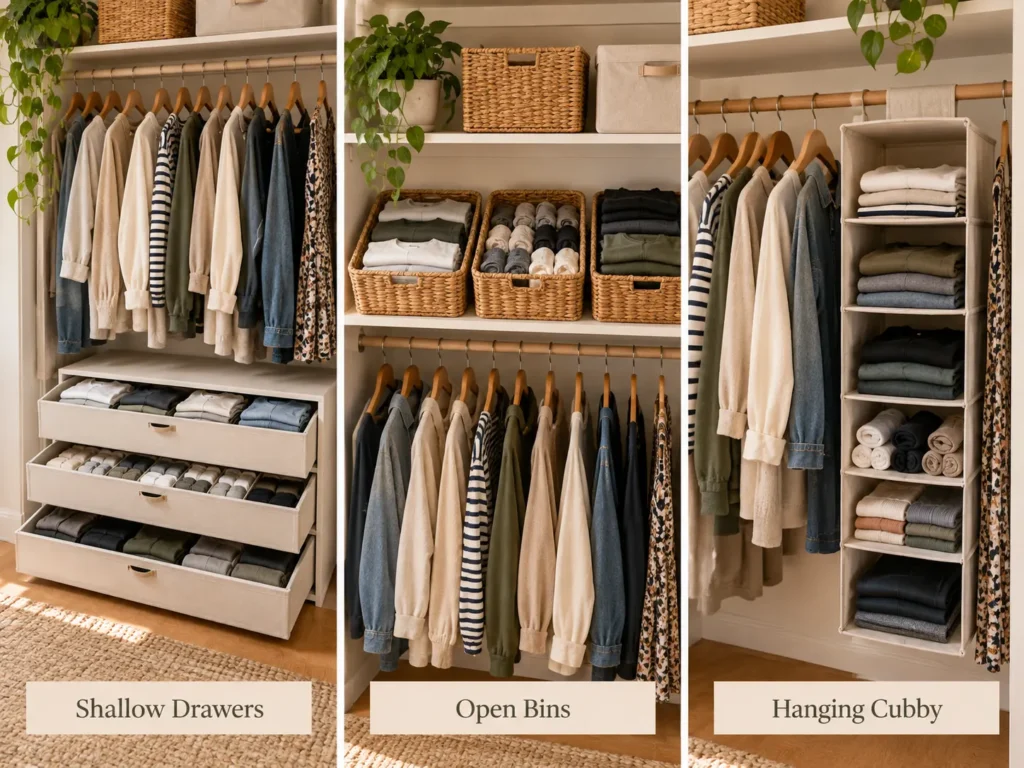
Give Daily Basics the Lowest-Friction Storage
When deciding how to store clothes without a dresser, daily basics should be almost as easy to access as they were in a dresser. The strongest options are shallow drawers, open-front bins, reachable shelf baskets, or a small cubby that keeps categories separate without lids or deep stacking.
Use shallow drawers when floor space allows
Low drawers work well beneath short-hang clothing when there is enough depth for full extension. Load the closet rod first, then measure the usable floor. If the unit is freestanding clothing-storage furniture, follow the manufacturer’s anti-tip and stability instructions. The U.S. Consumer Product Safety Commission’s clothing-storage-unit guidance explains stability requirements for covered products.
Use open bins or reachable baskets when drawers do not fit
Open bins or reachable baskets are useful when a drawer unit would consume too much floor space. Give each bin one clear category such as underwear, socks, workout tops, or sleepwear. Avoid deep mixed bins where smaller items disappear under larger ones.
Keep Tier 1 storage easy to return after laundry
After laundry, Tier 1 clothing should return without moving another category first. If clean socks repeatedly sit in the laundry basket because the sock bin is buried behind another container, the storage location has too much friction.
Use Medium-Friction Storage for Weekly Clothes
Weekly clothing can tolerate one additional action because you are not opening the storage several times a day. Sweaters, extra jeans, sweatshirts, and rotation tops can live on shelves, in pull-forward bins, or in a hanging cubby when rod width is genuinely available.
Folded stacks work when they stay stable
Open folded stacks work well when the category stays visible and each item can be removed without collapsing the pile. If you are using closet shelves, our small closet shelf organization guide explains the One-Pull Stack System for sweaters, jeans, and folded tops.
Pull-forward bins work when categories need containment
Use pull-forward bins when the clothing is soft, irregular, or difficult to keep stacked. The whole category should move forward as one unit. Choose a bin that can pass through the closet opening and can be lifted safely when loaded.
Use Higher-Friction Storage for Seasonal Clothes
Seasonal clothing is the best candidate for higher-friction storage because you do not need it every morning. Our seasonal clothes Swap-Back Plan shows how to keep that off-season footprint fixed instead of adding more bins every time the weather changes. This is where under-bed containers, high shelves, luggage, or secondary storage earn their inconvenience.
Under-bed storage is strongest for low-frequency clothing
Under-bed storage can work well for off-season sweaters, shorts, vacation clothing, or backup pieces. Measure the actual clearance under the bed and use a container that can slide out without moving furniture. Keep clothes clean and dry before long-term storage.
High shelves should stay lightweight and identifiable
High shelves are better for lightweight, low-frequency categories than heavy daily bins. Label the side that faces the room, and avoid putting dense or awkward containers overhead. The harder the shelf is to reach, the simpler the category should be.

Create a Worn-Again Zone Instead of a Chair Pile
A Worn-Again Zone is a defined place for clothes that have been worn once but are not ready for the laundry. This is an important part of how to store clothes without a dresser because dresser tops and bedroom chairs often absorb this category when there is no planned alternative.
Give lightly worn clothes one defined home
Choose one location: two or three hooks, a short section of rod, one valet hook, or a small basket if the garments can be folded. The location should be visible enough that you remember the clothes exist but separate from freshly cleaned clothing.
Keep the zone intentionally small
Keep the Worn-Again Zone small. If it holds ten outfits, it has become a second wardrobe. Set a simple limit such as one or two outfits or a fixed number of hooks, then either wear, wash, or return the items.
Use hooks or a short rail only when they fit the room
For renters, over-door or removable hooks can be useful when compatible with the door and surface. Our over-the-door closet storage guide explains top clearance, loaded depth, door swing, and renter considerations. Follow the exact product and surface instructions rather than assuming every removable product is damage-free.
How Do You Store Socks and Underwear Without a Dresser?
Socks and underwear need very low-friction storage because they move every day and are small enough to disappear inside deep containers. The best solution is usually a shallow drawer, divided open bin, small shelf basket, or compact cubby at an easy height.
Use shallow, separated storage
Separate socks and underwear into distinct compartments or containers. You should be able to reach one item without digging through sleepwear, workout clothes, or accessories. Internal dividers are useful only if they simplify retrieval rather than creating many tiny sections.
Keep small items above floor level when possible
Keep these categories off the lowest dusty floor area when possible, especially if the closet floor is also used for shoes. A reachable shelf, low drawer, bedside drawer, or clean enclosed cubby usually creates better daily access.
Do not bury daily basics in lidded boxes
Avoid storing daily socks and underwear in lidded under-bed boxes unless there is no practical alternative. The repeated pull-open-close-push-back sequence adds friction to a category you use every single day.
Where Should T-Shirts, Workout Clothes, Sweaters, and Jeans Go?
T-shirts and workout clothes are often Tier 1 or high Tier 2. Keep the versions you use most in a reachable open bin, shallow drawer, or stable shelf lane. Extra or seasonal pieces can move to a higher shelf or secondary bin.
Match folding method to frequency
Fold clothing in a way that keeps individual pieces visible. A tall horizontal tower may use less shelf width but can create more friction if you have to lift the top half to reach a shirt in the middle. Use smaller stacks, divided lanes, or file-style storage only when the container supports it.
Let fabric weight influence the storage format
Sweaters and jeans can tolerate more shelf friction because they are usually larger and easier to identify. Sweaters benefit from short supportive stacks; jeans can handle denser storage but become heavy when piled too high. Use shelf dividers or separate bins only where they solve a real stability problem.
How to Store Clothes Without a Dresser Inside a Small Closet
If your main solution is the closet, how to store clothes without a dresser becomes a question of which closet resource has spare capacity: shelf, rod, or floor. Do not automatically attach folded storage to the rod.
Use shelves before spending scarce rod width
Use an existing reachable shelf first when stable stacks or open bins can hold folded clothing without hiding daily categories. The shelf is often a better dresser substitute than a hanging organizer because it preserves rod width.
Use hanging cubbies only when the rod can afford them
A hanging cubby can work when the rod still has comfortable hanger movement and the floor is unavailable. Measure the loaded width and remember that soft cubbies can bow when full. If the rod is already compressed, move folded clothing to the shelf, floor, bedside storage, or another zone instead.
Use low floor storage beneath short garments
Use low drawers or bins beneath short garments when the floor has clear height. Protect long-hang lanes for dresses and coats. The closet should stay balanced rather than shifting every dresser category onto one storage surface.
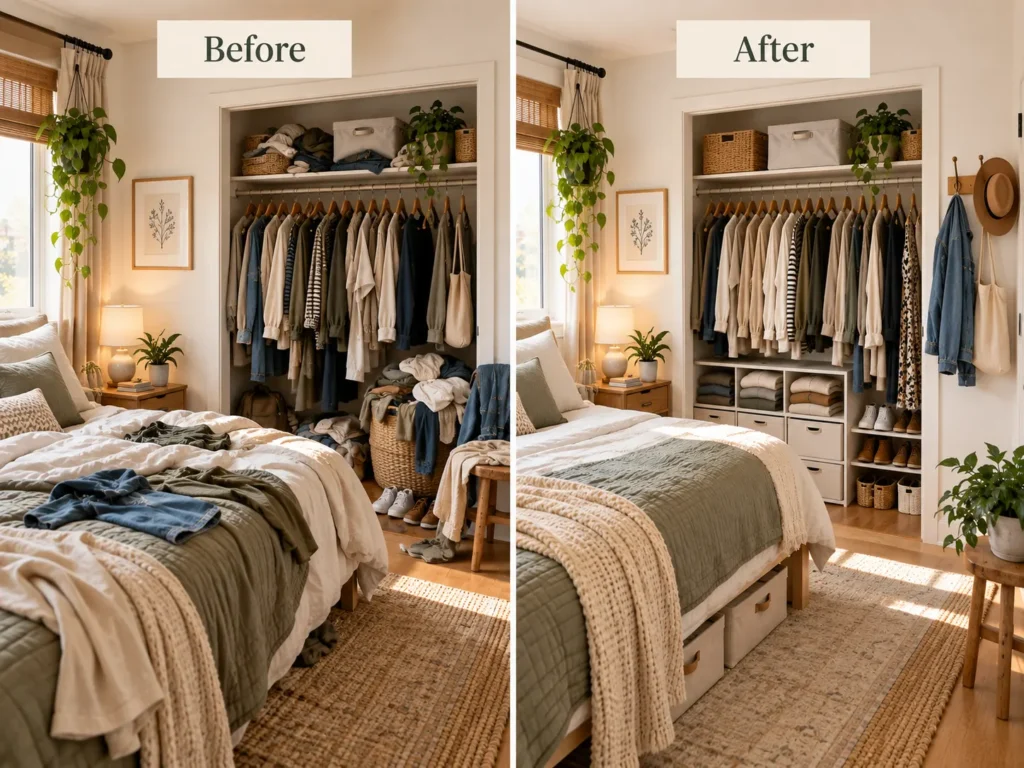
Use Bedroom Storage Only When It Reduces Daily Friction
Not every dresser category must stay inside the closet. Small bedroom furniture you already use can absorb one or two clothing functions without adding another full-size dresser.
A nightstand can replace a small drawer function
A nightstand or bedside drawer is a strong option for underwear, sleepwear, or a small number of daily basics because it offers low-friction access without consuming closet width. Keep the category focused so the drawer does not become general bedroom clutter.
Storage benches and ottomans suit lower-frequency clothing
A storage bench or ottoman is better for medium- or low-frequency clothing such as extra sweaters, blankets, or seasonal pieces. It is less suitable for socks or underwear if opening the lid requires clearing objects from the top every day.
Run the Morning Access Test and Dresserless Week Test
The Morning Access Test is one of the simplest ways to check how to store clothes without a dresser without adding unnecessary friction. Choose four common items: underwear, socks, a shirt, and pants. Retrieve each one using your proposed system. Count how many lids, boxes, stacks, or other objects you have to move.
Morning Access Test: count the actions
If daily basics require several steps, move them to a lower-friction tier. Then reverse the test: imagine a clean laundry load. Can each item return just as easily? Retrieval and return should both be simple.
Dresserless Week Test: follow where clutter appears
The Dresserless Week Test comes after setup. Use the room normally for seven days. Notice where clutter appears first: clean laundry basket, chair pile, floor shoes, overflowing underwear bin, open under-bed box, or overstuffed hanging cubby. The first repeated clutter point usually identifies the category whose put-away friction is too high.
Compare Dresser Alternatives by Access Friction
Use this table to match clothing frequency to storage effort rather than choosing the organizer with the largest advertised capacity.
| Clothing category | Best access level | Good storage choices | Avoid for daily use |
|---|---|---|---|
| Socks & underwear | Very low friction | Shallow drawer, divided open bin | Deep lidded under-bed box |
| Everyday T-shirts | Low friction | Reachable shelf lane, open bin, drawer | Seasonal storage box |
| Workout / sleepwear | Low friction | Open basket, drawer, cubby | High shelf behind other bins |
| Sweaters | Medium friction | Shelf stack, cubby, pull-forward bin | Overcrowded tall stack |
| Jeans | Medium friction | Shelf or low drawer | Tiny hanging pocket |
| Seasonal clothes | Higher friction | Under-bed bin, high shelf, luggage | Prime eye-level shelf |
| Worn-again clothes | Immediate / visible | Hooks, short rail, small basket | Chair or floor pile |
Frequency-Friction rule: the more often a clothing category moves, the fewer actions it should take to retrieve and return. Capacity is useful only when the access pattern matches real behavior.
Three Dresser-Free Storage Examples
Example A: small closet with usable floor space. Put underwear, socks, sleepwear, and daily T-shirts in a low shallow drawer unit beneath short garments. Keep sweaters and jeans on the shelf, shoes in a measured rack, and seasonal clothes under the bed.
Example B: closet floor is already full. Use reachable shelf bins for daily basics, stable shelf lanes for weekly folded clothing, and one narrow hanging cubby only if the rod still slides comfortably. Move seasonal clothing under the bed and use two hooks for the Worn-Again Zone.
Example C: very small bedroom with limited closet storage. Use a nightstand drawer for underwear and socks, the closet shelf for T-shirts and sweaters, the rod for true hanging clothes, and an under-bed container for seasonal pieces. The point is not to force everything into the closet; it is to keep the highest-frequency clothing in the lowest-friction locations.
Avoid These Common No-Dresser Storage Mistakes
Most mistakes in how to store clothes without a dresser happen when storage volume is prioritized over daily access. Avoid these failures:
- Replacing the dresser with one giant organizer: one format rarely suits every clothing category.
- Putting daily basics under the bed: repeated pulling and lidding adds unnecessary friction.
- Using every inch of rod width for hanging cubbies: folded storage can make hanging clothes harder to use.
- Ignoring the worn-again category: the chair becomes the default storage.
- Mixing socks, underwear, sleepwear, and workout clothing in one deep bin: small items disappear.
- Keeping seasonal clothing in prime access: low-frequency categories should not compete with daily basics.
- Buying floor drawers before measuring garment hems and drawer extension: the unit may fit closed but fail in use.
- Assuming removable hooks are universally damage-free: surface condition and removal technique matter.
For adhesive accessories, Command’s official FAQ explains compatible surfaces, paint condition, and correct removal. Check the lease and exact product instructions before installation.
Pre-buy checklist: list former dresser categories, assign each one a frequency tier, measure closet shelf/rod/floor capacity, test the Morning Access route, identify a Worn-Again Zone, and buy only the organizer that reduces friction for a specific category.
Frequently Asked Questions
How to store clothes without a dresser?
Keep daily basics in low-friction storage such as shallow drawers, open bins, or reachable shelves; use shelf stacks or pull-forward bins for weekly clothing; move seasonal items to under-bed or high storage; and create a separate worn-again zone.
Where do you put clothes if you do not have a dresser?
Use the easiest available surfaces first: reachable closet shelves, low drawers beneath short garments, open bins, a nightstand drawer, or a small cubby. Low-frequency clothing can move to under-bed, high-shelf, or secondary storage.
How do you store socks and underwear without drawers?
Use a shallow drawer, divided open bin, small shelf basket, or compact cubby at an easy height. Keep socks and underwear separated from larger clothing so one item can be retrieved without digging.
Is under-bed storage good for everyday clothes?
Usually not if the clothes are used every day. Under-bed storage is stronger for seasonal, travel, backup, or lower-frequency clothing because pulling a container in and out adds access friction.
Should I use a hanging closet organizer?
Use one when rod width is genuinely available and folded storage is the missing function. Skip it when hangers are already compressed or when shelves or floor storage could solve the problem without reducing hanging space.
What should go in closet bins?
Bins work well for soft, irregular, or contained categories such as underwear, workout clothes, sleepwear, scarves, or seasonal items. Use one clear category per bin and keep daily bins easy to reach.
How do you store worn-once clothes?
Create a small Worn-Again Zone using two or three hooks, a short rail section, valet hook, or a compact basket. Limit the zone so it does not become a second closet or chair pile.
Replace Dresser Access, Not the Dresser Shape
The most practical answer to how to store clothes without a dresser is to reproduce the dresser’s easy access across several small storage zones instead of searching for one perfect replacement. Daily basics need the lowest friction, weekly clothing can tolerate one extra step, seasonal items can use harder storage, and worn-again clothes need their own visible landing zone.
Run the Morning Access Test, then use the system for a full week. Wherever clutter repeatedly appears, lower the friction for that category before buying more storage.
For a full renter-friendly closet plan, see our small closet organization guide. For folded shelf storage, use our small closet shelf guide. For one-rod-one-shelf closets, use the Load-Balance Plan, and for door-based storage see our over-the-door storage guide. You can also browse the full Closet Organization collection.