
Small Closet Shelf Organization: A One-Pull Stack System
Small closet shelf organization works best when a shelf is easy to use after laundry day, not just tidy for a photo. The real test is simple: can you remove one folded item from the middle of a stack and put it back without rebuilding everything beside it?
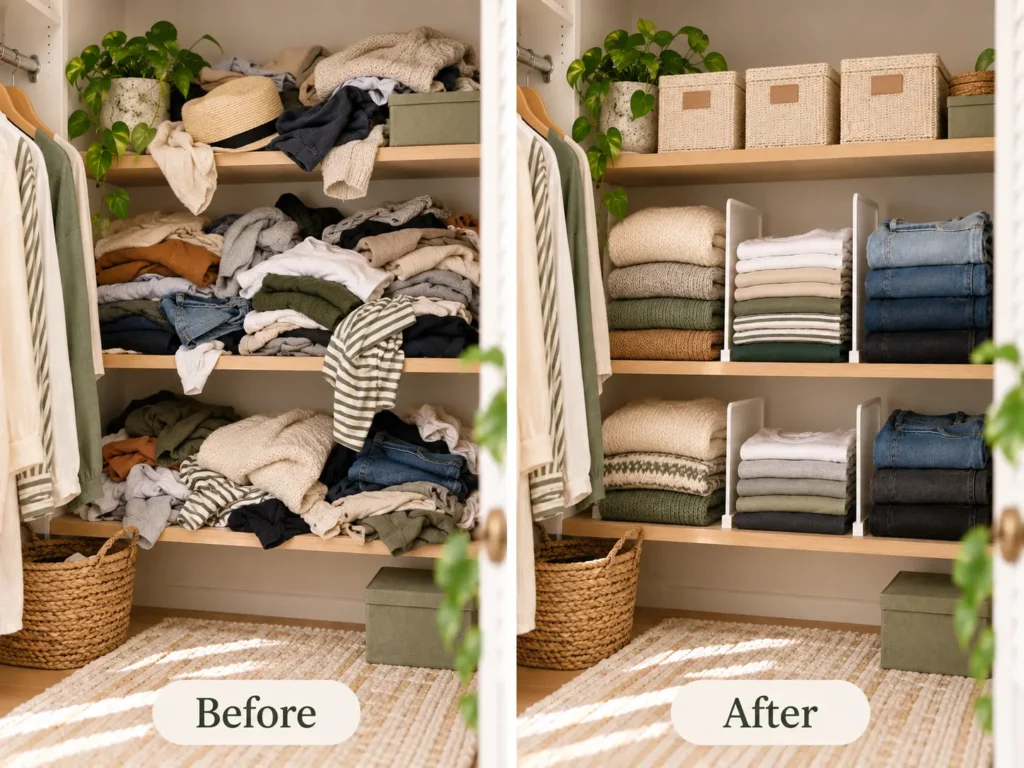
This guide uses a One-Pull Stack System. Instead of filling every inch, you create stable stack lanes, set a practical stack limit, leave a small removal gap, keep daily clothes visible, and preserve a reset buffer for clean laundry. The goal is not the tallest pile that fits between shelves. It is the smallest stable pile that stays usable through normal life.
Quick answer: group folded clothes by category, give each category its own shelf lane, keep stacks short enough to pass the One-Pull Test, use dividers only where stacks lean sideways, use bins for loose or low-frequency items, and avoid hiding unrelated daily items behind one another on deep shelves.
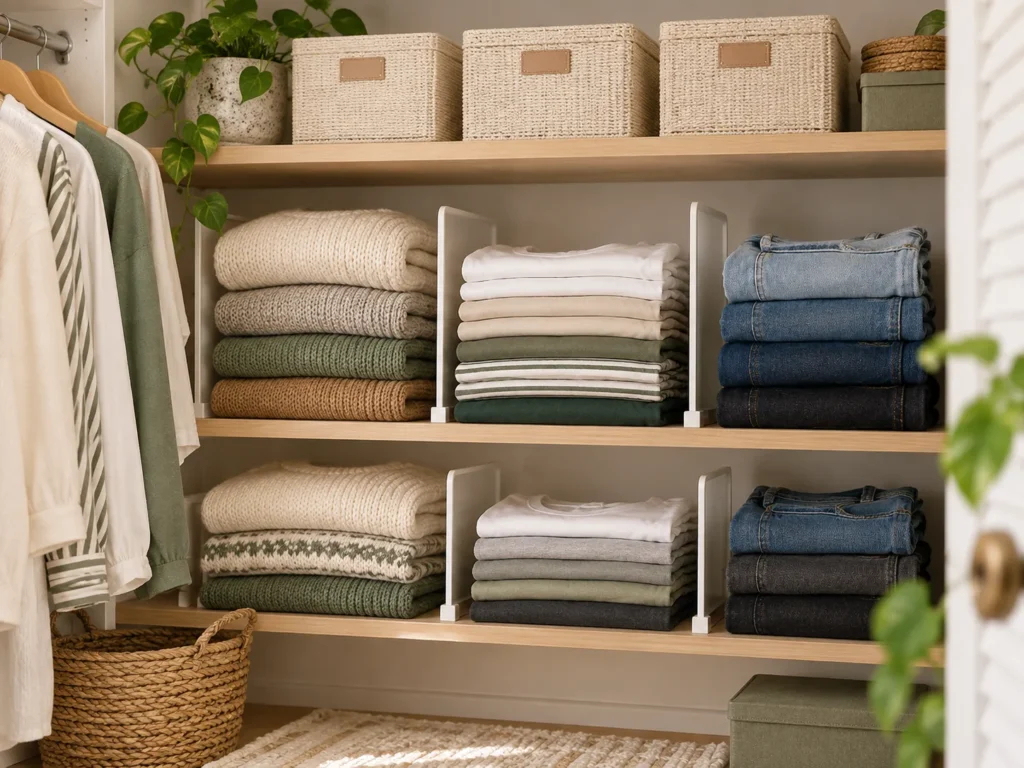
Why Small Closet Shelf Organization Falls Apart
Most small closet shelf organization problems are not caused by a lack of containers. They come from unstable stacks, poor visibility, and shelves packed so tightly that one ordinary retrieval creates a chain reaction.
Tall stacks fail from the middle
A tall sweater or T-shirt stack may look efficient because it uses vertical space, but the middle items become hard to remove. Pull one garment and the items above slide forward or collapse. If that happens every morning, the stack height is beyond its practical limit.
Wide stacks merge into each other
Without a physical or visual boundary, jeans lean into sweaters, sweatshirts creep into T-shirts, and one category slowly steals space from the next. Narrow stack lanes make categories easier to see and return.
Deep shelves hide a second row
Deep shelves create a visibility problem. A second row can double theoretical capacity while making the back row disappear. Daily-use categories should not sit behind unrelated daily-use categories unless the entire back group can pull forward as one unit.
No reset space means laundry becomes clutter
A shelf filled edge to edge has nowhere for clean laundry to return. The first basket of folded clothes becomes a temporary pile, and the temporary pile becomes permanent. For the broader renter-friendly closet system around your shelves, see our small closet organization ideas for renters.
Start With the One-Pull Stack System
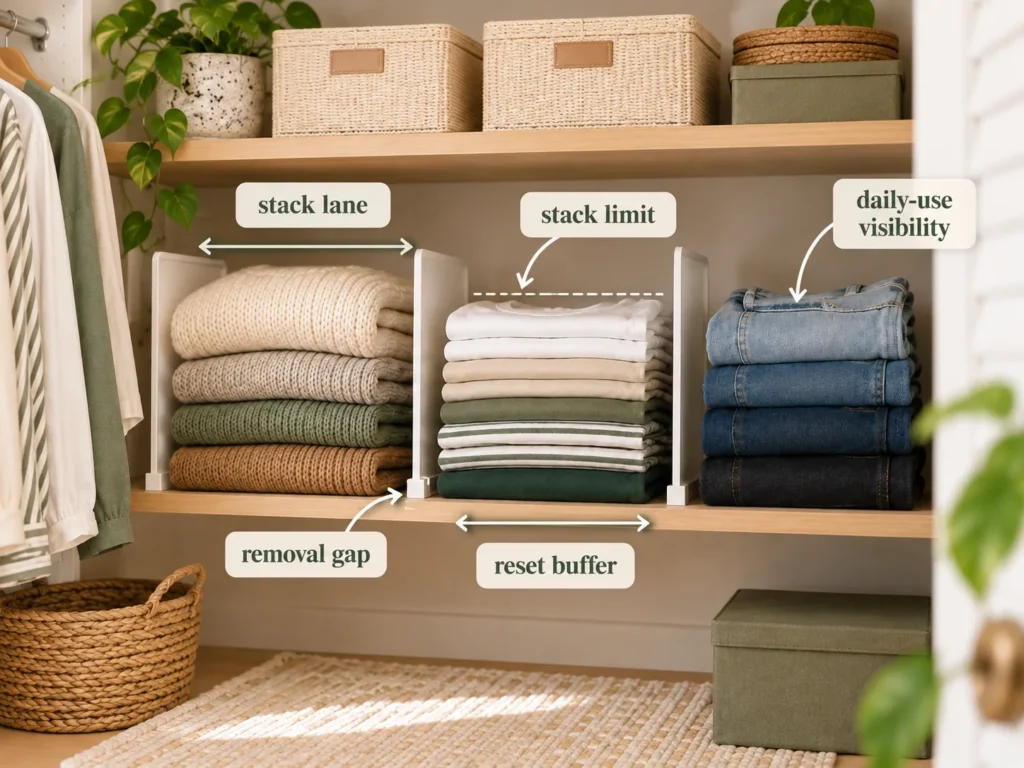
The One-Pull Stack System gives every folded-clothing shelf a few simple controls. A stack lane keeps one category from drifting into another. A stack limit stops piles from becoming too tall. A removal gap gives your fingers and the garment space to move. A visibility rule prevents daily clothing from disappearing behind another row, and a reset buffer leaves room for laundry to come back.
Control 1: stack lanes
A stack lane is the amount of shelf width assigned to one category. It might hold sweaters, jeans, sweatshirts, or folded tops. The lane can be defined by a shelf divider, the edge of a basket, or simply a consistent boundary. The important part is that the neighboring category does not have to move when you retrieve something.
Control 2: stack limit and removal gap
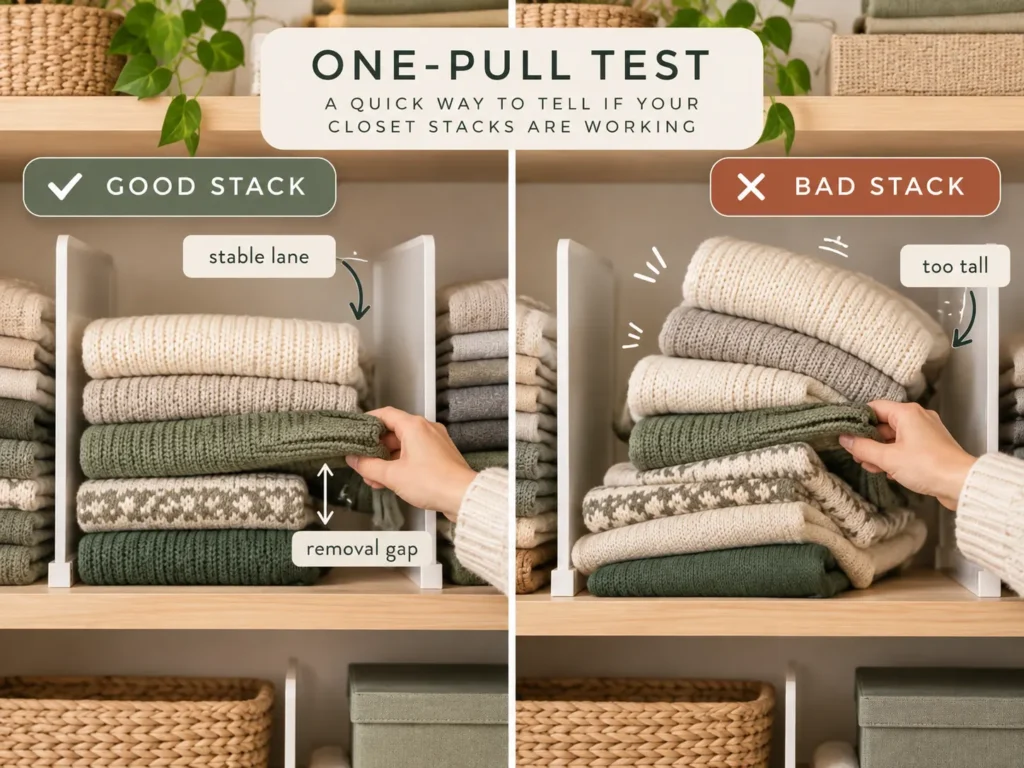
Do not choose stack height by the distance to the shelf above. Build the stack, then pull an item from the middle. If the pile collapses or you have to lift everything above it, lower the stack limit. Leave enough vertical space above the pile to grip, remove, and return an item comfortably.
Measure the Shelf Before You Build Stack Lanes
Good small closet shelf organization starts with the space you can actually reach. Record usable shelf width, shelf depth, vertical clearance to the next shelf or ceiling, and the clear access opening in front. Then note brackets, shelf lips, door returns, hanging clothes, and anything else that reduces movement.
Measure usable width and depth
Usable width is the part of the shelf where a stack or bin can sit without pressing into brackets or side walls. Usable depth is the distance a garment or container can occupy without projecting into doors, hanging clothes, or the closet opening.
Measure vertical clearance
Vertical clearance tells you how high a stack could physically become, but it should not determine how high it should become. Use the clearance to decide whether a shelf riser, bin, or second layer is possible, then let the One-Pull Test set the practical stack height.
Measure the access opening
In a reach-in closet, the shelf may extend beyond what the doorway exposes. Measure the visible opening and side pockets before placing rigid bins in hidden corners. Our small reach-in closet organization guide explains how to map blind side pockets and pull-forward access.
Build Stable Stack Lanes for Folded Clothes
The most durable small closet shelf organization layouts use smaller groups rather than one long shelf of mixed folded clothing. A lane is easier to maintain when everything in it behaves similarly.
Give each lane one clear job
Assign simple jobs such as “work sweaters,” “casual T-shirts,” “jeans,” or “sweatshirts.” Avoid vague categories like “miscellaneous clothes.” If a category is too large for one stable stack, split it by frequency or season instead of building a taller pile.
Keep similar fabric weights together
Heavy jeans and soft knitwear behave differently. Thick denim usually stays stable in a short stack, while slippery sweaters can lean or spread. Keeping similar fabric weights together makes each lane easier to control and reduces pressure on delicate pieces.
Leave a reset buffer
Do not fill the lane completely. Leave a small amount of width or height for clean laundry to return. That empty space is the reset buffer. It is not wasted capacity; it is what allows the shelf to recover after laundry day without creating a new pile on the floor.
Run the One-Pull Test
The One-Pull Test is the core of this small closet shelf organization method. Choose a normal stack, then remove one item from the middle as if you were getting dressed in a hurry.
Pull from the middle, not the top
Watch what happens to the items above and beside it. If the upper garments collapse, the stack is too tall or too slippery. If the neighboring pile moves, the lane needs more separation. If your fingers cannot reach the garment without dragging the entire stack forward, you need more removal gap.
Return the garment without rebuilding
Then fold the item and put it back in the same place. If returning it requires lifting the whole stack with one hand while pushing the garment in with the other, the system is too tight. Reduce the stack, add a divider, or choose a different folding orientation until one item can leave and return cleanly.
Set the Stack Limit by Stability, Not Shelf Height
A working stack is not the tallest pile that fits. It is the tallest pile that still passes the One-Pull Test. Fabric thickness, friction, and folding style vary, so there is no universal number of sweaters or T-shirts that belongs in one stack.
Use shorter working stacks
Shorter stacks usually stay straighter and make individual items easier to recognize. If you repeatedly reach for the same three sweaters while six others sit underneath, the problem may be access frequency rather than folding technique.
Split oversized categories
If a category has too many items for one stable stack, create two lanes, rotate seasonal pieces, or move low-frequency items to another shelf or storage zone. For a full rotation system, use our seasonal clothes Swap-Back Plan so off-season clothing does not permanently consume prime shelf space. Do not solve excess inventory by making the stack taller than you can use.
Use Shelf Dividers When Stacks Lean Sideways
Shelf dividers are useful when a stack is basically stable but tends to lean into the neighboring category. They create a vertical boundary while keeping folded clothes visible.
Dividers define lanes without hiding clothes
Use a divider between sweaters and jeans, between two T-shirt lanes, or at the end of a stack that has no wall support. The divider should prevent sideways migration, not compress the pile tightly.
Choose dividers that fit the shelf type
Choose a divider compatible with the actual shelf. Solid wood, laminate, and wire shelves may require different clip shapes or attachment methods. Check the product fit range and installation instructions rather than forcing a rigid clip onto the wrong shelf profile.
Do not use dividers to support unstable towers
A divider cannot make an overly tall stack easy to retrieve. If the middle item still causes the pile to collapse vertically, lower the stack first. Dividers solve sideways instability, not excessive height.
Use Bins When Containment Matters More Than Visibility
Bins are not automatically better than open stacks. They are most useful when the category contains loose, soft, or irregular items that would otherwise slump across the shelf.
Good categories for open baskets
Open baskets work well for scarves, workout accessories, small bags, rolled sleepwear, or other categories you can identify at a glance. A front opening or low side can make daily-use contents easier to retrieve without pulling the whole basket down.
When clear bins help
Clear bins help when containment matters but you still want visual inventory. They can work for occasional accessories or seasonal categories. Check that the bin can pass through the closet opening and that you can grip it safely when loaded.
When opaque bins make sense
Opaque bins are better for low-frequency items when visual calm matters more than instant recognition. Label the visible face with a specific category. For delicate or historic textiles, the Smithsonian recommends careful support and avoiding pressure or crushing during storage; ordinary household clothing does not require museum-level storage, but the same principle supports keeping delicate pieces out from under heavy stacks. See the Smithsonian’s textile-storage guidance.
Organize Deep Closet Shelves Without Losing the Back Row
Deep shelves tempt you to build two rows, but the back row becomes a memory problem. The strongest rule is simple: do not put one daily category behind a different daily category.
Do not hide unrelated daily categories
If everyday T-shirts sit in front of everyday sweaters, one category will always be hidden. Instead, keep daily categories side by side when possible. If the shelf is too narrow, move the lower-frequency category to another zone rather than burying it.
Use pull-forward storage for the back
If you must use the back, store a backup of the same category or use one complete pull-forward container. A handled bin can bring the entire back group forward at once. The back row should move as one unit rather than requiring you to unload the front row piece by piece.
Use High Shelves for Lightweight, Low-Frequency Storage
High shelves are valuable, but they are poor places for heavy daily-use items. A container can be clearly visible and still be awkward to lift down safely.
Visibility and reach are different
Use upper shelves for lightweight seasonal clothing, spare soft goods, occasional bags, or clearly labeled low-frequency categories. If handbags are part of that shelf, our handbag storage Bag-Envelope Plan helps account for handles, depth, hardware, and lift-out clearance. Keep the items you reach for every week closer to eye or shoulder level whenever possible.
Keep heavy items lower
Avoid heavy boxes, dense stacks of jeans, glass, or other hard objects overhead. If a container is difficult to control with two hands, it belongs lower. The goal is easy retrieval, not simply using every cubic inch above the rod.
Make high bins easy to identify
Label the side of the bin that faces the doorway. If the shelf is deep, use one pull-forward container instead of several loose items. A high shelf should require fewer decisions because you already have less visual and physical access.
Adapt Small Closet Shelf Organization to Wire Shelves
Small closet shelf organization on wire shelving needs a slightly different approach because narrow wire spacing can leave small items uneven, and clips or dividers may not fit the same way they do on solid shelves.
Use a stable folding surface when needed
If folded items sag between wires or become hard to slide, use a manufacturer-compatible liner or another approved stable surface. Avoid improvised materials that can shift, block ventilation, or interfere with the shelf system.
Check divider and bin compatibility
Choose bins and dividers designed for the shelf profile. Measure wire spacing, shelf thickness, and front lip before buying. A divider that grips a solid shelf may not attach securely to a ventilated wire shelf.
Store Sweaters, Jeans, and Delicate Clothes Differently
One shelf does not have to use one storage method for every garment. Fabric weight and structure should influence the stack lane. Soft knitwear, denim, and delicate pieces behave differently when stacked, so treating them identically usually creates either wasted space or excessive pressure.
Sweaters need support, not compression
Sweaters usually benefit from folding rather than hanging when hanging would stretch the shoulders. Keep sweater stacks short enough that bottom pieces are not heavily compressed and middle garments can be removed cleanly. A divider can stop a soft stack from leaning, but it should not squeeze the pile.
Jeans and delicate pieces need different limits
Jeans are heavier and usually more stable in a compact stack, yet very tall denim piles become difficult to lift. Delicate knitwear, embellished pieces, and sentimental garments should not sit underneath heavy stacks. The U.S. National Park Service’s textile-care guidance emphasizes supporting textiles and minimizing damaging pressure and folds in long-term storage. Household closets can apply the practical part of that principle by giving delicate pieces their own light stack or protected container. See the NPS textile-storage guidance.
Organize Shared Closet Shelves by Ownership and Frequency
Shared shelves become confusing when every stack looks interchangeable. If two people share the closet, our Two-Home-Base Plan shows how to divide shelf, hanging, shoe, and accessory zones without forcing a 50/50 split. Give each person a defined lane or shelf section first, then organize within that boundary by frequency. Instead of mixing both people’s jeans in one pile, create left and right lanes or separate shelf levels. Ownership boundaries make laundry return faster because there is only one correct destination.
Shared items such as spare linens, travel accessories, or seasonal gear should have their own labeled bin or shelf zone. Do not let the shared category expand into personal daily-use lanes simply because there is temporary empty space. If one person has substantially more folded clothing, give that person more shelf width deliberately rather than allowing categories to drift across the entire shelf.
Compare Small Closet Shelf Organization Methods
The best small closet shelf organization method depends on whether the problem is leaning, loose contents, deep access, or excess vertical clearance. Use the table below to choose the smallest intervention that fixes the actual failure.
| Method | Best use | Main tradeoff |
|---|---|---|
| Open stack | Visible folded clothes | Can lean or collapse |
| Shelf divider | Stable stack lanes | Does not contain loose items |
| Open basket | Soft or irregular daily categories | Uses shelf width |
| Clear bin | Containment with visibility | Needs pull-out clearance |
| Opaque bin | Seasonal or low-frequency items | Requires labeling |
| Shelf riser | Unused vertical clearance | Adds another retrieval layer |
| Pull-forward bin | Deep shelf back zone | Needs clear front path |
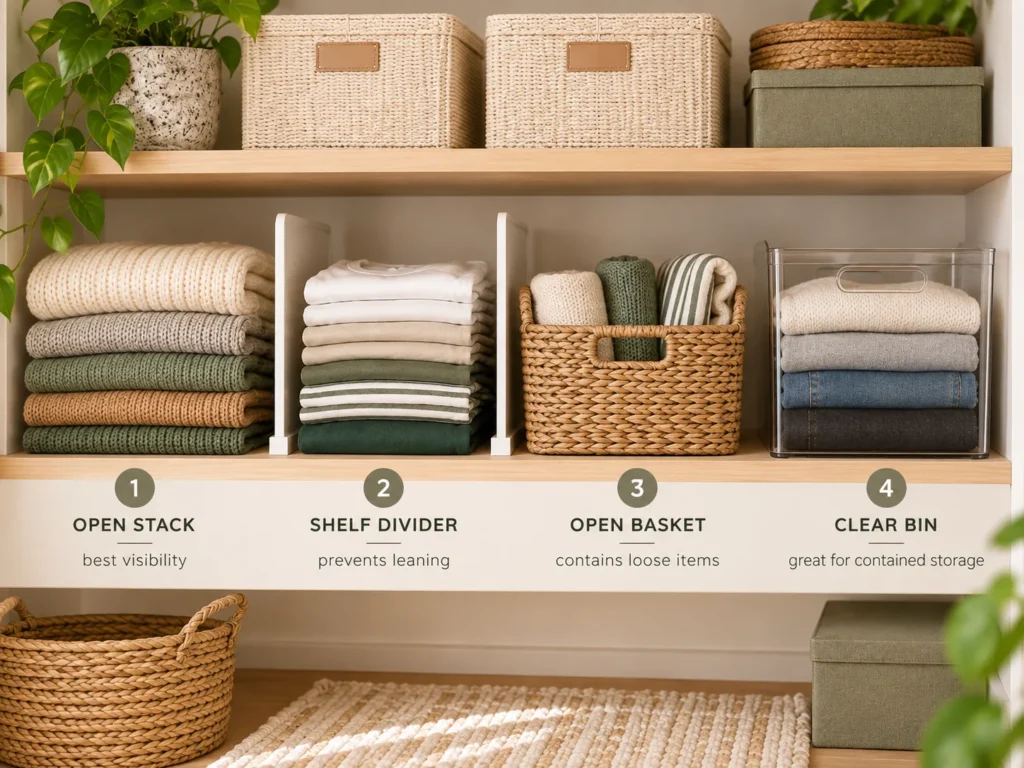
Choose open stacks when visibility is the priority, dividers when stacks lean, baskets when small soft items spread, and bins when containment matters more than instant access. Start with folding, lane boundaries, and stack height before buying multiple organizers. If a shorter stack already passes the One-Pull Test, a divider may be the only product you need.
Three Layouts and the Mistakes to Avoid
Layout A: one high shelf above a closet rod. Keep lightweight seasonal items in two labeled pull-forward bins and reserve one visible center section for a low stack of occasional sweaters. Daily folded clothes are usually better in drawers or another easier-to-reach zone.
Layout B: three adjustable solid shelves. Use the middle shelf for daily sweater and T-shirt stack lanes, the lower shelf for jeans and sweatshirts, and the highest shelf for low-frequency bins. Add dividers only between stacks that actually lean.
Layout C: deep reach-in shelf. Keep daily categories side by side at the front and use one handled pull-forward bin at the back for seasonal backup items. If the shelf disappears behind the doorway, use the access rules in our reach-in closet organization guide.
Across all three layouts, avoid the same failures: building stacks to the shelf above, using bins for everything, hiding unrelated daily categories front-to-back, filling every inch, using dividers to prop up unstable towers, and storing heavy objects overhead. Before buying anything, measure shelf width, depth, vertical clearance, and doorway access; identify which stack fails the One-Pull Test; and decide whether the real problem is leaning, containment, or access.
Small Space Scout rule: if pulling one folded item forces you to rebuild the shelf, the stack is too tall, too wide, too tight, or insufficiently separated.
Frequently Asked Questions
How do I organize shelves in a small closet?
Start by grouping folded clothes into clear categories, then give each category a stack lane. Keep stacks short enough to pass the One-Pull Test, use dividers only where piles lean, and leave a small reset buffer for clean laundry.
How high should I stack folded clothes?
There is no universal number. Stack only as high as you can remove an item from the middle and replace it without the pile collapsing. Fabric thickness and slipperiness matter more than a fixed count.
Are shelf dividers worth using?
Yes, when stacks are stable vertically but lean sideways into neighboring categories. Dividers define lanes while keeping clothing visible. They are less useful for loose accessories that need containment.
Should I use bins for clothes on closet shelves?
Use bins when the category is loose, irregular, seasonal, or easier to manage as one contained group. Open stacks are often better for daily folded clothes because you can see individual garments immediately.
How do I organize a deep closet shelf?
Avoid putting unrelated daily categories in front of one another. Keep daily items at the front and use a complete pull-forward container for backup or low-frequency items at the back.
What should go on the top closet shelf?
Use the highest shelf for lightweight, lower-frequency items such as seasonal clothing, spare soft goods, or occasional accessories in clearly labeled containers. Keep heavy or frequently handled items lower.
How do I keep sweater stacks from falling over?
Reduce the stack height, group similar fabric weights together, and add a shelf divider if the pile still leans sideways. Do not use a divider to hold up a stack that is already too tall to retrieve comfortably.
Build Shelves Around Retrieval, Not Maximum Capacity
The strongest small closet shelf organization system is one that survives an ordinary week. Give each folded category a clear lane, set the stack limit with the One-Pull Test, leave enough removal gap to use the middle of the pile, and keep a reset buffer for laundry.
Use shelf dividers for leaning stacks, baskets for loose daily categories, bins for low-frequency containment, and pull-forward storage for deep shelves. Do not add an organizer unless it fixes a specific access problem.
For the complete renter-friendly closet framework, see our small closet organization guide. For shoe storage on closet shelves or floors, use our small closet shoe storage guide. You can also browse the full Closet Organization collection.