
How to Organize a Closet With One Rod and One Shelf: A Load-Balance Plan
If you are wondering how to organize a closet with one rod and one shelf, start by balancing storage across three usable zones instead of asking the rod to solve every problem. Keep the rod for clothing that truly needs to hang, use the shelf for lightweight folded or lower-frequency items, and reserve the floor for shoes or one compact freestanding solution beneath short garments.
This guide uses a Load-Balance Plan: Rod Budget, Shelf Budget, and Floor Budget. Every organizer has to earn the space it consumes. A hanging cubby spends rod width, a second rod spends vertical drop, drawers spend floor depth, and a shoe rack spends floor width.
Quick answer: protect long-hang clothing first, group short garments together, test whether the rod can still slide comfortably, keep the shelf retrievable rather than packed, then measure the floor only after the hanging clothes are loaded. Add one organizer at a time and rebalance if one zone becomes crowded while another stays underused.

Why a One-Rod, One-Shelf Closet Gets Overloaded
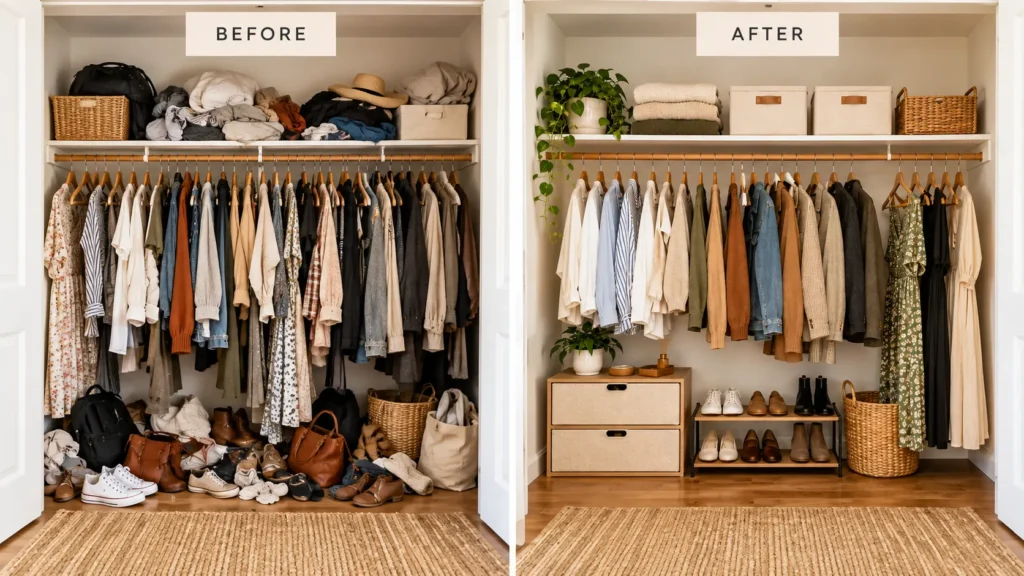
Understanding how to organize a closet with one rod and one shelf starts with recognizing what the builder-grade layout actually gives you. A basic rental closet often starts with one fixed rod, one shelf above it, and an open floor. That looks flexible, but it creates a predictable problem: the rod becomes responsible for hanging clothes, hanging cubbies, bags, accessories, and sometimes a second lower rail. The result is a closet with plenty of “storage products” but very little breathing room.
The rod becomes the default answer to every problem
When folded clothes do not have a clear home, a hanging organizer seems convenient. When more shirts arrive, a second rod seems logical. When bags are hard to see, accessory hangers appear. Each solution spends rod width or vertical drop. Eventually the rod cannot slide, long garments have nowhere to fall, and the closet feels smaller than before.
The shelf becomes a catch-all
The single shelf often collects everything that does not fit elsewhere: sweaters, handbags, linens, seasonal clothing, spare boxes, and random household items. Once unrelated categories share the same shelf, visibility falls and retrieval becomes slow. Our small closet shelf organization guide goes deeper into stable stacks, dividers, bins, and top-shelf access.
The floor looks empty until clothes are loaded
The floor can also be misleading. It may look open when the closet is empty, but dresses, coats, and shirts consume vertical space once the rod is loaded. A drawer tower or shoe rack that fits on the bare floor can end up under garment hems or in the path of the closet door.
More organizers can reduce usable storage
Good one rod one shelf closet organization is not about maximizing every surface independently. It is about preserving enough access in all three zones. For the broader renter-friendly framework, see our small closet organization ideas for renters.
Start With the Load-Balance Plan
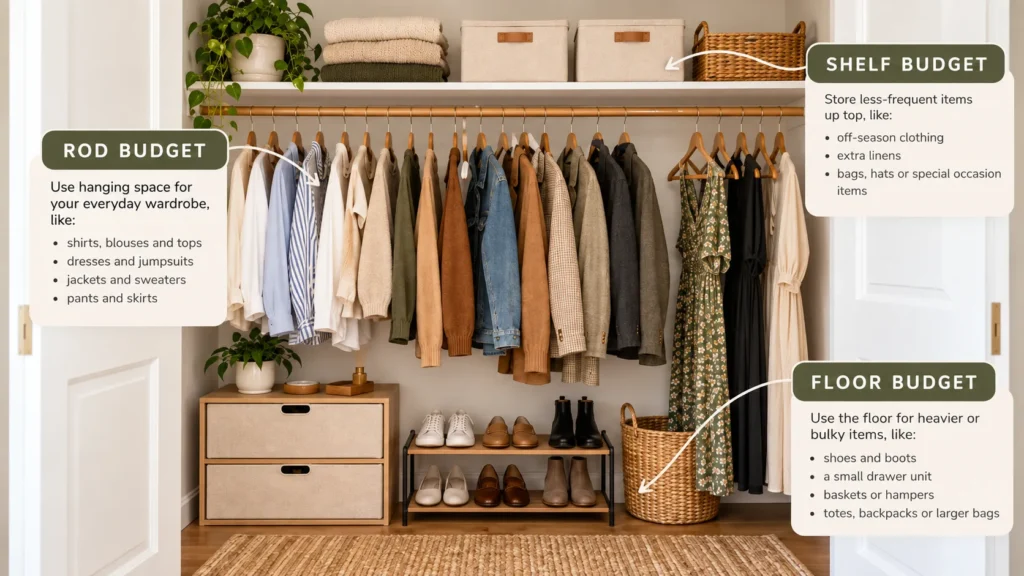
The Load-Balance Plan treats the closet as three connected budgets. Before buying anything, ask where the storage problem should be solved and what resource the proposed organizer will consume. If the rod is already crowded, adding a hanging cubby is not a neutral decision. If the shelf is already hard to reach, another deep bin may make access worse.
Rod Budget
Rod Budget is the usable hanging width plus the vertical drop beneath it. Spend it first on garments that genuinely benefit from hanging: dresses, coats, jackets, shirts, wrinkle-prone pieces, and trousers you prefer on hangers. Every hanging shelf, accessory hanger, or lower rail reduces some part of that budget.
Shelf and Floor Budgets
Shelf Budget is the width, depth, and retrieval space above the rod. Floor Budget is the usable footprint that remains after clothes hang at their normal length and the door moves normally. Folded clothing, shoes, drawers, and seasonal storage should use whichever budget has spare capacity rather than automatically moving onto the rod.
How to Organize a Closet With One Rod and One Shelf: Measure First
Before deciding how to organize a closet with one rod and one shelf, measure the closet in its working state. Record usable rod width, rod height, the drop of short and long garments, shelf width and depth, floor width and depth, and the doorway opening. Note trim, shelf brackets, baseboards, door tracks, and hidden side pockets.
Measure usable rod width and garment drop
For the rod, measure from the first hanger position that clears the side wall to the last usable position. Then hang one of your longest garments and one of your shortest. The difference between those hem heights determines where a lower rod, shoe rack, or drawers might fit without crushing clothing.
Measure shelf access, not just shelf size
For the shelf, measure what you can actually reach from the doorway. A shelf can be wider than the visible opening, especially in a reach-in closet. If the sides disappear behind wall returns, rigid bins may fit but be difficult to remove. Our small reach-in closet organization guide explains blind pockets and pass-through clearance in more detail.
Measure the floor with clothes and doors in place
For the floor, measure after the rod is loaded and the closet door is operating normally. Open drawers, sliding panels, or bifold doors fully. The usable footprint is the part that remains reachable after clothing, door travel, and retrieval paths are accounted for.
What Should Go on the Single Closet Rod?
The single rod should serve the clothing categories that gain the most from hanging. That usually means long garments, jackets, shirts, wrinkle-prone pieces, and frequently worn clothing that is faster to choose when visible. Do not use the rod as default storage for every category simply because it already exists.
Protect long-hang space first
Protect long-hang space first. Group dresses, coats, long cardigans, and other full-length pieces at one end. This creates one uninterrupted vertical lane and prevents a future lower rod, drawer unit, or shoe rack from blocking garment hems.
Give the visible center to active short-hang clothes
Give the easiest-to-see center portion to active short-hang clothes such as shirts, blouses, folded-over trousers, and short jackets. These pieces may later support storage underneath because their hems stop higher than long garments.
Run the Rod-Pressure Test
Rod-Pressure Test: load the rod with the clothes you plan to keep there, then try to slide individual hangers apart with one hand. If hangers are compressed so tightly that you have to force them or move a whole group at once, the rod is already over budget. Edit the wardrobe or move folded categories elsewhere before adding another hanging organizer.
Should You Add a Second Hanging Rod?
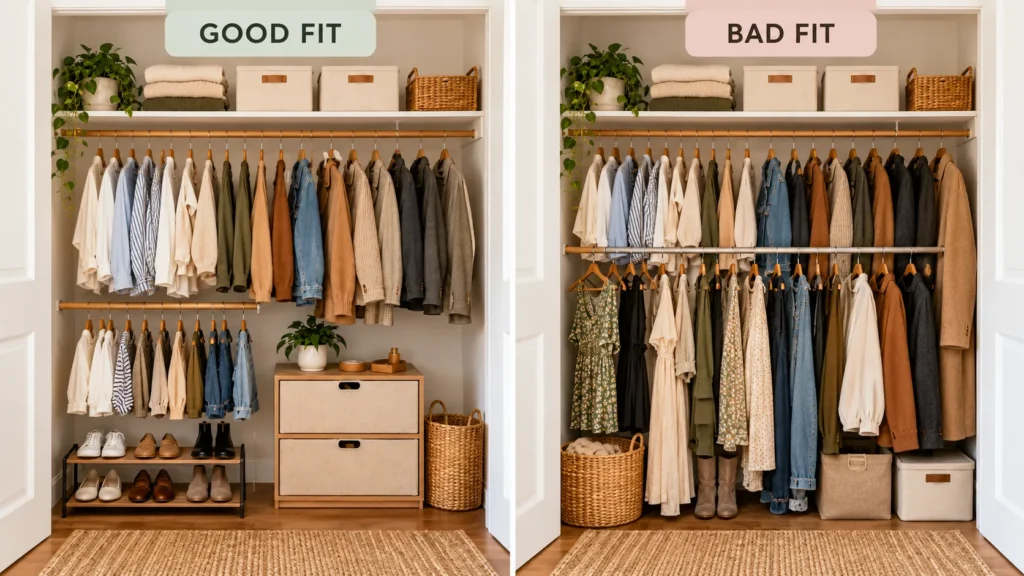
When deciding how to organize a closet with one rod and one shelf, a second rod should be a response to a specific short-hang problem rather than an automatic “double your space” upgrade. It spends vertical drop and often removes part of the floor budget.
When a lower rod can help
A lower removable rail makes sense when a large portion of the wardrobe is short-hang clothing, the upper garments leave enough vertical clearance, both rows remain visible, and you value hanging capacity more than floor drawers or shoe storage. Measure with the upper row fully loaded and follow the lower-rod product’s fit and load instructions.
When a second rod makes the closet worse
Skip or reduce the second rod when dresses and coats dominate, when the lower row would sit behind a sliding-door blind spot, when it would block the only practical shoe or drawer zone, or when the original rod already carries a hanging cubby. If you have no shelf at all, our small closet with no shelves guide explains the tradeoff between lower rods, hanging cubbies, and floor storage in more detail.
Hanging Cubby or Lower Rod: Which Uses the Rod Budget Better?
A hanging cubby and a lower rod solve different problems. The cubby creates folded-item compartments but consumes horizontal rod width. The lower rod creates more hanging capacity but consumes vertical drop. The better choice depends on what your closet lacks.
Choose based on the missing function
Choose a hanging cubby when you genuinely need folded storage, the rod still has spare width after the Rod-Pressure Test, and the floor is unavailable or better used for shoes. Choose a lower rod when short-hang clothing is the dominant problem and the shelf already handles folded items adequately.
Use floor drawers when rod width is the scarce resource
If rod width is tight but the floor beneath short garments is open, low freestanding drawers may solve folded storage more efficiently. If you use a freestanding clothing-storage unit, follow the manufacturer’s stability and anti-tip instructions. The U.S. Consumer Product Safety Commission’s guidance on clothing storage units explains stability requirements and anti-tip provisions for covered products.
What Should Go on the Single Shelf?
A key part of how to organize a closet with one rod and one shelf is keeping the shelf retrievable rather than turning it into a storage attic. Use it for folded items, lightweight accessories, or lower-frequency categories that remain easy enough to retrieve. The best shelf contents depend on height: a shelf near eye level can serve active clothing, while a high shelf is better for lightweight occasional storage.
Keep lightweight active or occasional categories visible
If sweaters, jeans, or folded tops live on the shelf, create small stable groups rather than one continuous wall of clothing. Keep categories visible and leave enough gap to remove one item without disturbing neighboring stacks. This is where the One-Pull Stack System from Article #25 becomes useful.
Run the Shelf-Retrieval Test
Shelf-Retrieval Test: take one normal item or container from the shelf using the same movement you would use on a weekday. If you must unload items in front, lift several stacks, or pull down a heavy bin just to reach one thing, the shelf is over budget. Reduce the category, split it, or move lower-frequency items elsewhere.
Use deep or high shelf space for lower-frequency storage
On a deep or high shelf, use clearly labeled pull-forward bins for lightweight seasonal or occasional items. Do not hide one daily category behind another daily category. The back of the shelf should either contain a backup of the same category or move forward as one unit.

What Should Go on the Closet Floor?
For anyone learning how to organize a closet with one rod and one shelf, the floor budget is most useful beneath short garments because that is where vertical space remains after the rod is loaded. Long-hang lanes should usually stay clear so dresses and coats do not rest on shoes, bins, or furniture.
Use the floor beneath short garments first
A low shoe rack is a good choice when shoes are the main floor problem and folded clothing already has a home. Count the pairs that genuinely need closet access and measure the largest everyday pair before selecting a rack. Our small closet shoe storage ideas guide covers pair width, shoe depth, boot height, and rack tradeoffs in detail.
Choose between a shoe rack and low drawers
Low drawers make more sense when folded clothing is the bigger bottleneck and enough depth remains for the drawers to open fully. Do not assume a unit fits because the closed cabinet fits the footprint. Test full drawer extension with the closet door and nearby furniture in place.
Run the Floor-Footprint Test
Floor-Footprint Test: hang the real clothing first, mark the proposed organizer footprint with painter’s tape, open every relevant door or drawer, and retrieve an item from the back of the closet. If the organizer blocks garment hems, door travel, cleaning, or retrieval, reduce its footprint.
Where Should Folded Clothes Go?
Folded clothes do not automatically belong in a hanging cubby. In a one-rod, one-shelf closet, folded storage should go to the zone with the most spare capacity and the least access penalty.
Use the shelf when visibility is the priority
Use the shelf for folded clothes when it is reachable, the stacks stay visible, and the Shelf-Retrieval Test passes. Sweaters, jeans, sweatshirts, and folded tops can work well there when each category has a clear lane and enough reset space for laundry.
Use drawers or another zone when the shelf is already full
Use low drawers, a dresser, or another appropriate storage zone when the shelf is already serving seasonal bins or is too high for daily folded clothing. If the bedroom has no dresser at all, use our clothes-without-a-dresser Frequency-Friction Plan to rebuild easy daily access without overloading the rod. Moving one category outside the closet can be better than attaching another organizer to an overloaded rod.
How to Organize a Closet With One Rod and One Shelf by Access Frequency
A good one rod one shelf closet organization plan gives the easiest spaces to the items that move most often. Access frequency helps decide which category deserves the visible center, the front of the shelf, or the open floor zone.
Active items get the easiest rod, shelf, and floor positions
Active items are worn weekly and should be visible with one-move retrieval. They belong in the center of the rod, front of a reachable shelf, or easiest shoe tier. These are the categories that create friction when buried.
Occasional and seasonal items can use harder zones
Occasional items can tolerate side positions, upper shelf bins, or a second retrieval move. Seasonal items can use the highest shelf, under-bed storage, or another dry location outside the closet. Prime closet space should not be permanently reserved for items you will not use for months.
Run the Balance Test
Balance Test: after organizing, ask three questions. Can hangers slide on the rod? Can one shelf item come out without unloading the shelf? Can the floor be reached and cleaned without moving several objects? If one zone fails while another remains mostly empty, rebalance before buying another organizer.
Compare the Main Storage Moves
Use this table to decide where the next storage problem should be solved. It is designed to be a quick answer for both readers and search/answer systems evaluating how to organize a closet with one rod and one shelf.
| If your problem is… | Best budget to check first | Consider | Avoid when… |
|---|---|---|---|
| Too many short garments | Rod + vertical drop | Removable lower rod | Long garments dominate |
| No folded-clothes home | Shelf or floor | Stable stacks, bins, low drawers | Rod is already crowded |
| Shoes cover the floor | Floor | Low shoe rack | Long hems need the same zone |
| Shelf is overflowing | Secondary storage | Seasonal rotation | Daily categories are being hidden |
| Rod is crowded | Shelf/floor/outside closet | Move folded categories off rod | Adding another hanging cubby |
| Floor under shirts is empty | Floor | Low drawers or shoe storage | Drawer extension is blocked |
Solve the problem in the least-crowded budget
Choose the budget with spare capacity. If the rod is crowded but the floor under shirts is empty, use the floor. If the floor is blocked but the shelf is easy to reach, improve the shelf. If all three are at practical capacity, the next step is editing or secondary storage, not another organizer.
Avoid solving every problem on the rod
Adding products to the most crowded zone usually makes the system worse. In particular, hanging cubbies, accessory hangers, and lower rods all compete for the same structural resource. Use them selectively rather than stacking solutions onto the rod.
Three One-Rod, One-Shelf Closet Layouts
These examples show how the same closet can use different balances. A third useful setup is a folded-clothes-heavy wardrobe: keep a moderate short-hang rod, use the shelf for stable daily stacks, place low drawers beneath shirts, and move most seasonal shoes or bulky pieces outside the closet. The correct layout follows the wardrobe, not a universal template.
Layout A: mostly short-hang clothes
Mostly short-hang clothes: reserve a small end section for long pieces, use the center for active shirts and jackets, add a lower rod only across part of the closet, keep the shelf for lightweight folded or seasonal items, and use the remaining floor for one low shoe rack. This setup spends more of the vertical-drop budget because hanging capacity is the priority.
Layout B: mixed wardrobe with dresses and coats
Mixed wardrobe with dresses and coats: protect one full-height long-hang lane, keep short garments in the visible center, skip a full-width second rod, use the shelf for folded sweaters and one seasonal bin, and place low drawers only under short clothing. This setup preserves long-hang and floor flexibility.
Avoid the Most Common One-Rod, One-Shelf Mistakes
The biggest mistakes happen when storage is added without considering which budget it consumes. Avoid these failures:
- Putting every problem on the rod: hanging cubbies, accessory hangers, and lower rails all reduce rod capacity.
- Running a second rod across the full closet: protect the long-hang lane first.
- Buying floor storage before loading clothes: garment hems change the usable floor height.
- Turning the shelf into mixed overflow: every shelf category should have a clear job.
- Filling the shelf edge to edge: retrieval and laundry return need buffer space.
- Using drawers that cannot fully open: measure extension into the room.
- Keeping seasonal items in prime zones: access frequency should control placement.
- Assuming no-drill means no risk: follow exact product instructions and check the lease before using adhesives or other mounts.
For removable adhesive accessories, surface condition and removal method matter. Command’s official FAQ notes that weak, old, uncured, or damaged paint can pull away and that correct removal technique is important.
Use This Pre-Buy Load-Balance Checklist
- Measure usable rod width.
- Measure the drop of the shortest and longest garments.
- Protect a full-height lane if you own long clothing.
- Run the Rod-Pressure Test before adding a hanging organizer.
- Measure shelf width, depth, height, and doorway access.
- Run the Shelf-Retrieval Test with a real item or loaded bin.
- Load hanging clothes before measuring the floor.
- Mark the proposed floor organizer with painter’s tape.
- Open closet doors and proposed drawers fully.
- Decide whether the problem belongs to the rod, shelf, or floor budget.
- Move seasonal items out of prime access before buying more storage.
- Follow manufacturer fit, load, installation, and anti-tip instructions.
- Check lease rules before adhesives, screws, or permanent modifications.
- Leave a reset buffer for clean laundry.
Small Space Scout rule: every organizer should solve one clear problem without making another storage budget harder to use.
Quick Decision Guide: What Should You Add Next?
If the rod is crowded but the floor is open: do not add a hanging cubby first; consider low drawers or move folded categories off the rod.
If the rod has room but folded clothes have no home: a narrow hanging cubby can work, provided the Rod-Pressure Test still passes after installation.
If short garments dominate and floor storage is less important: consider a partial lower rod.
If the shelf is packed with seasonal items: rotate or relocate seasonal storage before adding another organizer.
If shoes are the only floor problem: use a measured low rack rather than a large drawer tower.
If all three budgets are crowded: edit inventory or move low-frequency categories outside the closet. More products are unlikely to improve access.
Frequently Asked Questions
How to organize a closet with one rod and one shelf?
Balance the closet across three zones. Keep true hanging clothes on the rod, use the shelf for retrievable folded or lower-frequency items, and place shoes or low drawers beneath short garments. Add organizers only where that zone still has spare capacity.
What should I put on the single closet rod?
Use the rod for clothing that benefits from hanging: dresses, coats, shirts, jackets, wrinkle-prone pieces, and frequently worn garments. Protect long-hang space before adding lower rails or hanging cubbies.
What should go on the top shelf?
Use a reachable shelf for stable folded stacks or lightweight accessories. Use a high shelf for clearly labeled, lightweight occasional or seasonal items. Avoid heavy boxes overhead and unrelated daily categories hidden behind one another.
Should I add a second closet rod?
Add a lower rod when short-hang clothing dominates, enough vertical drop remains, both rows stay visible, and floor storage is less valuable. Skip it when long garments, drawers, or shoe storage need the same vertical space.
Where should folded clothes go?
Use the shelf when folded clothes remain visible and easy to retrieve. Use low drawers or another storage zone when the shelf is high, full, or better reserved for seasonal items. Do not automatically spend rod width on hanging cubbies.
What should I put on the closet floor?
Use the floor for shoes, low drawers, or one compact bin beneath short garments. Keep the long-hang lane clear and test door movement, drawer extension, cleaning access, and garment hems before buying.
How do I know if the closet is over-organized?
If hangers cannot slide, shelf items require unloading, and floor storage blocks retrieval or cleaning, the system is over capacity even if everything technically fits. Rebalance or reduce inventory before adding another organizer.
Balance the Rod, Shelf, and Floor Before Adding More
The best answer to how to organize a closet with one rod and one shelf is to stop treating the rod as the only expandable resource. Protect true hanging clothes, keep the shelf retrievable, and use the floor only where loaded garments and doors leave real working space.
Run the Rod-Pressure Test, Shelf-Retrieval Test, Floor-Footprint Test, and final Balance Test before buying another organizer. If one zone is crowded while another has spare capacity, move the storage problem instead of adding more products to the crowded area.
For the complete renter-friendly framework, use our small closet organization guide. If your closet has no built-in shelf, see our small closet with no shelves guide. For shelf-specific folded storage, use our small closet shelf organization guide, and for shoes use our small closet shoe storage guide. You can also browse the full Closet Organization collection.