
How to Organize a Small Closet for Two People: A Two-Home-Base Plan
If you are figuring out how to organize a small closet for two people, do not start by drawing a line down the middle. Start by giving each person a complete “home base” for the storage jobs they actually use: hanging clothes, folded clothes, shoes, and everyday accessories. Then keep shared storage small and clearly defined.
This guide uses a Two-Home-Base Plan. Person A and Person B each get personal hanging, folded, and shoe zones sized to their wardrobe, not to an automatic 50/50 split. A separate shared neutral zone holds only genuinely shared items. The system is then tested with a normal laundry load to make sure both people can put things away without moving the other person’s belongings.
Quick answer: divide the closet by storage function rather than equal inches, build one complete return path for each person, use visible physical boundaries, and create an overflow rule so one person’s growing wardrobe does not silently migrate into the other person’s zone.
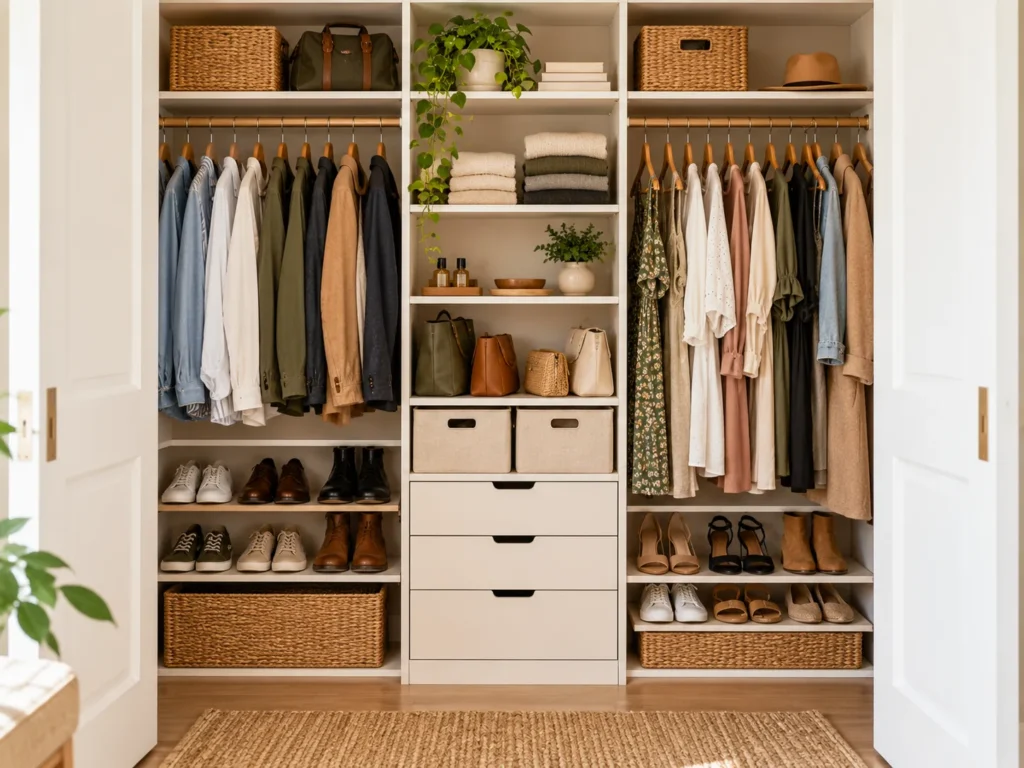
Why a 50/50 Shared Closet Often Fails
Many guides on how to organize a small closet for two people begin with “split it in half.” That is easy to explain but often weak in practice. Two people may own similar numbers of garments while needing very different combinations of hanging height, shelf space, shoe storage, and floor clearance.
Equal width does not mean equal usefulness
One person may need more short-hang width for shirts and jackets. The other may need less rod width but more long-hang height for dresses, more folded storage for knitwear, or more floor space for shoes. Equal inches can create unequal function.
Different wardrobes need different storage jobs
Storage jobs also differ. Someone who hangs almost everything may need rod width more than shelf space. Someone who folds most casual clothing may need shelves or drawers more than a second rail. Measure the category before allocating the zone.
Invisible boundaries drift over time
A verbal rule like “your side ends around here” tends to weaken once laundry, shopping, travel bags, and seasonal items return. A shelf edge, divider, drawer, basket, hanger type, or clear physical break is easier to maintain than a boundary that exists only in memory.
Shared space can become unassigned overflow
The shared area is especially vulnerable. If it becomes the place for “things we do not know where to put,” it will eventually consume both home bases. For the complete renter-friendly closet framework around this article, see our small closet organization ideas for renters.
Start With the Two-Home-Base Plan
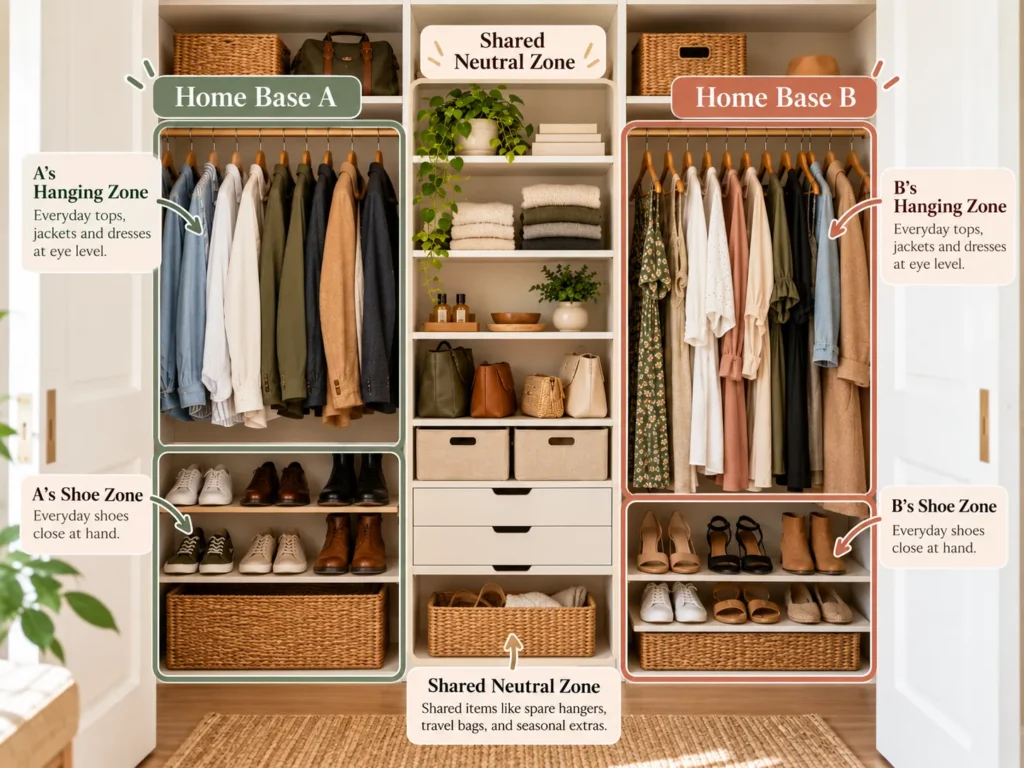
The Two-Home-Base Plan gives each person a complete storage route instead of only a “side.” Each home base should answer four questions: where do my hanging clothes go, where do my folded clothes go, where do my shoes go, and where do my everyday accessories return?
Home Base A
Home Base A can include more rod width and less shelf space if Person A hangs most clothing. It can also include a specific shoe row, drawer, or basket. The important part is that all common categories have an obvious return point.
Home Base B and the shared neutral zone
Home Base B may use a different mix. The shared neutral zone sits outside both home bases and should be limited to genuinely shared categories such as spare hangers, a shared hamper, or travel items. Unassigned overflow does not qualify as a shared category.
How to Organize a Small Closet for Two People: Inventory by Storage Job
The most reliable way to decide how to organize a small closet for two people is to inventory each wardrobe separately by storage job. Do not begin with total garment count. A long dress, a folded sweater, and a pair of boots consume three different kinds of space.
Count hanging categories separately
For each person, count long-hang garments, short-hang garments, and pieces that can reasonably be folded. This shows who needs full vertical drop, who needs the most rod width, and whether a lower rod would help or interfere.
Count folded categories separately
Next count folded categories such as sweaters, T-shirts, jeans, sweatshirts, workout clothes, and sleepwear. Decide which of those genuinely need closet storage and which can live in a dresser or another appropriate zone.
Count shoes and accessories separately
Finally count active shoes, bags, belts, hats, and other accessories. If either person owns several purses or work bags, use our handbag storage Bag-Envelope Plan to size shelf or cubby space around the bag’s full resting shape instead of body width alone. Shoes in particular can dominate a shared floor quickly, so measure the largest everyday pair instead of relying only on pair count. Our small closet shoe storage ideas guide covers shoe width, depth, and boot height in more detail.
Build a Complete Home Base for Each Person
A home base is complete only when a normal laundry load has somewhere to return. That is the practical core of how to organize a small closet for two people: both people need a full return path, not just a visual half of the closet. If Person A has a hanging section but no folded zone, folded laundry will migrate to Person B’s shelf or become a temporary pile. The same problem happens with shoes and accessories.
Give each person a hanging lane
Assign each person a hanging lane that matches the wardrobe. Use one clear endpoint such as a closet wall, shelf support, divider, or intentionally different hanger section. Keep frequently worn items nearest the easiest access point.
Give each person a folded-clothes destination
Assign a folded-clothes destination even if it is small. That might be one shelf lane, one drawer unit, or one clearly labeled basket. If shelf storage is part of the plan, our small closet shelf organization guide explains stable stack lanes and the One-Pull Test.
Give each person a shoe or floor zone
Give each person a defined shoe or floor zone. This can be separate tiers on one rack, left/right halves, or different storage formats if the shoe collections are very different. A visible boundary prevents the floor from becoming the first place where the two home bases blur together.
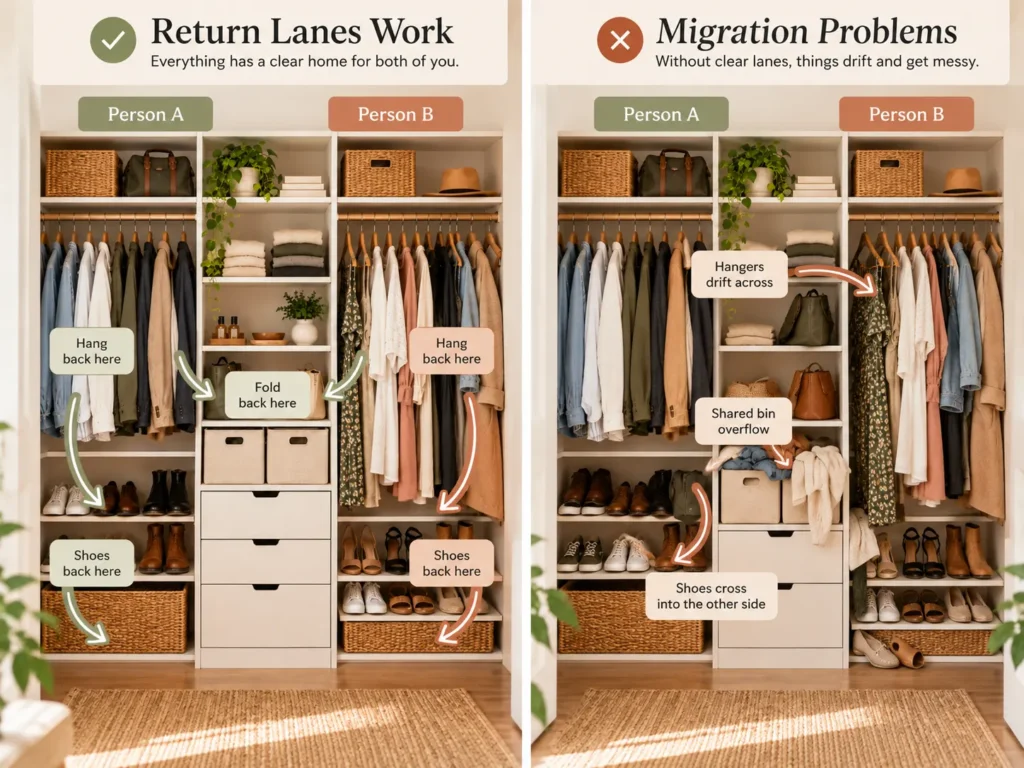
Run the Return-Lane Test
The Return-Lane Test is the core maintenance test for how to organize a small closet for two people. A closet is not truly shared well if it looks neat after setup but one person cannot put away laundry without moving the other person’s belongings.
Return Person A’s laundry without touching Person B’s zone
Take a normal clean-laundry load for Person A. Return shirts, folded clothes, shoes, and accessories using only Home Base A plus any genuinely shared zone. If an item has no obvious destination or requires moving Person B’s belongings first, Home Base A is incomplete or undersized.
Repeat the test for Person B
Then repeat for Person B. Both return routes should work independently. If one person’s laundry only fits when the other person’s section is temporarily empty, the system is not balanced enough for daily use.
Keep the Shared Neutral Zone Small and Named
The shared neutral zone should solve shared functions, not absorb uncertainty. When deciding how to organize a small closet for two people, keep this zone intentionally small so it cannot become permanent overflow for either wardrobe. Good examples include spare hangers, a shared hamper, travel organizers, or one clearly defined household category that truly belongs in the closet.
Only genuinely shared categories belong there
Use named categories rather than a vague “shared” basket. “Travel bags” or “spare hangers” is maintainable. “Miscellaneous” is not. If neither person can explain why an item belongs in shared storage, it probably belongs in one home base or outside the closet.
Create an overflow rule before overflow happens
Create an overflow rule before either wardrobe grows. For example: when a personal hanging lane is full, that person edits, rotates seasonal items, or moves low-frequency pieces elsewhere. The rule should not be “use the other person’s empty space until they need it.”
How Should Two People Divide Hanging Space?
Hanging space should be divided by garment type and access need, not by a perfect center line. The goal is for each person to have enough functional rod width while preserving the vertical drop required by long garments.
Protect long-hang needs first
Protect long-hang needs first. If one person owns dresses, long coats, or jumpsuits and the other mostly owns shirts, a full-height lane may belong primarily to the long-garment wardrobe. That does not mean the first person “gets more closet”; it means the vertical job is being assigned where it is needed.
Divide short-hang width by actual wardrobe demand
For short-hang clothing, compare the actual width each person needs after editing and seasonal rotation. A removable lower rail can help the person with many short garments, but only if it does not block shoes, drawers, or long-hang clothing.
Keep daily clothes in the easiest access
Keep active clothes in the easiest visible section of each home base. In a reach-in closet, access can be more important than nominal width. If sliding doors or wall returns hide part of the rod, use our small reach-in closet organization guide to map the visible core and blind side pockets.
How Should Two People Divide Shelf Space?
Shelf space should follow folded-clothing demand. One person may need two stable sweater lanes while the other only needs one basket for accessories. Forcing equal shelf width can leave one side half empty and the other permanently overflowing.
Use shelf lanes instead of mixed shared stacks
Use shelf lanes, bins, or drawers as physical boundaries. Avoid building one shared sweater wall unless both people genuinely want to manage the category together. Personal folded storage is usually easier to maintain when ownership is obvious.
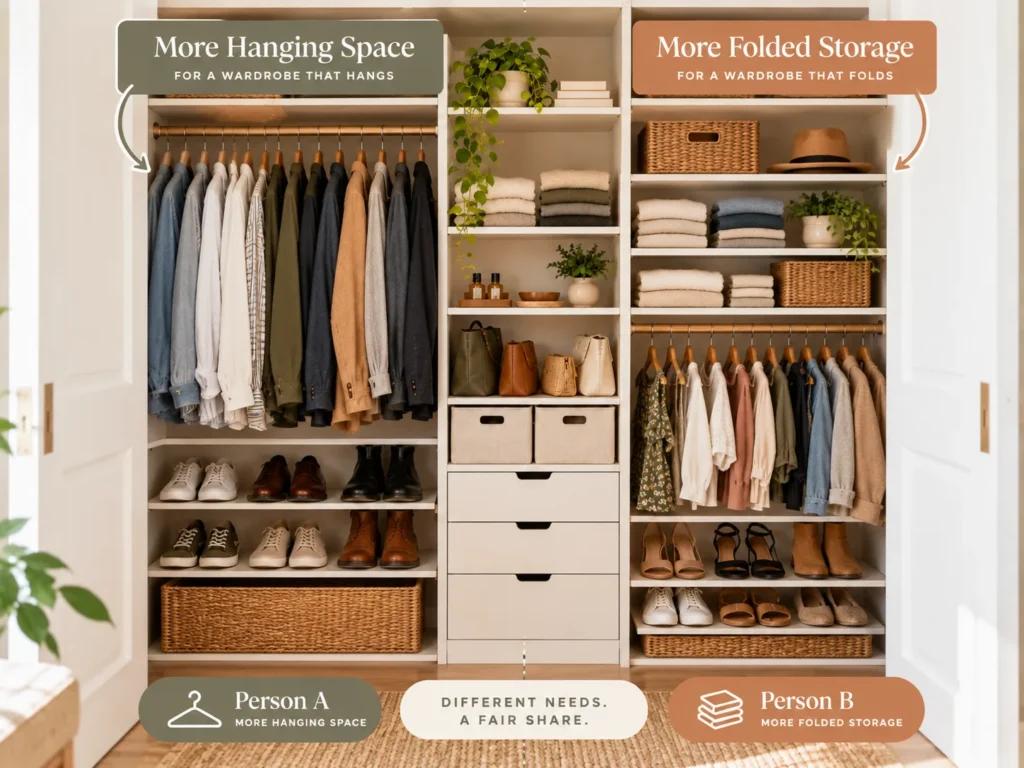
Give more shelf width to the person who folds more
If one person folds far more clothing, give that person more shelf or drawer capacity while the other person receives more rod width. Functional fairness does not require identical storage formats.
Keep shared shelf categories separate
Keep shared shelf categories in a dedicated location rather than placing them between personal stacks. This prevents a shared bin from gradually expanding and pushing both people’s clothing outward.
How Should Two People Divide Shoes and Floor Space?
Shared floors become cluttered quickly because shoes are easy to drop and difficult to separate visually. Give each person an active shoe zone sized to the pairs they wear regularly, then move seasonal or occasional footwear to secondary storage when the floor is tight.
Give each person an active shoe zone
Use separate rack tiers, left/right halves, or different organizers if shoe types differ substantially. Someone with bulky sneakers may need deeper storage than someone with flats. The boundary should still be obvious enough that returning a pair requires no decision.
Keep long garments clear of floor storage
Keep the long-hang lane clear. Dresses and coats should not rest on someone else’s shoes, baskets, or drawers. Measure the floor after hanging clothes are loaded so the storage plan reflects the real vertical clearance.
How to Organize a Small Closet for Two People With One Rod and One Shelf
If your closet has one fixed rod and one fixed shelf, how to organize a small closet for two people becomes a load-balancing problem. Each home base should use some combination of rod, shelf, and floor rather than competing for the same resource.
Balance the rod, shelf, and floor across both home bases
One person may use more rod width while the other uses more shelf width. That is often more functional than splitting both rod and shelf exactly in half. Our one rod and one shelf closet guide explains the Rod Budget, Shelf Budget, and Floor Budget in detail.
Do not make the single rod solve every shortage
Do not solve every shortage by adding hanging cubbies, accessory hangers, or another rail. All of those spend rod width or vertical drop. If the rod is crowded but the floor beneath short garments is open, low drawers may be a better shared-closet solution.
Use the existing shelf by access frequency
Use the single shelf by access frequency. Daily folded clothing belongs in the easiest section. Lightweight seasonal or occasional items can move higher or farther to the side. Keep each person’s shelf lane physically distinct so laundry return stays independent.
What If One Person Owns Much More?
A shared closet does not have to be numerically equal, but both people need a complete and workable home base. If one person owns far more clothing, give them more of the storage type they actually need while preserving the other person’s minimum hanging, folded, and shoe destinations.
Allocate by storage job, not by total item count
Do not calculate fairness only by garment count. Fifty T-shirts stored in drawers may use less closet rod than fifteen jackets. Measure the storage job: short-hang width, long-hang height, folded shelf width, shoe footprint, and accessory containment.
Protect a minimum complete home base for both people
Protect a minimum complete home base for the person with the smaller wardrobe. Their section should not become a permanent “buffer” for the larger wardrobe. A smaller collection still needs predictable return points.
Run the Migration Test After One Normal Week
The Migration Test checks whether the setup survives real behavior. After one normal week, inspect where belongings have moved. A strong shared closet should look slightly used but still preserve both home bases.
Look for boundary drift
Look for shoes crossing the floor boundary, hangers drifting past the divider, folded clothes spilling into the other person’s shelf, shared items expanding into personal storage, or clean laundry collecting outside the closet. Those are signs that the boundary is unclear or the home base is undersized.
Fix the first zone that repeatedly crosses the line
Fix the first recurring migration instead of reorganizing the entire closet. If shoes cross first, strengthen the shoe boundary. If folded clothes spill first, increase shelf or drawer capacity. The point is to correct the weakest return path, not rebuild everything.
Three Shared-Closet Layout Examples
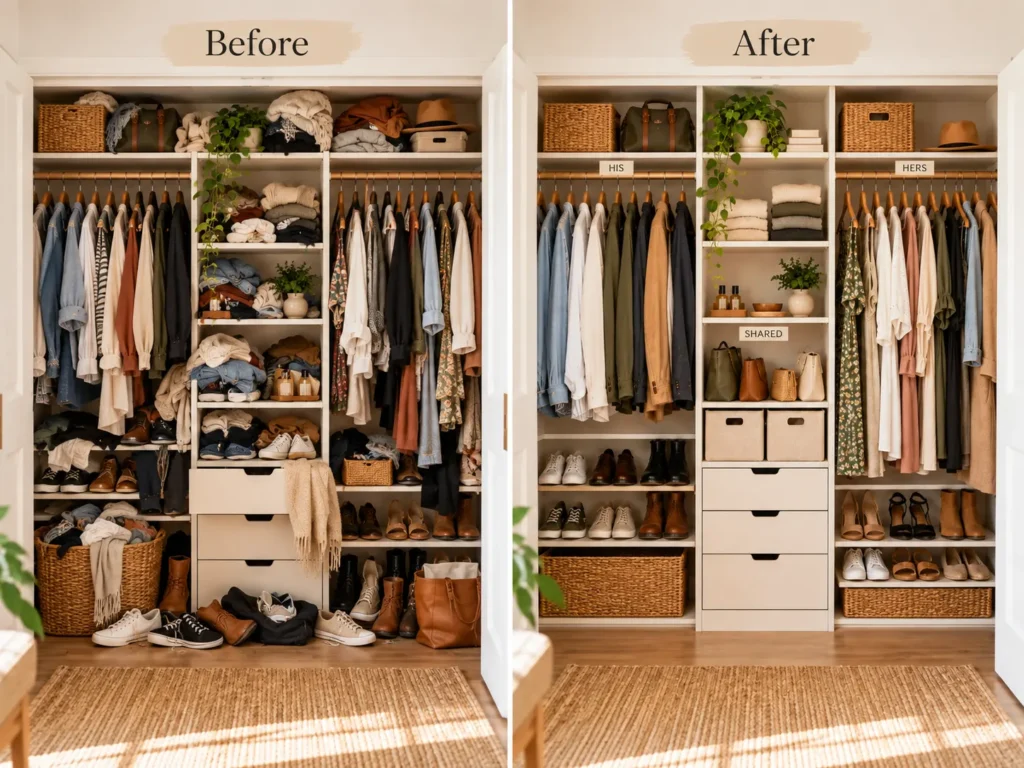
Layout A: Person A hangs more; Person B folds more. Give Person A more short-hang rod width, give Person B more shelf or drawer width, split the shoe rack by tier, and keep one small shared zone for spare hangers and the hamper.
Layout B: one person owns long garments. Reserve a full-height lane for dresses or coats, give the other person more short-hang width, divide the shelf by folded-clothing demand, and keep floor storage only beneath short garments.
Layout C: sliding-door reach-in. Build each home base around the access window each door panel reveals. Do not place one person’s everyday clothing permanently behind the other person’s visible section. Put rigid drawers only where a panel can slide completely away.
In all three layouts, functional capacity matters more than symmetry. The closet should make it obvious where each person’s next shirt, sweater, shoe, and accessory returns.
Avoid These Common Shared-Closet Mistakes
Most shared-closet failures are boundary or return problems rather than a total lack of storage. Avoid these mistakes:
- Splitting every surface 50/50 automatically: different wardrobes use different storage jobs.
- Giving someone only a rod zone: both people also need folded and shoe destinations.
- Calling overflow “shared storage”: shared categories need names.
- Using verbal boundaries only: physical breaks are easier to maintain.
- Allowing one wardrobe to borrow the other side indefinitely: use an overflow rule instead.
- Mixing both people’s folded clothes in one stack: laundry return becomes slower and less obvious.
- Ignoring access geometry: equal inches behind sliding doors may not provide equal access.
- Buying organizers before measuring both wardrobes: storage format should follow the category.
If you use freestanding drawers or clothing-storage furniture, follow the manufacturer’s stability and anti-tip instructions. The U.S. Consumer Product Safety Commission’s clothing-storage-unit guidance explains stability requirements and anti-tip provisions for covered units.
Use This Pre-Buy Two-Person Closet Checklist
- Inventory Person A and Person B separately.
- Count long-hang and short-hang clothing separately.
- List folded-clothing categories for each person.
- Count active shoes and measure the largest everyday pairs.
- Measure rod width, shelf width, floor footprint, garment drop, and doorway access.
- Build a complete home base for each person.
- Define one small shared neutral zone with named categories.
- Create an overflow rule before buying more organizers.
- Use physical boundaries where migration is likely.
- Run the Return-Lane Test for Person A.
- Run the Return-Lane Test for Person B.
- Use the closet normally for a week.
- Run the Migration Test and fix the first recurring drift.
- Check lease rules before adhesives, screws, or permanent modifications.
If removable adhesive accessories are part of the plan, check surface compatibility and removal instructions. Command’s official FAQ notes that paint condition and correct removal technique can affect whether damage occurs.
Small Space Scout rule: each person should be able to put away a normal laundry load without moving the other person’s belongings.
Frequently Asked Questions
How to organize a small closet for two people?
Give each person a complete home base with clearly defined hanging, folded, and shoe storage. Size those zones by wardrobe need rather than equal inches, keep shared storage small, and test the setup by returning a normal laundry load for each person independently.
Should couples split closet space 50/50?
Not necessarily. Equal space can be inefficient when one person hangs more clothing and the other folds more or owns long garments. Functional capacity should match the storage job while both people retain a complete personal home base.
How do you share one closet when one person owns more clothes?
Give the larger wardrobe more of the specific storage type it needs, such as rod width or shelf width, but protect a minimum complete home base for the other person. Move true excess to seasonal or secondary storage rather than letting it migrate across the boundary.
How should two people divide hanging space?
Protect long-hang needs first, then divide short-hang width according to the garments each person actually keeps on hangers. Keep each person’s most-worn pieces in the easiest-access part of their own lane.
How should two people divide shoe storage?
Give each person a defined active shoe zone, such as separate rack tiers or left/right sections. Size those zones to actual shoe dimensions and move seasonal or rarely worn pairs outside the prime floor area.
What should be shared in a shared closet?
Only genuinely shared categories should live there, such as spare hangers, a shared hamper, or travel organizers. “Miscellaneous” and unassigned overflow should not count as shared storage.
How do you keep clothes from crossing into the other person’s side?
Use physical boundaries such as shelf edges, dividers, drawers, baskets, rack tiers, or clear hanger sections. Then run the Migration Test after one week and strengthen whichever boundary repeatedly fails.
Give Both People a Complete Return Path
The best answer to how to organize a small closet for two people is not a perfect 50/50 split. It is two complete home bases that let both people store, retrieve, and return their belongings without interfering with the other person.
Inventory by storage job, size the hanging, folded, and shoe zones to real wardrobe demand, keep shared storage small and named, and use physical boundaries where migration is likely. Then run the Return-Lane Test and Migration Test before deciding the system is finished.
For the wider renter-friendly system, use our small closet organization guide. For reach-in access problems, see our reach-in closet organization guide. For shelves, use our small closet shelf organization guide, and for a one-rod-one-shelf layout use our Load-Balance Plan. You can also browse the full Closet Organization collection.